Department of Psychiatry and Biobehavioral Sciences and Semel Institute, David Geffen School of Medicine, University of California, Los Angeles, CA 90095, USA.
Psychopharmacology (Berl). 2011 Jun;215(4):801-11. doi: 10.1007/s00213-011-2182-y. Epub 2011 Feb 5.
Cigarette smoking has been linked to real-world risky behavior, but this association has been based largely on retrospective self-reports. Limitations of self-report data can be avoided by using laboratory, performance-based measures, such as the Balloon Analogue Risk Task (BART; Lejuez et al., J Exp Psychol Appl 8:75-84, 2002). Initial studies have suggested that smokers display greater risk-taking on this task than nonsmokers, but these studies did not account for drug abuse and psychiatric comorbidities, which are commonplace among smokers.
We sought to examine the performance of smokers and nonsmokers on the BART after excluding drug abuse and psychiatric comorbidities.
We conducted a study of late adolescent/young adult (age 18 to 21) smokers (n = 26) and nonsmokers (n = 38) performing the BART and excluded individuals with positive drug or alcohol toxicology screens, substance abuse or dependence diagnoses, and/or current psychiatric conditions.
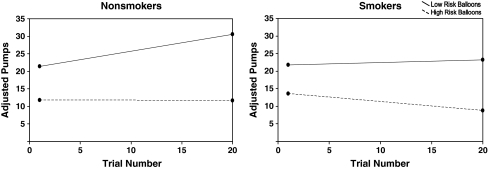
Contrary to previous findings, smokers did not display greater risk-taking on the BART than nonsmokers. In fact, when performance was examined trial-by-trial, the nonsmokers displayed progressively greater pumping relative to smokers over time (p < .001), earning them a nonsignificantly greater amount of money than the smokers. Controlling for smoking status, additional analyses revealed that pumping on the BART was positively associated with years of education, nonverbal IQ, and employment.
The results suggest that in young adults, smoking may be associated with a failure to take risks in situations where risk-taking is adaptive.
吸烟与现实生活中的冒险行为有关,但这种关联主要基于回顾性的自我报告。通过使用实验室、基于表现的测量方法,如气球模拟风险任务(BART;Lejuez 等人,J Exp Psychol Appl 8:75-84, 2002),可以避免自我报告数据的局限性。最初的研究表明,吸烟者在这项任务上的冒险行为大于非吸烟者,但这些研究没有考虑到滥用药物和精神共病,这在吸烟者中很常见。
我们试图在排除药物滥用和精神共病后,检查吸烟者和非吸烟者在 BART 上的表现。
我们对青少年晚期/年轻成年人(18 至 21 岁)的吸烟者(n=26)和非吸烟者(n=38)进行了一项 BART 研究,并排除了药物或酒精毒理学检测呈阳性、药物滥用或依赖诊断以及/或当前有精神疾病的个体。
与之前的发现相反,吸烟者在 BART 上的冒险行为并不大于非吸烟者。事实上,当按试验进行分析时,随着时间的推移,非吸烟者相对于吸烟者的泵气次数逐渐增加(p<.001),从而比吸烟者获得了略多的钱。控制吸烟状况后,进一步的分析表明,BART 上的泵气与受教育年限、非言语智商和就业呈正相关。
这些结果表明,在年轻人中,吸烟可能与在需要冒险的情况下无法冒险有关,而这种冒险是适应性的。