Department of Biomedical Engineering, Vanderbilt University, Nashville, Tennessee, USA.
J Nanobiotechnology. 2011 Feb 27;9:7. doi: 10.1186/1477-3155-9-7.
Drug and contrast agent delivery systems that achieve controlled release in the presence of enzymatic activity are becoming increasingly important, as enzymatic activity is a hallmark of a wide array of diseases, including cancer and atherosclerosis. Here, we have synthesized clusters of ultrasmall superparamagnetic iron oxides (USPIOs) that sense enzymatic activity for applications in magnetic resonance imaging (MRI). To achieve this goal, we utilize amphiphilic poly(propylene sulfide)-bl-poly(ethylene glycol) (PPS-b-PEG) copolymers, which are known to have excellent properties for smart delivery of drug and siRNA.
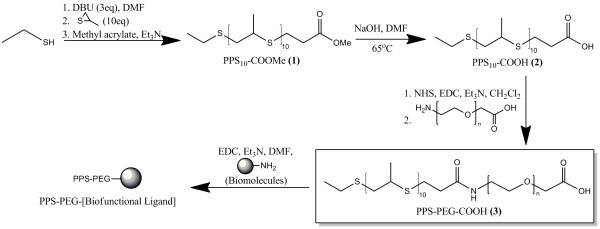
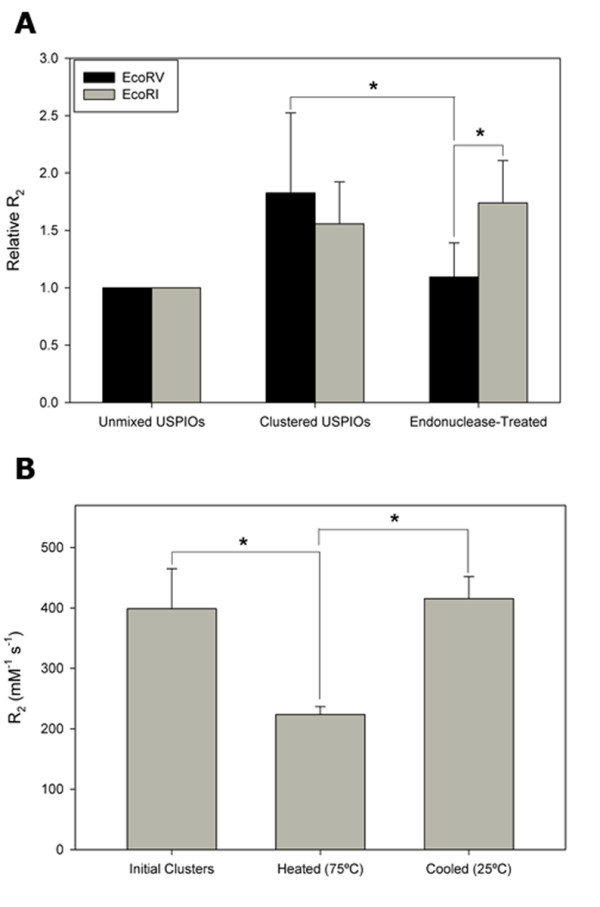
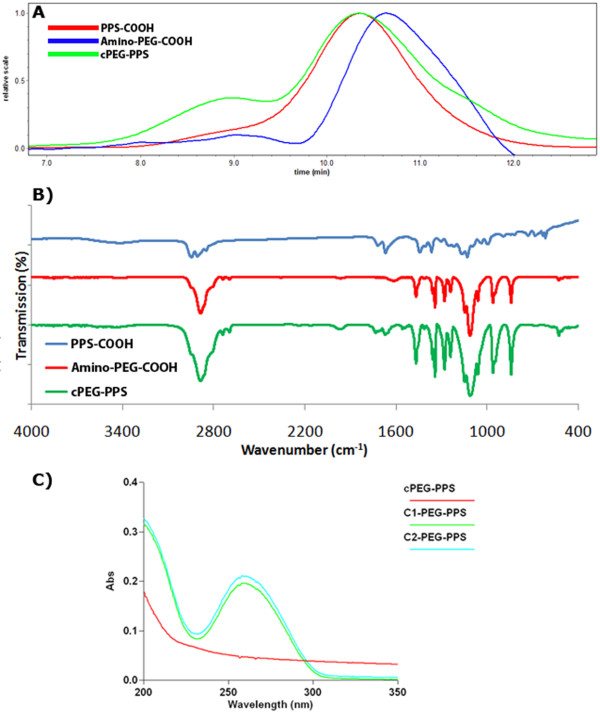
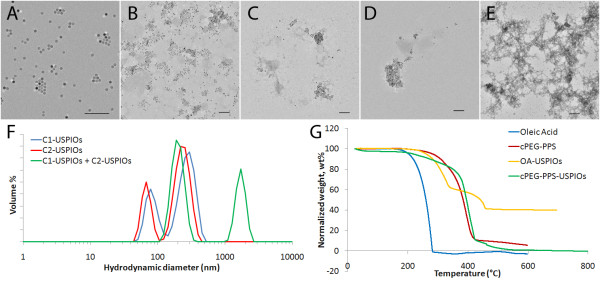
Monodisperse PPS polymers were synthesized by anionic ring opening polymerization of propylene sulfide, and were sequentially reacted with commercially available heterobifunctional PEG reagents and then ssDNA sequences to fashion biofunctional PPS-bl-PEG copolymers. They were then combined with hydrophobic 12 nm USPIO cores in the thin-film hydration method to produce ssDNA-displaying USPIO micelles. Micelle populations displaying complementary ssDNA sequences were mixed to induce crosslinking of the USPIO micelles. By design, these crosslinking sequences contained an EcoRV cleavage site. Treatment of the clusters with EcoRV results in a loss of R2 negative contrast in the system. Further, the USPIO clusters demonstrate temperature sensitivity as evidenced by their reversible dispersion at ~75°C and re-clustering following return to room temperature.
This work demonstrates proof of concept of an enzymatically-actuatable and thermoresponsive system for dynamic biosensing applications. The platform exhibits controlled release of nanoparticles leading to changes in magnetic relaxation, enabling detection of enzymatic activity. Further, the presented functionalization scheme extends the scope of potential applications for PPS-b-PEG. Combined with previous findings using this polymer platform that demonstrate controlled drug release in oxidative environments, smart theranostic applications combining drug delivery with imaging of platform localization are within reach. The modular design of these USPIO nanoclusters enables future development of platforms for imaging and drug delivery targeted towards proteolytic activity in tumors and in advanced atherosclerotic plaques.
在酶活性存在的情况下实现控制释放的药物和对比剂输送系统变得越来越重要,因为酶活性是包括癌症和动脉粥样硬化在内的多种疾病的标志。在这里,我们合成了超小超顺磁性氧化铁(USPIO)簇,用于磁共振成像(MRI)中的酶活性感应。为了实现这一目标,我们利用了具有良好智能药物和 siRNA 传递性能的两亲性聚(丙烯硫醚)-b-聚(乙二醇)(PPS-b-PEG)共聚物。
通过丙烯硫醚的阴离子开环聚合合成了单分散的 PPS 聚合物,并与市售的杂双功能 PEG 试剂和然后 ssDNA 序列依次反应,形成生物功能化的 PPS-b-PEG 共聚物。然后,它们在薄膜水合方法中与疏水 12nm USPIO 核结合,以产生显示 ssDNA 的 USPIO 胶束。显示互补 ssDNA 序列的胶束群体混合以诱导 USPIO 胶束的交联。通过设计,这些交联序列包含一个 EcoRV 切割位点。用 EcoRV 处理簇会导致系统中 R2 负对比的丧失。此外,USPIO 簇表现出温度敏感性,这表现为它们在约 75°C 时可逆分散,并在回到室温后重新聚集。
这项工作证明了用于动态生物传感应用的酶激活和温度响应系统的概念验证。该平台表现出纳米颗粒的控制释放,导致磁弛豫变化,从而能够检测酶活性。此外,所提出的功能化方案扩展了 PPS-b-PEG 的潜在应用范围。结合使用该聚合物平台在氧化环境中实现控制药物释放的先前发现,结合药物输送和平台定位成像的智能治疗应用是可行的。这些 USPIO 纳米簇的模块化设计使针对肿瘤和高级动脉粥样硬化斑块中的蛋白水解活性的成像和药物输送平台的未来发展成为可能。