Academic Centre for Medical Education, UCL Division of Medical Education, London N19 5LW, UK.
BMJ. 2011 Mar 8;342:d901. doi: 10.1136/bmj.d901.
To determine whether the ethnicity of UK trained doctors and medical students is related to their academic performance.
Systematic review and meta-analysis.
Online databases PubMed, Scopus, and ERIC; Google and Google Scholar; personal knowledge; backwards and forwards citations; specific searches of medical education journals and medical education conference abstracts.
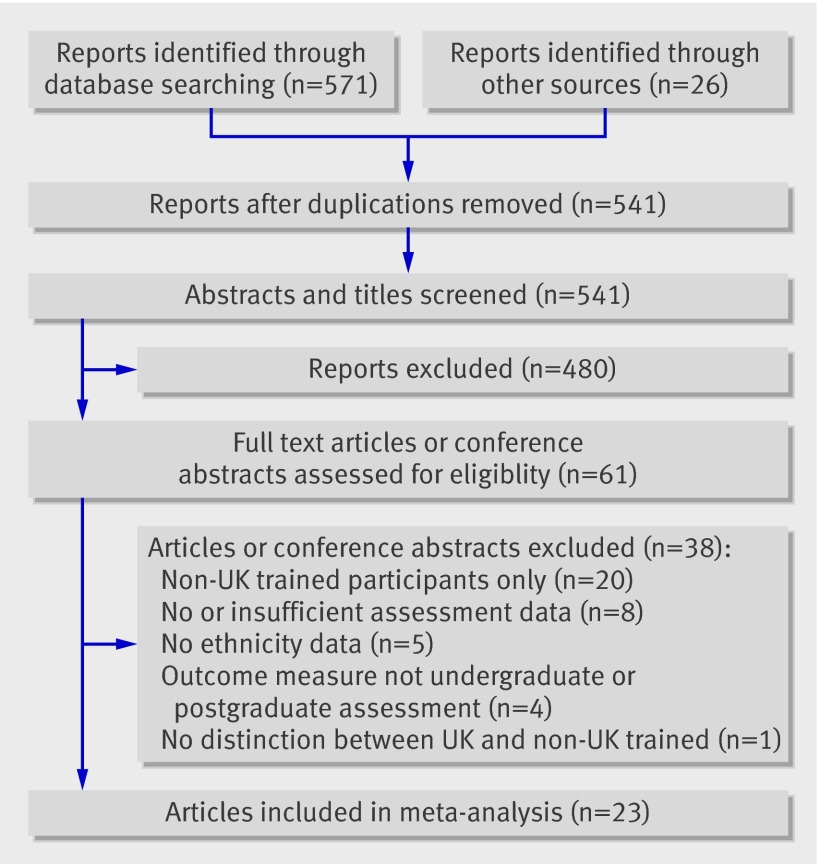
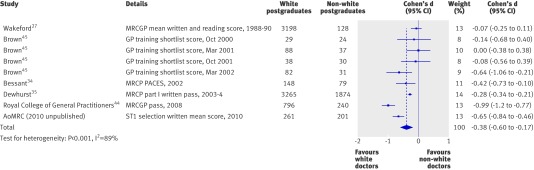
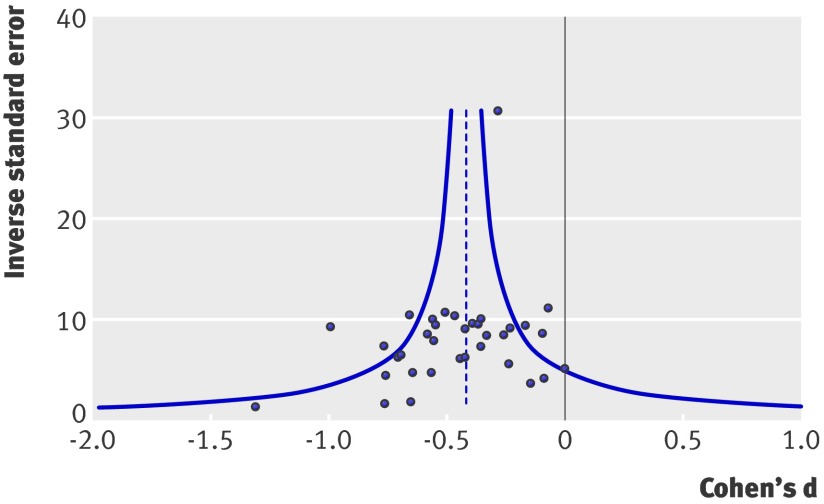
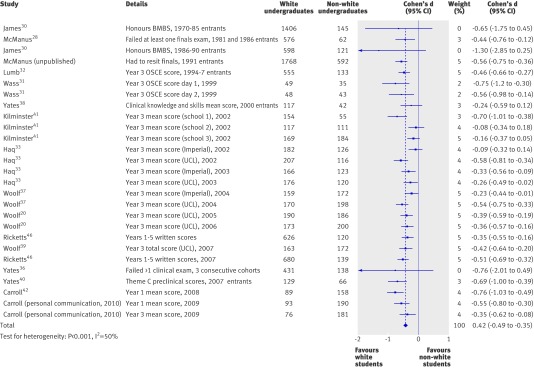
The included quantitative reports measured the performance of medical students or UK trained doctors from different ethnic groups in undergraduate or postgraduate assessments. Exclusions were non-UK assessments, only non-UK trained candidates, only self reported assessment data, only dropouts or another non-academic variable, obvious sampling bias, or insufficient details of ethnicity or outcomes. Results 23 reports comparing the academic performance of medical students and doctors from different ethnic groups were included. Meta-analyses of effects from 22 reports (n = 23,742) indicated candidates of "non-white" ethnicity underperformed compared with white candidates (Cohen's d = -0.42, 95% confidence interval -0.50 to -0.34; P<0.001). Effects in the same direction and of similar magnitude were found in meta-analyses of undergraduate assessments only, postgraduate assessments only, machine marked written assessments only, practical clinical assessments only, assessments with pass/fail outcomes only, assessments with continuous outcomes only, and in a meta-analysis of white v Asian candidates only. Heterogeneity was present in all meta-analyses.
Ethnic differences in academic performance are widespread across different medical schools, different types of exam, and in undergraduates and postgraduates. They have persisted for many years and cannot be dismissed as atypical or local problems. We need to recognise this as an issue that probably affects all of UK medical and higher education. More detailed information to track the problem as well as further research into its causes is required. Such actions are necessary to ensure a fair and just method of training and of assessing current and future doctors.
确定英国受训医生和医学生的族裔是否与其学业成绩相关。
系统评价和荟萃分析。
在线数据库 PubMed、Scopus 和 ERIC;Google 和 Google Scholar;个人知识;回溯和前向引文;特定的医学教育期刊和医学教育会议摘要搜索。
纳入的定量报告衡量了不同族裔的医学生或英国受训医生在本科或研究生评估中的表现。排除标准为非英国评估、仅非英国受训候选人、仅自我报告评估数据、仅辍学或其他非学术变量、明显的抽样偏差或族裔或结果的详细信息不足。结果:共纳入 23 项比较不同族裔医学生和医生学业成绩的报告。22 项报告(n = 23742)的荟萃分析结果表明,“非白人”族裔的候选人表现不如白人候选人(Cohen's d = -0.42,95%置信区间 -0.50 至 -0.34;P<0.001)。在仅本科评估、仅研究生评估、机器标记书面评估、仅实践临床评估、仅通过/失败结果评估、仅连续结果评估的荟萃分析以及仅白人和亚洲候选人的荟萃分析中,均发现了相同方向和相似大小的效果。所有荟萃分析均存在异质性。
学业成绩方面的族裔差异在不同医学院、不同类型的考试以及本科生和研究生中广泛存在。这些差异已经存在多年,不能被视为非典型或局部问题而忽视。我们需要认识到这是一个可能影响英国所有医学和高等教育的问题。需要更详细的信息来跟踪这个问题,并进一步研究其原因。这些行动是确保培训和评估当前和未来医生的公平公正方法所必需的。