Cornelis J J, Chen Y Q, Spruyt N, Duponchel N, Cotmore S F, Tattersall P, Rommelaere J
Unité d'Oncologie Moléculaire, Institut Pasteur de Lille, Institut National de la Santé et de la Recherche Médicale U186, France.
J Virol. 1990 Jun;64(6):2537-44. doi: 10.1128/JVI.64.6.2537-2544.1990.
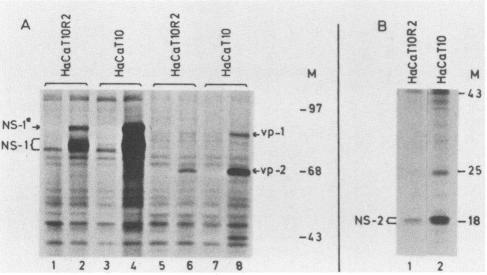
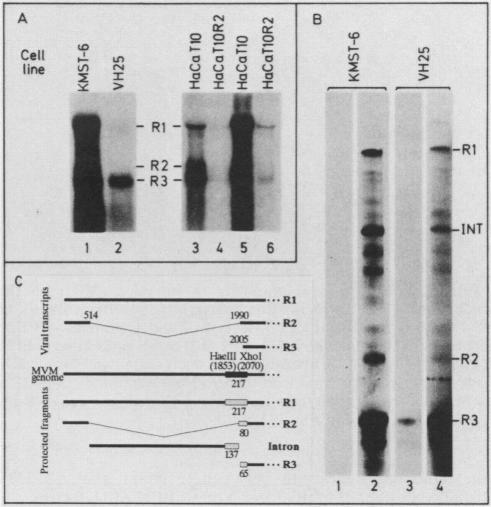
Human fibroblasts and epithelial cells differing in their susceptibility to killing by the autonomous parvoviruses H-1 and minute virus of mice were compared for their capacity to express viral mRNAs and proteins. The transition from a parvovirus-resistant to a parvovirus-sensitive phenotype correlated with a proportional increase in the production of the three major viral transcripts and of structural and nonstructural proteins. In contrast, cell sensitization to parvovirus could not be correlated with detectable changes in virus uptake, intracellular localization of gene products, stability of viral mRNAs, or phosphorylation of viral nonstructural polypeptides. Moreover, the H-1 virus-sensitive keratinocyte line studied did not sustain a greater level of viral DNA amplification than its resistant derivative. Therefore, the differential susceptibility of the human cells tested to parvovirus infection appears to be mainly controlled at the level of transcription of the viral genome. Parvoviral gene expression could not be elevated by increasing the input multiplicity of infection in either of the cell systems analyzed. Together, these data suggest that a cellular factor(s) regulating parvoviral transcription may be modulated by oncogenic transformation or by differentiation, as both features have been shown to affect cell susceptibility to parvoviruses.
对人成纤维细胞和上皮细胞进行了比较,它们对自主细小病毒H-1和小鼠微小病毒的杀伤敏感性不同,比较了它们表达病毒mRNA和蛋白质的能力。从对细小病毒抗性表型到敏感性表型的转变与三种主要病毒转录本以及结构和非结构蛋白产量的成比例增加相关。相反,细胞对细小病毒的致敏与病毒摄取、基因产物的细胞内定位、病毒mRNA的稳定性或病毒非结构多肽的磷酸化方面可检测到的变化无关。此外,所研究的对H-1病毒敏感的角质形成细胞系并不比其抗性衍生物维持更高水平的病毒DNA扩增。因此,所测试的人细胞对细小病毒感染的不同敏感性似乎主要在病毒基因组转录水平受到控制。在分析的任何一种细胞系统中,通过增加感染复数都不能提高细小病毒基因表达。总之,这些数据表明,调节细小病毒转录的一种或多种细胞因子可能受致癌转化或分化的调节,因为这两种特性均已显示会影响细胞对细小病毒的敏感性。