Cleveland Clinic Fertility Center, Department of OB/GYN and Women's Health Institute, Cleveland Clinic Foundation, USA.
BMC Biotechnol. 2011 Mar 30;11:29. doi: 10.1186/1472-6750-11-29.
High cooling rates with vitrification can be achieved through the use of carriers that allow cryopreservation in fluid volumes < one μl. Open carriers allow direct contact of embryos with liquid nitrogen (LN2) whereas closed carrier systems sequester the embryo within a sealed system during immersion in LN2. The use of closed systems may be preferable to reduce the possibility of cross-contamination. In the present study, we compare open and closed carriers for vitrification of embryos. We also examine their ability to retain embryo viability during vapor phase transport.
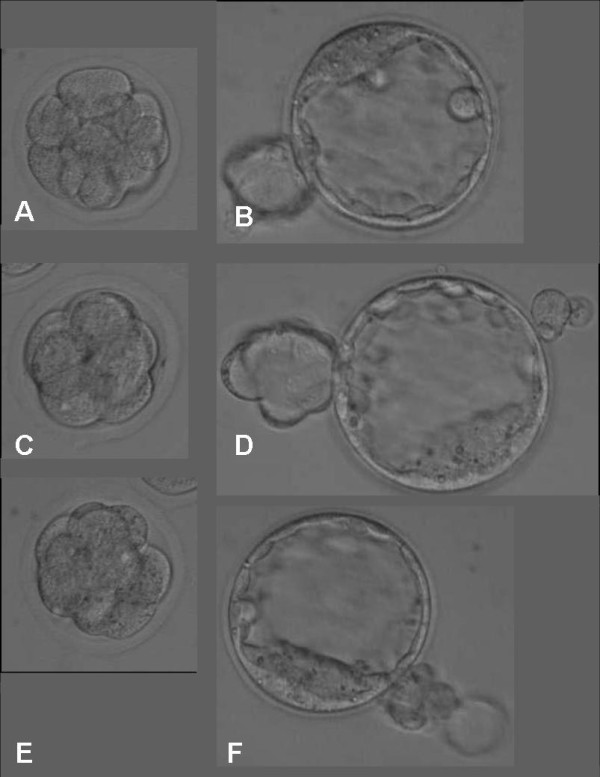
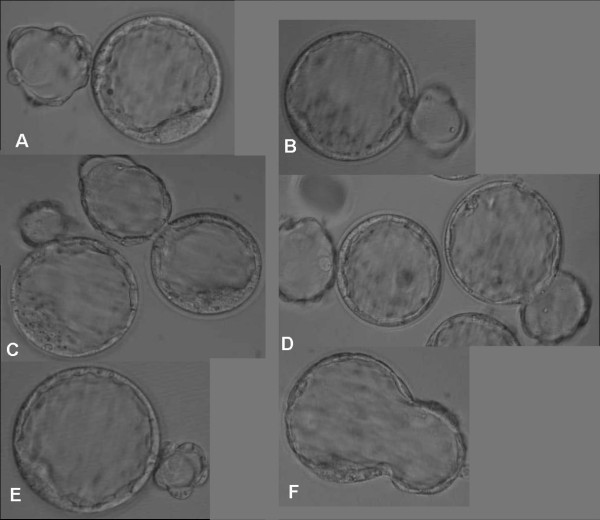
Frozen one-cell mouse embryos were thawed and randomly allocated to treatment groups. Embryos were cultured and vitrified at the 8-cell (CL) or at the blastocyst (BL) stage. The cryoloop, an open carrier was tested against two closed systems, the Cryotip and the HSV straw. Carriers were tested for their ability to maintain embryo viability when held in the vapor phase of a dry shipper for a period of 96 hours. Outcome parameters monitored were embryo survival, recovery, subsequent development and signs of DNA damage.
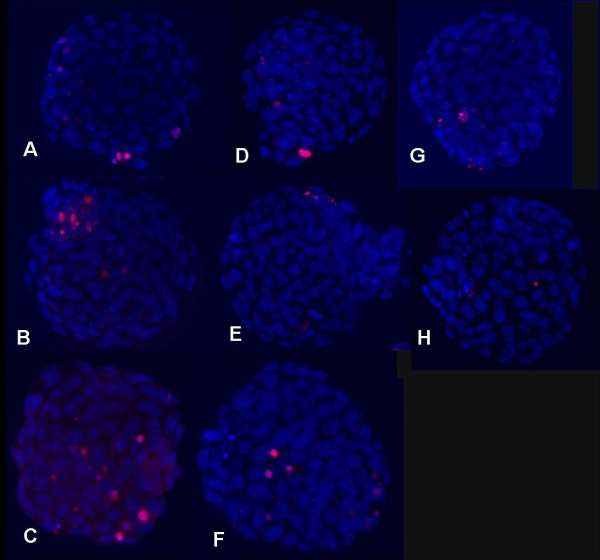
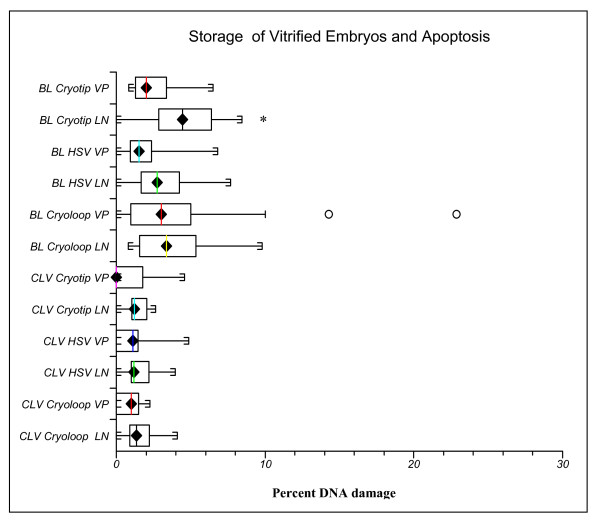
A total of 561 embryos were vitrified. The only parameter significantly affected by the type of carrier was the percentage of embryos recovered after warming. Vitrification of both CL and BL stage embryos in the Cryotip resulted in significantly lower recovery rates (P < 0.001). The subsequent developmental parameters were unaffected by either the carrier or the cell stage. Vapor phase storage for 96 hours under "transport conditions" did not appear to adversely affect the viability after warming. Quantitative analysis for DNA damage showed that <5% of cells were TUNEL positive. Interestingly, the overall percent of cells exhibiting DNA damage was lower after CL stage vitrification (P < 0.001).
This study is one of the first to examine DNA integrity after vitrification on different carriers and at different cell stages. It also provides insight on relative safety of short term vapor storage of vitrified embryos during transport. Within the limits of this study we could not detect an adverse effect of vapor storage on blastomere DNA or other measured outcome parameters.
通过使用允许在小于 1 μl 的液体体积中进行冷冻保存的载体,可以实现高冷却速率的玻璃化。开放式载体允许胚胎直接与液氮(LN2)接触,而封闭式载体系统在浸入 LN2 时将胚胎封闭在密封系统内。使用封闭系统可能更可取,以减少交叉污染的可能性。在本研究中,我们比较了开放式和封闭式载体在胚胎玻璃化中的应用。我们还研究了它们在气相运输过程中保持胚胎活力的能力。
冷冻的单细胞小鼠胚胎解冻后,随机分配到处理组。胚胎在 8 细胞(CL)或囊胚(BL)阶段进行培养和玻璃化。Cryoloop(开放式载体)与两种封闭式系统,Cryotip 和 HSV straw 进行了比较。载体在干燥货箱的气相中保持 96 小时的过程中,监测其保持胚胎活力的能力。监测的结果参数包括胚胎存活率、复苏率、后续发育和 DNA 损伤迹象。
共处理了 561 个胚胎。唯一受载体类型显著影响的参数是解冻后胚胎的回收率。在 Cryotip 中对 CL 和 BL 阶段的胚胎进行玻璃化处理,导致回收率显著降低(P < 0.001)。随后的发育参数不受载体或细胞阶段的影响。在“运输条件”下进行 96 小时的气相储存似乎不会对解冻后的活力产生不利影响。DNA 损伤的定量分析显示,<5%的细胞呈 TUNEL 阳性。有趣的是,CL 阶段玻璃化后,总细胞 DNA 损伤百分比较低(P < 0.001)。
本研究是首次在不同载体和不同细胞阶段研究玻璃化后 DNA 完整性的研究之一。它还提供了关于在运输过程中短时间气相储存玻璃化胚胎的相对安全性的见解。在本研究的范围内,我们无法检测到气相储存对卵裂球 DNA 或其他测量结果参数的不利影响。