UCL Centre for International Health and Development, Institute of Child Health, University College London, 30 Guilford St, London, UK.
J Urban Health. 2011 Oct;88(5):919-32. doi: 10.1007/s11524-011-9556-7.
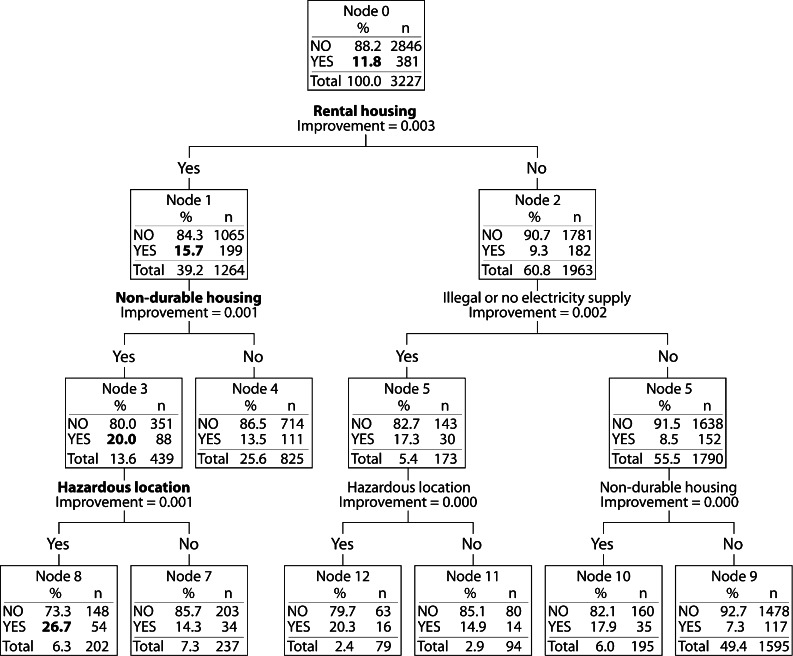
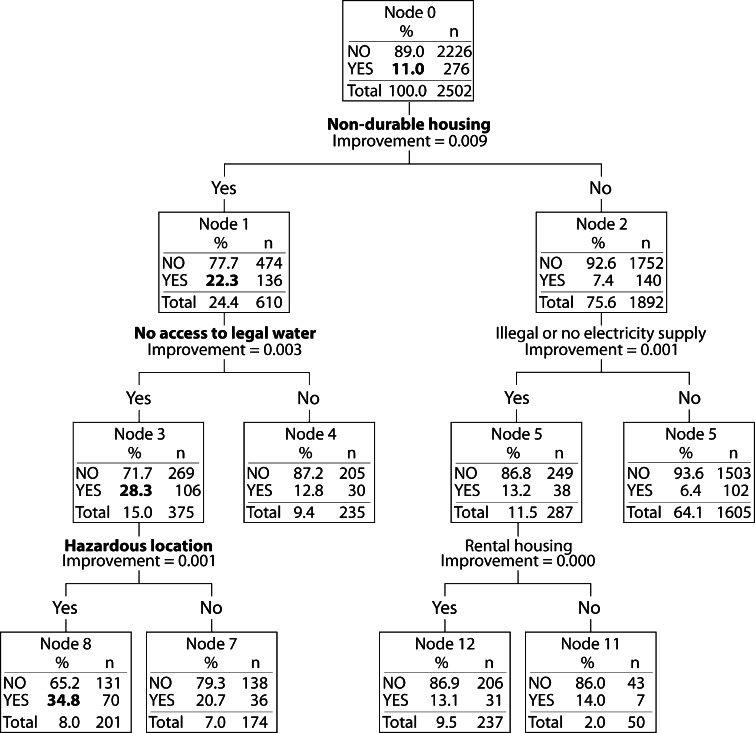
The communities who live in urban informal settlements are diverse, as are their environmental conditions. Characteristics include inadequate access to safe water and sanitation, poor quality of housing, overcrowding, and insecure residential status. Interventions to improve health should be equity-driven and target those at higher risk, but it is not clear how to prioritise informal settlements for health action. In implementing a maternal and child health programme in Mumbai, India, we had conducted a detailed vulnerability assessment which, though important, was time-consuming and may have included collection of redundant information. Subsequent data collection allowed us to examine three issues: whether community environmental characteristics were associated with maternal and newborn healthcare and outcomes; whether it was possible to develop a triage scorecard to rank the health vulnerability of informal settlements based on a few rapidly observable characteristics; and whether the scorecard might be useful for future prioritisation. The City Initiative for Newborn Health documented births in 48 urban slum areas over 2 years. Information was collected on maternal and newborn care and mortality, and also on household and community environment. We selected three outcomes-less than three antenatal care visits, home delivery, and neonatal mortality-and used logistic regression and classification and regression tree analysis to test their association with rapidly observable environmental characteristics. We developed a simple triage scorecard and tested its utility as a means of assessing maternal and newborn health risk. In analyses on a sample of 10,754 births, we found associations of health vulnerability with inadequate access to water, toilets, and electricity; non-durable housing; hazardous location; and rental tenancy. A simple scorecard based on these had limited sensitivity and positive predictive value, but relatively high specificity and negative predictive value. The scorecard needs further testing in a range of urban contexts, but we intend to use it to identify informal settlements in particular need of family health interventions in a subsequent program.
居住在城市非正规住区的社区多种多样,其环境条件也各不相同。这些特征包括获得安全用水和卫生设施的机会不足、住房质量差、过度拥挤以及居住地位不安全。改善健康的干预措施应该以公平为导向,针对那些风险较高的人群,但目前尚不清楚如何确定健康行动的非正规住区的优先顺序。在印度孟买实施母婴健康方案时,我们进行了一项详细的脆弱性评估,虽然这很重要,但却很耗时,并且可能包括收集冗余信息。随后的数据收集使我们能够研究三个问题:社区环境特征是否与母婴保健和结果有关;是否有可能根据一些快速观察到的特征制定一个分诊记分卡,对非正规住区的健康脆弱性进行排名;以及该记分卡是否对未来的优先排序有用。城市新生儿健康倡议在 2 年内记录了 48 个城市贫民窟地区的分娩情况。收集了关于孕产妇和新生儿护理以及死亡率的信息,还收集了家庭和社区环境的信息。我们选择了三个结果——产前护理次数少于三次、家庭分娩和新生儿死亡,并使用逻辑回归和分类回归树分析来检验它们与快速观察到的环境特征的关系。我们制定了一个简单的分诊记分卡,并测试了其作为评估母婴健康风险的一种手段的效用。在对 10754 例分娩的样本进行分析时,我们发现健康脆弱性与获得水、厕所和电力的机会不足、非耐用住房、危险位置和租赁租赁有关。一个基于这些因素的简单记分卡的敏感性和阳性预测值有限,但特异性和阴性预测值相对较高。该记分卡需要在一系列城市环境中进一步测试,但我们打算在随后的项目中使用它来确定特别需要家庭健康干预的非正规住区。