Schumacher Julie A, Coffey Scott F, Stasiewicz Paul R, Murphy Christopher M, Leonard Kenneth E, Fals-Stewart William
Department of Psychiatry and Human Behavior, University of Mississippi Medical Center, Jackson, MS.
J Aggress Maltreat Trauma. 2011;20(2):103-127. doi: 10.1080/10926771.2011.546749.
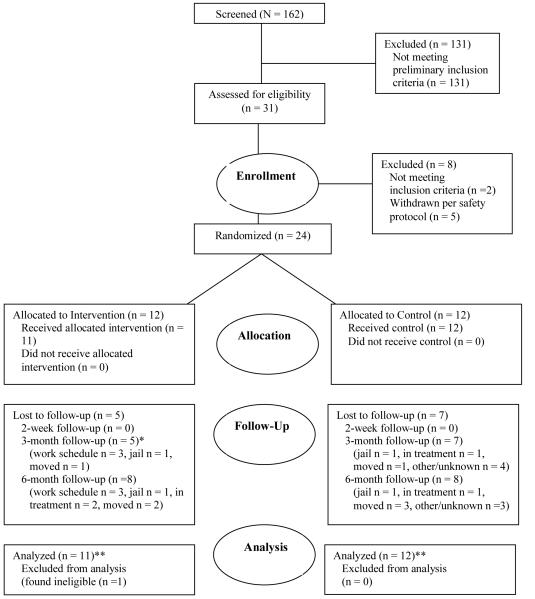
The current studies were a manual development study and a small pilot study of a 90-minute motivational enhancement style intervention to address IPV in alcohol treatment-seeking men. Analyses of feedback provided during manual development suggest participants: (a) liked the intervention, (b) reported behavior change intentions, and (c) found the feedback compelling. Findings from the pilot study suggest the intervention may be superior to referral only in increasing short-term help-seeking and lead to marginally significant enhancements in motivation and self-reported intimacy. Help-seeking and motivation findings were associated with medium-large to large effect sizes. At 3- and 6-month follow-up, both groups showed improvements in self-reported alcohol outcomes, anger, and verbal and physical aggression. These findings support further research on this intervention.
当前的研究包括一项手册开发研究和一项针对寻求酒精治疗的男性的90分钟动机增强式干预措施的小型试点研究,该干预措施旨在解决亲密伴侣暴力问题。对手册开发过程中提供的反馈进行分析表明,参与者:(a)喜欢该干预措施,(b)报告了行为改变的意图,(c)认为反馈很有说服力。试点研究的结果表明,该干预措施在增加短期求助行为方面可能优于仅进行转介,并且在动机和自我报告的亲密关系方面有轻微但显著的增强。求助行为和动机方面的研究结果与中到大至大的效应量相关。在3个月和6个月的随访中,两组在自我报告的酒精问题、愤怒以及言语和身体攻击方面均有改善。这些发现支持对该干预措施进行进一步研究。