Yang-Feng T L, Xue F Y, Zhong W W, Cotecchia S, Frielle T, Caron M G, Lefkowitz R J, Francke U
Department of Human Genetics, Yale University School of Medicine, New Haven, CT 06510.
Proc Natl Acad Sci U S A. 1990 Feb;87(4):1516-20. doi: 10.1073/pnas.87.4.1516.
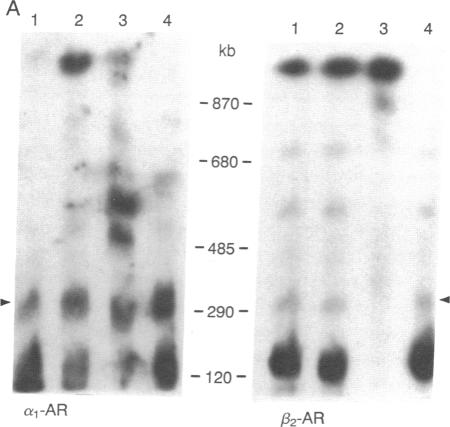
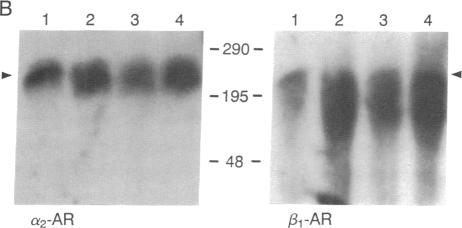
The adrenergic receptors (ARs) (subtypes alpha 1, alpha 2, beta 1, and beta 2) are a prototypic family of guanine nucleotide binding regulatory protein-coupled receptors that mediate the physiological effects of the hormone epinephrine and the neurotransmitter norepinephrine. We have previously assigned the genes for beta 2- and alpha 2-AR to human chromosomes 5 and 10, respectively. By Southern analysis of somatic cell hybrids and in situ chromosomal hybridization, we have now mapped the alpha 1-AR gene to chromosome 5q32----q34, the same position as beta 2-AR, and the beta 1-AR gene to chromosome 10q24----q26, the region where alpha 2-AR is located. In mouse, both alpha 2- and beta 1-AR genes were assigned to chromosome 19, and the alpha 1-AR locus was localized to chromosome 11. Pulsed field gel electrophoresis has shown that the alpha 1- and beta 2-AR genes in humans are within 300 kilobases (kb) and the distance between the alpha 2- and beta 1-AR genes is less than 225 kb. The proximity of these two pairs of AR genes and the sequence similarity that exists among all the ARs strongly suggest that they are evolutionarily related. Moreover, they likely arose from a common ancestral receptor gene and subsequently diverged through gene duplication and chromosomal duplication to perform their distinctive roles in mediating the physiological effects of catecholamines. The AR genes thus provide a paradigm for understanding the evolution of such structurally conserved yet functionally divergent families of receptor molecules.
肾上腺素能受体(ARs)(α1、α2、β1和β2亚型)是鸟嘌呤核苷酸结合调节蛋白偶联受体的典型家族,介导激素肾上腺素和神经递质去甲肾上腺素的生理效应。我们先前已分别将β2-AR和α2-AR基因定位于人类染色体5和10。通过对体细胞杂种的Southern分析和原位染色体杂交,我们现在已将α1-AR基因定位于染色体5q32----q34,与β2-AR相同的位置,以及将β1-AR基因定位于染色体10q24----q26,即α2-AR所在的区域。在小鼠中,α2-AR和β1-AR基因均定位于染色体19,而α1-AR基因座定位于染色体11。脉冲场凝胶电泳显示,人类中的α1-AR和β2-AR基因在300千碱基(kb)范围内,α2-AR和β1-AR基因之间的距离小于225 kb。这两对AR基因的接近以及所有AR之间存在的序列相似性强烈表明它们在进化上相关。此外,它们可能起源于一个共同的祖先受体基因,随后通过基因复制和染色体复制而分化,以在介导儿茶酚胺的生理效应中发挥其独特作用。因此,AR基因提供了一个范例,用于理解这种结构保守但功能不同的受体分子家族的进化。