Centre for Infectious Diseases, Division of Pathway Medicine, School of Biomedical Sciences, College of Medicine and Veterinary Medicine, University of Edinburgh, Edinburgh, UK.
Parasit Vectors. 2011 May 7;4:68. doi: 10.1186/1756-3305-4-68.
Diagnosis of blood borne infectious diseases relies primarily on the detection of the causative agent in the blood sample. Molecular techniques offer sensitive and specific tools for this although considerable difficulties exist when using these approaches in the field environment. In large scale epidemiological studies, FTA®cards are becoming increasingly popular for the rapid collection and archiving of a large number of samples. However, there are some difficulties in the downstream processing of these cards which is essential for the accurate diagnosis of infection. Here we describe recommendations for the best practice approach for sample processing from FTA®cards for the molecular diagnosis of trypanosomiasis using PCR.
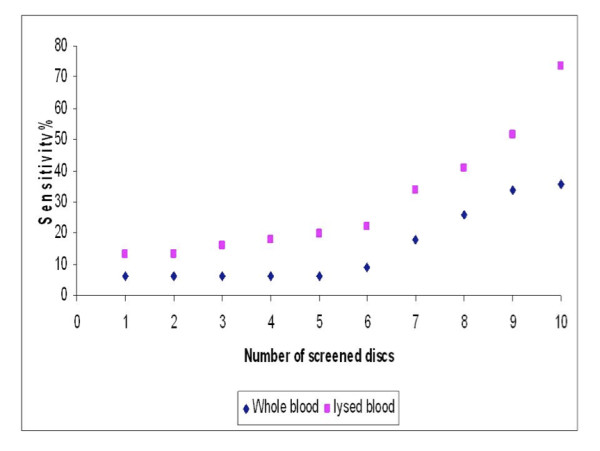
A comparison of five techniques was made. Detection from directly applied whole blood was less sensitive (35.6%) than whole blood which was subsequently eluted from the cards using Chelex®100 (56.4%). Better apparent sensitivity was achieved when blood was lysed prior to application on the FTA cards (73.3%) although this was not significant. This did not improve with subsequent elution using Chelex®100 (73.3%) and was not significantly different from direct DNA extraction from blood in the field (68.3%).
Based on these results, the degree of effort required for each of these techniques and the difficulty of DNA extraction under field conditions, we recommend that blood is transferred onto FTA cards whole followed by elution in Chelex®100 as the best approach.
血液传染病的诊断主要依赖于血液样本中病原体的检测。分子技术为此提供了敏感和特异的工具,尽管在现场环境中使用这些方法存在相当大的困难。在大规模的流行病学研究中,FTA®卡越来越受欢迎,可用于快速收集和存档大量样本。然而,这些卡的下游处理存在一些困难,对于感染的准确诊断至关重要。在这里,我们描述了使用 PCR 进行分子诊断锥虫病时,从 FTA®卡进行样本处理的最佳实践方法的建议。
比较了五种技术。直接应用全血的检测敏感性较低(35.6%),不如随后用 Chelex®100 从卡上洗脱的全血(56.4%)。在将血液应用于 FTA 卡之前进行裂解可获得更好的表观敏感性(73.3%),尽管这并不显著。用 Chelex®100 进行后续洗脱并没有改善(73.3%),与现场直接从血液中提取 DNA 也没有显著差异(68.3%)。
基于这些结果,考虑到每种技术所需的努力程度以及现场条件下 DNA 提取的难度,我们建议将血液整体转移到 FTA 卡上,然后用 Chelex®100 洗脱,这是最佳方法。