Aaron Julie A, Christianson David W
Roy and Diana Vagelos Laboratories, Department of Chemistry, University of Pennsylvania, Philadelphia, PA, 19104-6323, USA.
Pure Appl Chem. 2010;82(8):1585-1597. doi: 10.1351/PAC-CON-09-09-37.
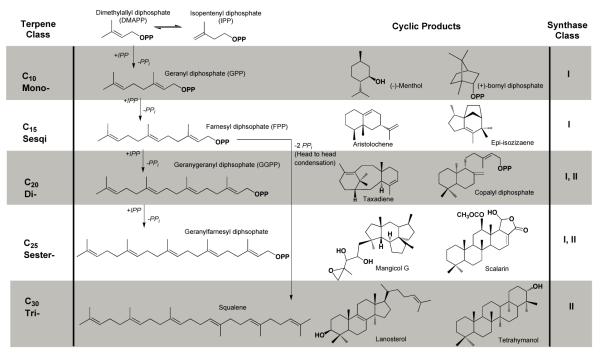
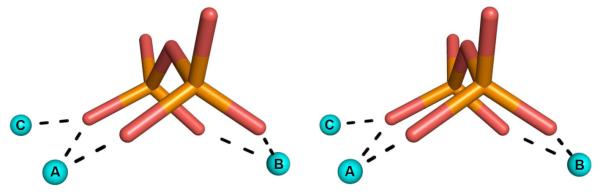
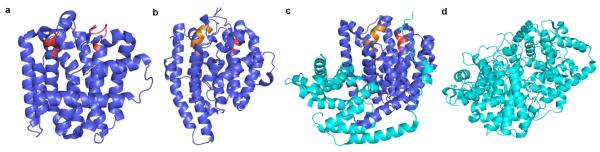
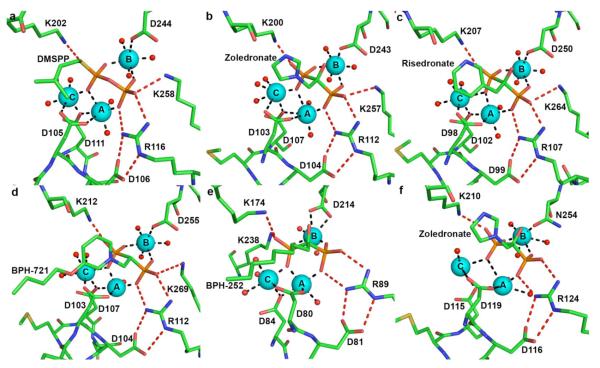
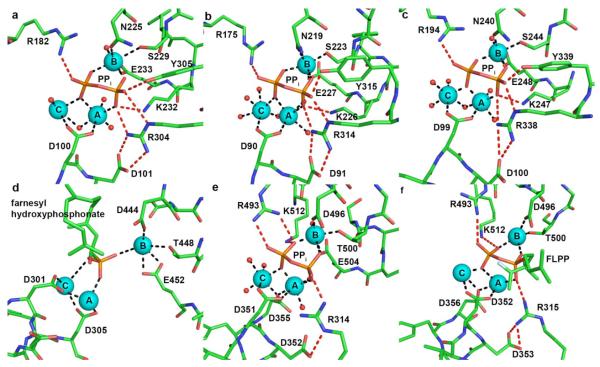
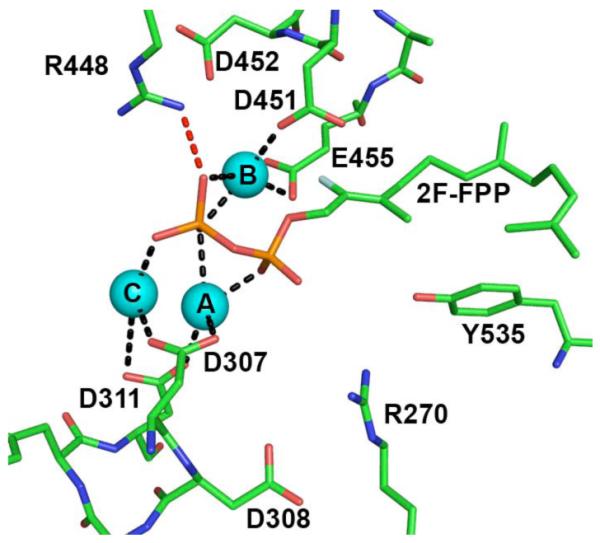
Terpenoid synthases are ubiquitous enzymes that catalyze the formation of structurally and stereochemically diverse isoprenoid natural products. Many isoprenoid coupling enzymes and terpenoid cyclases from bacteria, fungi, protists, plants, and animals share the class I terpenoid synthase fold. Despite generally low amino acid sequence identity among these examples, class I terpenoid synthases contain conserved metal binding motifs that coordinate to a trinuclear metal cluster. This cluster not only serves to bind and orient the flexible isoprenoid substrate in the precatalytic Michaelis complex, but it also triggers the departure of the diphosphate leaving group to generate a carbocation that initiates catalysis. Additional conserved hydrogen bond donors assist the metal cluster in this function. Crystal structure analysis reveals that the constellation of three metal ions required for terpenoid synthase catalysis is generally identical among all class I terpenoid synthases of known structure.
萜类合酶是普遍存在的酶,可催化结构和立体化学多样的类异戊二烯天然产物的形成。来自细菌、真菌、原生生物、植物和动物的许多类异戊二烯偶联酶和萜类环化酶具有I类萜类合酶折叠结构。尽管这些例子之间的氨基酸序列同一性普遍较低,但I类萜类合酶含有与三核金属簇配位的保守金属结合基序。该金属簇不仅用于在催化前的米氏复合物中结合并定向柔性类异戊二烯底物,还会引发二磷酸离去基团的离去,生成启动催化作用的碳正离子。其他保守的氢键供体在该功能中协助金属簇。晶体结构分析表明,已知结构的所有I类萜类合酶中,萜类合酶催化所需的三个金属离子的组合通常是相同的。