UMR-MD3-University Montpellier 1, Comparative Molecular Immuno-Physiopathology Lab, Faculté de Pharmacie, 34093 Montpellier, France.
Virol J. 2011 May 13;8:223. doi: 10.1186/1743-422X-8-223.
Andes virus (ANDV), a rodent-borne Hantavirus, is the major etiological agent of Hantavirus cardiopulmonary syndrome (HCPS) in South America, which is mainly characterized by a vascular leakage with high rate of fatal outcomes for infected patients. Currently, neither specific therapy nor vaccines are available against this pathogen. ANDV infects both dendritic and epithelial cells, but in despite that the severity of the disease directly correlates with the viral RNA load, considerable evidence suggests that immune mechanisms rather than direct viral cytopathology are responsible for plasma leakage in HCPS. Here, we assessed the possible effect of soluble factors, induced in viral-activated DCs, on endothelial permeability. Activated immune cells, including DC, secrete gelatinolytic matrix metalloproteases (gMMP-2 and -9) that modulate the vascular permeability for their trafficking.
A clinical ANDES isolate was used to infect DC derived from primary PBMC. Maturation and pro-inflammatory phenotypes of ANDES-infected DC were assessed by studying the expression of receptors, cytokines and active gMMP-9, as well as some of their functional status. The ANDES-infected DC supernatants were assessed for their capacity to enhance a monolayer endothelial permeability using primary human vascular endothelial cells (HUVEC).
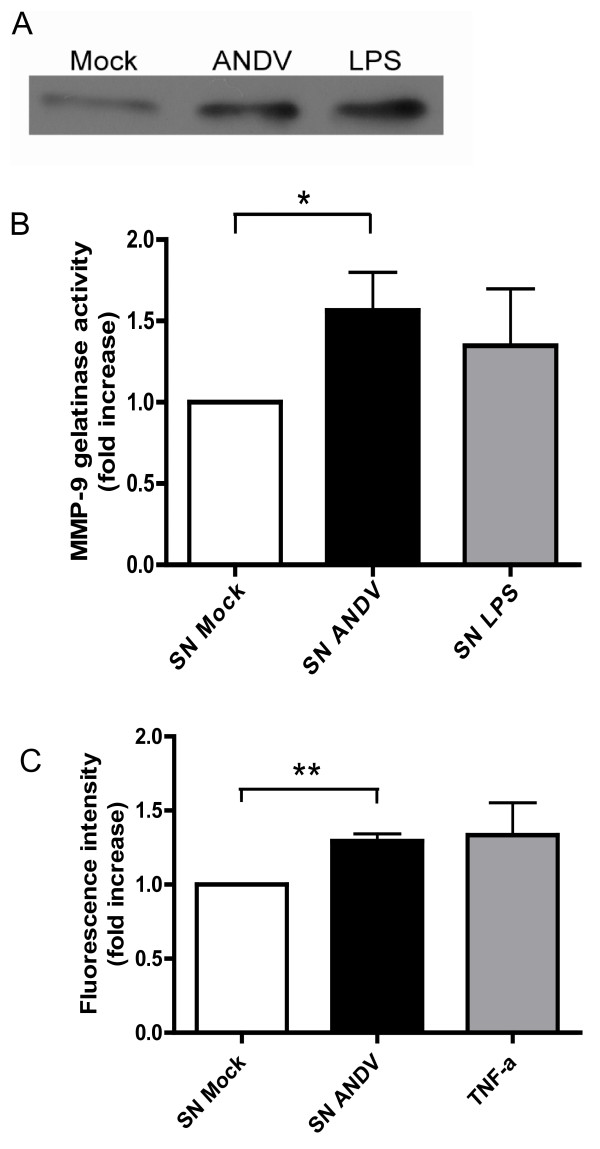
Here, we show that in vitro primary DCs infected by a clinical isolate of ANDV shed virus RNA and proteins, suggesting a competent viral replication in these cells. Moreover, this infection induces an enhanced expression of soluble pro-inflammatory factors, including TNF-α and the active gMMP-9, as well as a decreased expression of anti-inflammatory cytokines, such as IL-10 and TGF-β. These viral activated cells are less sensitive to apoptosis. Moreover, supernatants from ANDV-infected DCs were able to indirectly enhance the permeability of a monolayer of primary HUVEC.
Primary human DCs, that are primarily targeted by hantaviruses can productively be infected by ANDV and subsequently induce direct effects favoring a proinflammatory phenotype of infected DCs. Finally, based on our observations, we hypothesize that soluble factors secreted in ANDV-infected DC supernatants, importantly contribute to the endothelial permeability enhancement that characterize the HCPS.
安第斯病毒(ANDV)是一种啮齿动物传播的汉坦病毒,是南美的汉坦病毒心肺综合征(HCPS)的主要病原体,其主要特征是血管渗漏,感染患者的死亡率很高。目前,针对这种病原体既没有特效疗法,也没有疫苗。ANDV 感染树突状细胞和上皮细胞,但尽管疾病的严重程度与病毒 RNA 载量直接相关,但大量证据表明,免疫机制而不是直接的病毒细胞病理学是 HCPS 中血浆渗漏的原因。在这里,我们评估了在病毒激活的树突状细胞中诱导的可溶性因子对内皮通透性的可能影响。包括树突状细胞在内的激活免疫细胞会分泌明胶酶基质金属蛋白酶(gMMP-2 和 -9),以调节其运输的血管通透性。
使用临床分离的 ANDES 株感染源自原代 PBMC 的 DC。通过研究受体、细胞因子和活性 gMMP-9 的表达以及它们的一些功能状态,评估 ANDES 感染的 DC 的成熟和促炎表型。使用原代人血管内皮细胞(HUVEC)评估 ANDES 感染的 DC 上清液增强单层内皮通透性的能力。
在这里,我们表明,体外原代 DC 被临床分离的 ANDV 感染后会释放病毒 RNA 和蛋白质,表明这些细胞中存在有效的病毒复制。此外,这种感染会诱导可溶性促炎因子(包括 TNF-α 和活性 gMMP-9)的表达增强,以及抗炎细胞因子(如 IL-10 和 TGF-β)的表达降低。这些被病毒激活的细胞对凋亡的敏感性降低。此外,ANDV 感染的 DC 上清液能够间接增强原代 HUVEC 单层的通透性。
汉坦病毒主要靶向的原代人 DC 可以被 ANDV 有效感染,随后诱导直接作用,有利于感染 DC 的促炎表型。最后,根据我们的观察,我们假设 ANDV 感染的 DC 上清液中分泌的可溶性因子,对 HCPS 特征性的内皮通透性增强有重要贡献。