Bethel University, 3900 Bethel Drive, St. Paul, MN 55112, USA.
J Abnorm Child Psychol. 2011 Nov;39(8):1187-98. doi: 10.1007/s10802-011-9527-1.
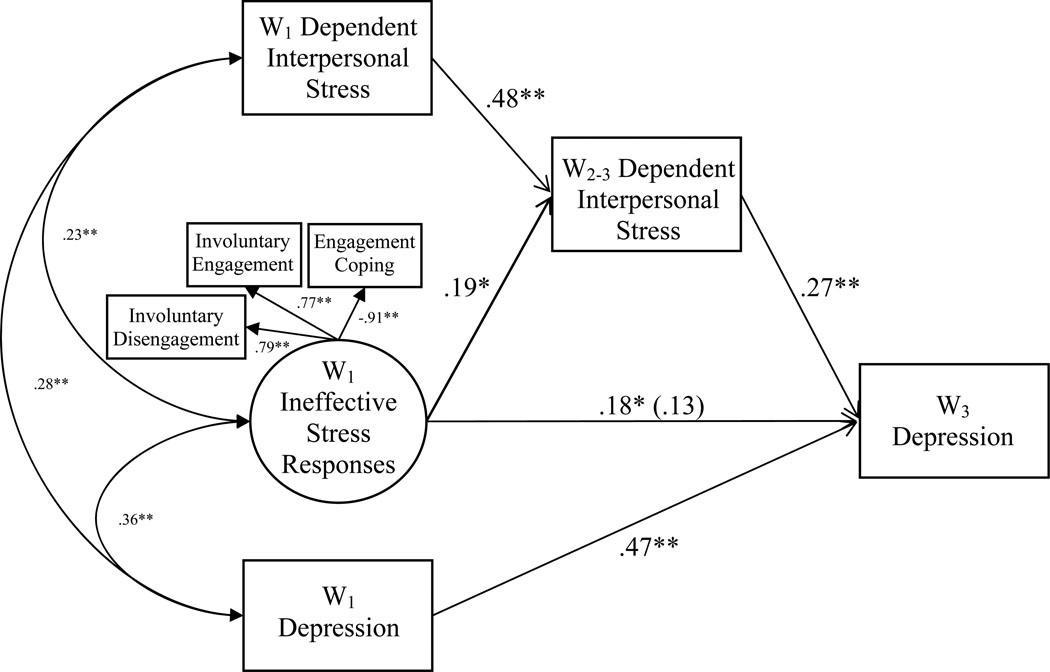
This research examined the proposal that ineffective responses to common interpersonal problems disrupt youths' relationships, which, in turn, contributes to depression during adolescence. Youth (86 girls, 81 boys; M age = 12.41, SD = 1.19) and their primary female caregivers participated in a three-wave longitudinal study. Youth completed a measure assessing interpersonal stress responses; youth and caregivers completed semi-structured interviews assessing youths' life stress and psychopathology. Consistent with the hypothesized model, ineffective stress responses (low levels of effortful engagement, high levels of involuntary engagement and disengagement) predicted the generation of subsequent interpersonal stress, which partially accounted for the association between stress responses and depression over time. Moreover, results revealed that self-generated interpersonal, but not noninterpersonal stress, predicted depression, and that this explanatory model was specific to the prediction of depression but not anxiety. This research builds on interpersonal stress generation models of depression, and highlights the importance of implementing depression-focused intervention programs that promote effective stress responses and adaptive interpersonal relationships during adolescence.
本研究检验了以下假设,即青少年应对常见人际问题的无效反应会破坏他们的人际关系,进而导致抑郁。研究对象为 86 名女孩和 81 名男孩,他们的主要女性照顾者参与了一项为期三波的纵向研究。青少年完成了一项评估人际压力反应的测量;青少年和照顾者完成了半结构化访谈,评估青少年的生活压力和精神病理学。与假设模型一致,无效的压力反应(努力参与程度低、非自愿参与和脱离程度高)预测了随后人际压力的产生,这部分解释了压力反应与随时间推移的抑郁之间的关联。此外,结果表明,自我产生的人际压力而非非人际压力预测了抑郁,并且该解释模型仅适用于抑郁的预测,而不适用于焦虑的预测。这项研究是对抑郁的人际压力产生模型的扩展,并强调了在青少年时期实施以抑郁为重点的干预计划的重要性,该计划促进了有效的压力反应和适应性的人际关系。