Institute for Behavioral Genetics, 447 UCB, University of Colorado, Boulder, CO 80309, USA.
Dev Psychol. 2011 Sep;47(5):1410-30. doi: 10.1037/a0023750.
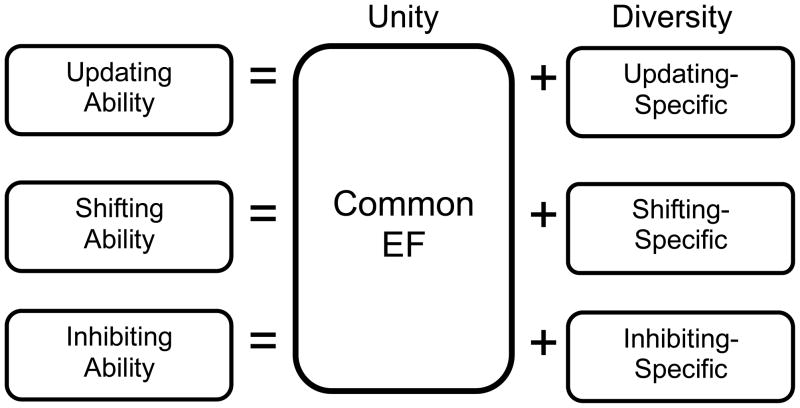
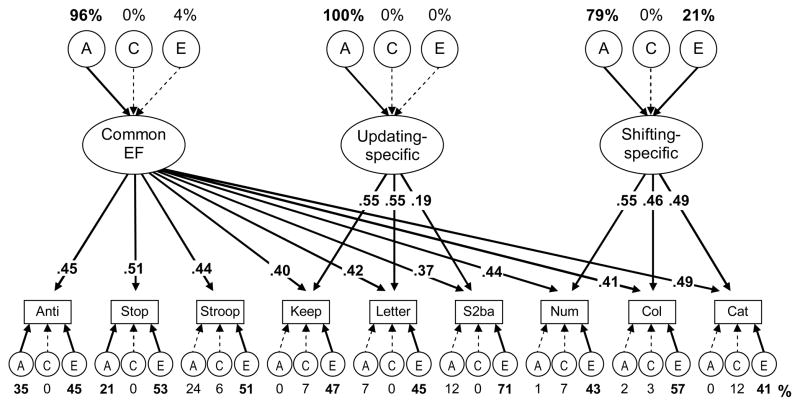
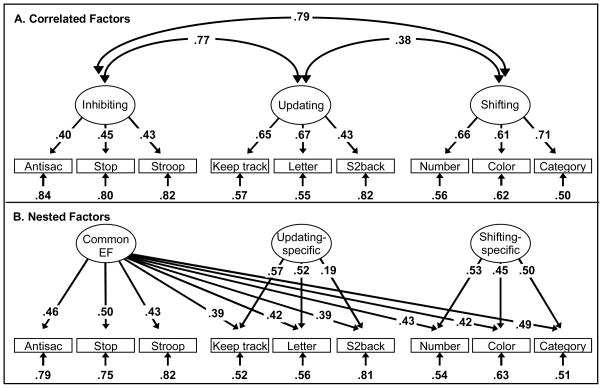
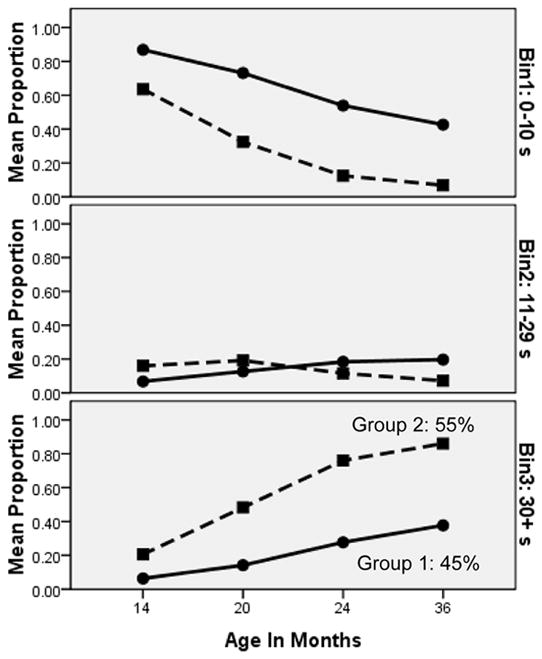
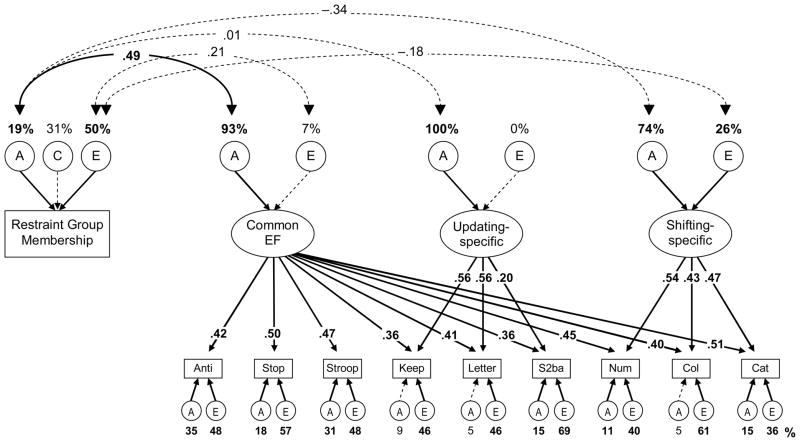
We examined whether self-restraint in early childhood predicted individual differences in 3 executive functions (EFs; inhibiting prepotent responses, updating working memory, and shifting task sets) in late adolescence in a sample of approximately 950 twins. At ages 14, 20, 24, and 36 months, the children were shown an attractive toy and told not to touch it for 30 s. Latency to touch the toy increased with age, and latent class growth modeling distinguished 2 groups of children that differed in their latencies to touch the toy at all 4 time points. Using confirmatory factor analysis, we decomposed the 3 EFs (measured with latent variables at age 17 years) into a Common EF factor (isomorphic to response inhibition ability) and 2 factors specific to updating and shifting. Less-restrained children had significantly lower scores on the Common EF factor, equivalent scores on the Updating-Specific factor, and higher scores on the Shifting-Specific factor than did the more-restrained children. The less-restrained group also had lower IQ scores, but this effect was entirely mediated by the EF components. Twin models indicated that the associations were primarily genetic in origin for the Common EF variable but split between genetics and nonshared environment for the Shifting-Specific variable. These results suggest a biological relation between individual differences in self-restraint and EFs, one that begins early in life and persists into late adolescence.
我们在大约 950 对双胞胎的样本中研究了儿童期的自我克制是否可以预测青少年晚期的 3 种执行功能(EF;抑制优势反应、更新工作记忆和转换任务集)的个体差异。在 14、20、24 和 36 个月大时,孩子们被展示了一个有吸引力的玩具,并被告知 30 秒内不要碰它。触摸玩具的潜伏期随年龄增长而增加,潜在类别增长模型区分了两组在所有 4 个时间点触摸玩具的潜伏期不同的儿童。使用验证性因子分析,我们将 3 种 EF(在 17 岁时通过潜在变量进行测量)分解为一个共同 EF 因素(与反应抑制能力同形)和 2 个专门用于更新和转换的因素。与自我克制程度较高的儿童相比,自我克制程度较低的儿童在共同 EF 因素上的得分显著较低,在更新特定因素上的得分相当,在转换特定因素上的得分较高。自我克制程度较低的儿童的智商得分也较低,但这种影响完全是由 EF 成分介导的。双胞胎模型表明,这些关联主要是共同 EF 变量的遗传起源,但在转换特定变量中,遗传和非共享环境之间存在分歧。这些结果表明,自我克制和 EF 之间的个体差异存在生物学关系,这种关系始于生命早期,并持续到青少年晚期。