Fred Hutchinson Cancer Research Center, Seattle, Washington, USA.
Nat Biotechnol. 2011 Jun 19;29(7):625-34. doi: 10.1038/nbt.1900.
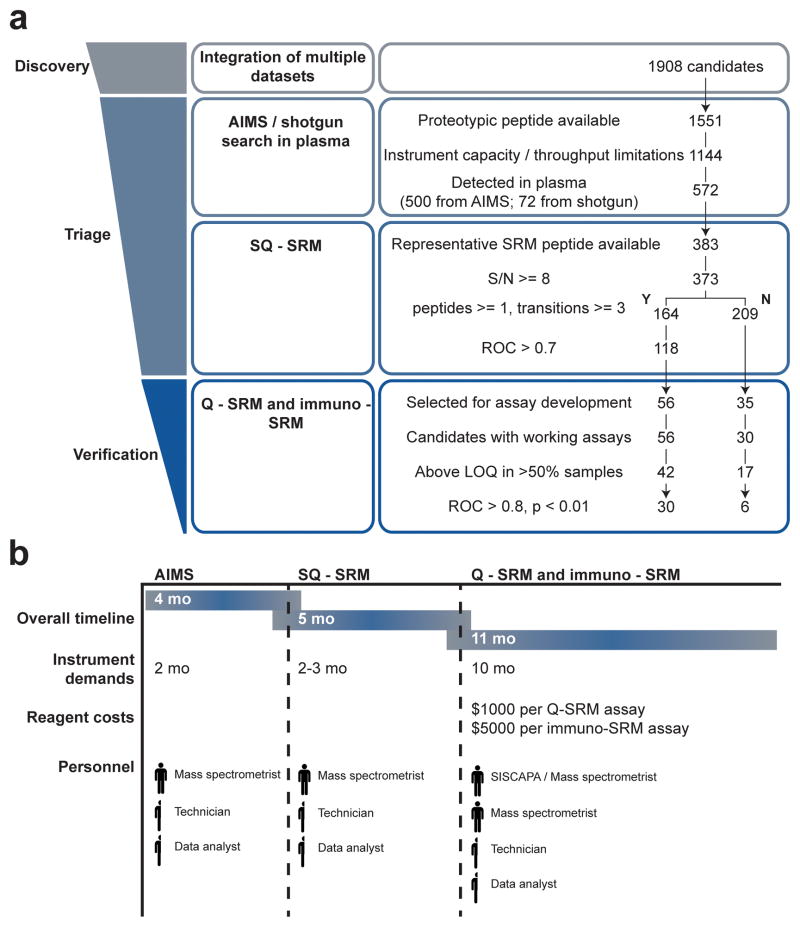
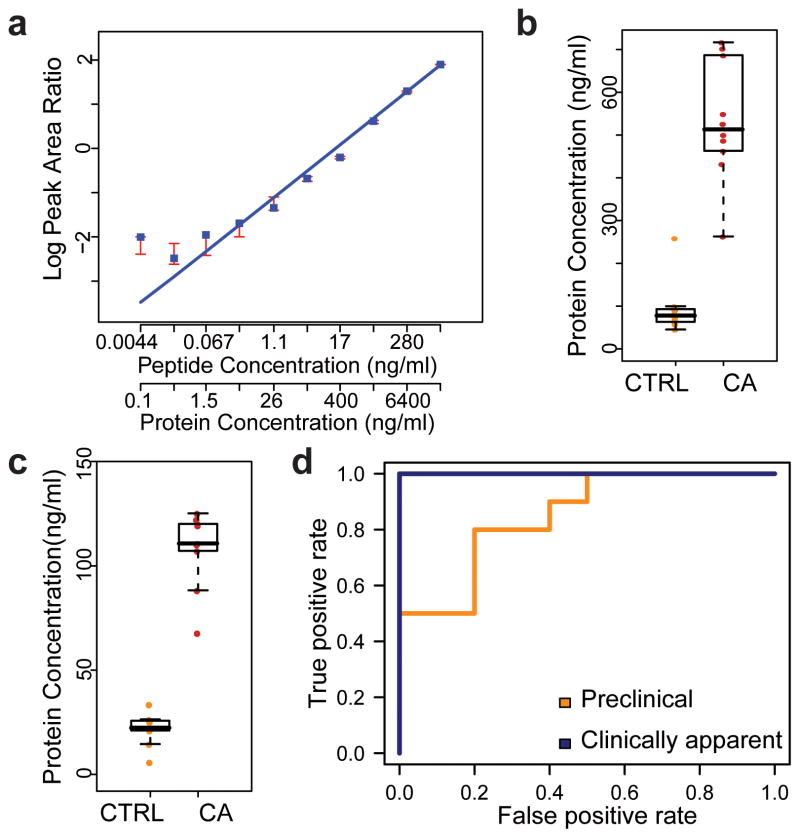
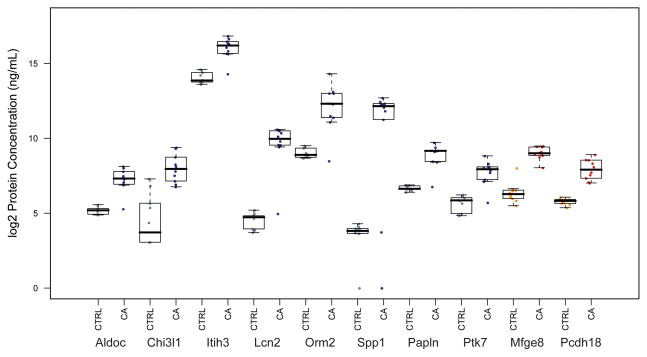
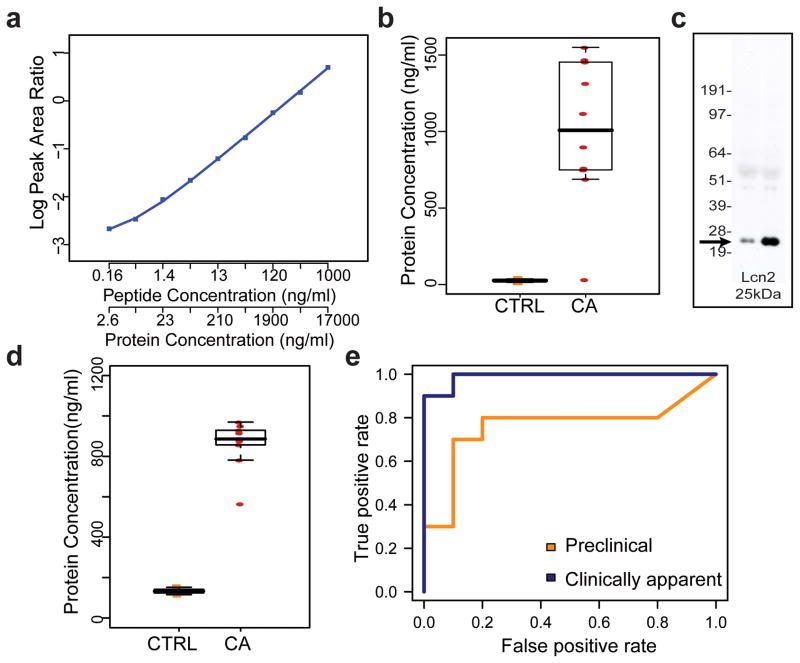
High-throughput technologies can now identify hundreds of candidate protein biomarkers for any disease with relative ease. However, because there are no assays for the majority of proteins and de novo immunoassay development is prohibitively expensive, few candidate biomarkers are tested in clinical studies. We tested whether the analytical performance of a biomarker identification pipeline based on targeted mass spectrometry would be sufficient for data-dependent prioritization of candidate biomarkers, de novo development of assays and multiplexed biomarker verification. We used a data-dependent triage process to prioritize a subset of putative plasma biomarkers from >1,000 candidates previously identified using a mouse model of breast cancer. Eighty-eight novel quantitative assays based on selected reaction monitoring mass spectrometry were developed, multiplexed and evaluated in 80 plasma samples. Thirty-six proteins were verified as being elevated in the plasma of tumor-bearing animals. The analytical performance of this pipeline suggests that it should support the use of an analogous approach with human samples.
高通量技术现在可以相对轻松地识别出任何疾病的数百种候选蛋白质生物标志物。然而,由于大多数蛋白质都没有检测方法,并且从头开发免疫测定的成本过高,因此很少有候选生物标志物在临床研究中进行测试。我们测试了基于靶向质谱的生物标志物识别管道的分析性能是否足以对候选生物标志物进行数据依赖的优先级排序、从头开发测定和多重生物标志物验证。我们使用数据依赖的分类过程来对来自先前使用乳腺癌小鼠模型鉴定的>1000 种候选生物标志物的一个子集进行优先级排序。基于选择反应监测质谱法开发了 88 种新的定量测定方法,并对 80 个血浆样本进行了多重化和评估。验证了 36 种蛋白质在荷瘤动物的血浆中升高。该管道的分析性能表明,它应该支持使用类似的方法对人体样本进行分析。