Cleeremans Axel
Consciousness, Cognition and Computation Group, Université Libre de Bruxelles Bruxelles, Belgium.
Front Psychol. 2011 May 9;2:86. doi: 10.3389/fpsyg.2011.00086. eCollection 2011.
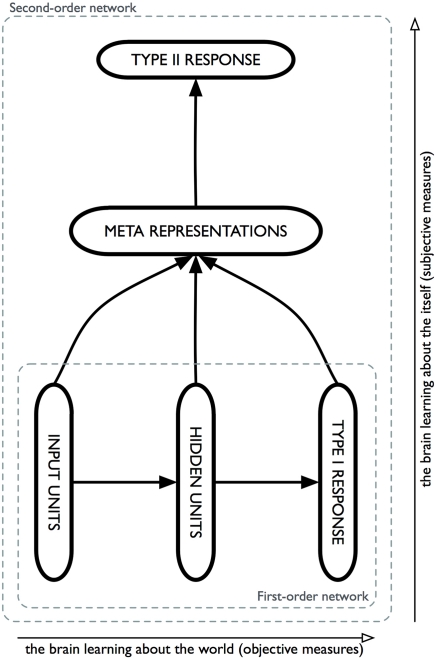
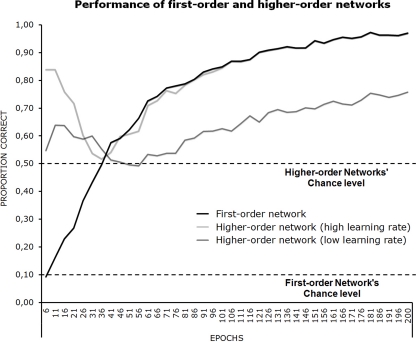
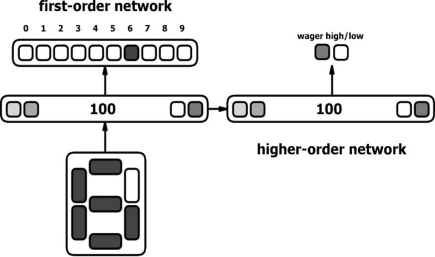
In this paper, I explore the idea that consciousness is something that the brain learns to do rather than an intrinsic property of certain neural states and not others. Starting from the idea that neural activity is inherently unconscious, the question thus becomes: How does the brain learn to be conscious? I suggest that consciousness arises as a result of the brain's continuous attempts at predicting not only the consequences of its actions on the world and on other agents, but also the consequences of activity in one cerebral region on activity in other regions. By this account, the brain continuously and unconsciously learns to redescribe its own activity to itself, so developing systems of meta-representations that characterize and qualify the target first-order representations. Such learned redescriptions, enriched by the emotional value associated with them, form the basis of conscious experience. Learning and plasticity are thus central to consciousness, to the extent that experiences only occur in experiencers that have learned to know they possess certain first-order states and that have learned to care more about certain states than about others. This is what I call the "Radical Plasticity Thesis." In a sense thus, this is the enactive perspective, but turned both inwards and (further) outwards. Consciousness involves "signal detection on the mind"; the conscious mind is the brain's (non-conceptual, implicit) theory about itself. I illustrate these ideas through neural network models that simulate the relationships between performance and awareness in different tasks.
在本文中,我探讨了这样一种观点:意识是大脑学会去做的事情,而非某些神经状态所固有的属性,其他神经状态则不然。从神经活动本质上是无意识的这一观点出发,问题就变成了:大脑是如何学会产生意识的?我认为,意识的产生是大脑持续尝试的结果,这种尝试不仅是预测其行为对世界和其他主体的影响,还包括预测一个脑区的活动对其他脑区活动的影响。据此,大脑持续且无意识地学会向自身重新描述其自身活动,从而发展出元表征系统,这些系统对目标一阶表征进行表征和限定。这种通过与之相关的情感价值得以丰富的习得性重新描述,构成了意识体验的基础。因此,学习和可塑性对于意识来说至关重要,因为体验仅发生在那些已经学会知晓自身拥有某些一阶状态,并且已经学会更关注某些状态而非其他状态的体验者身上。这就是我所说的“激进可塑性论点”。从某种意义上说,这就是生成认知视角,但它既向内又(进一步)向外转变。意识涉及“心灵上的信号检测”;有意识心灵是大脑关于自身的(非概念性、隐含的)理论。我通过神经网络模型来说明这些观点,这些模型模拟了不同任务中表现与意识之间的关系。