State Key Laboratory for Turbulence and Complex Systems, Center for Systems and Control, College of Engineering, Peking University, Beijing, China.
PLoS One. 2011;6(6):e20577. doi: 10.1371/journal.pone.0020577. Epub 2011 Jun 8.
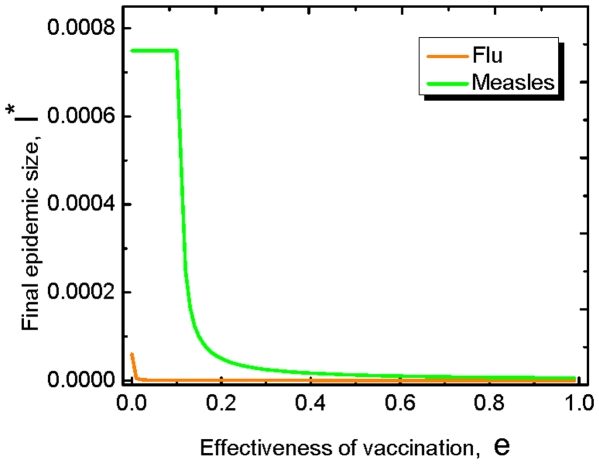
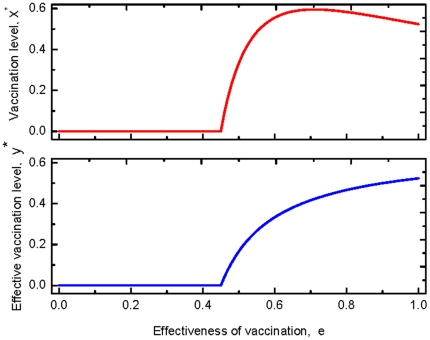
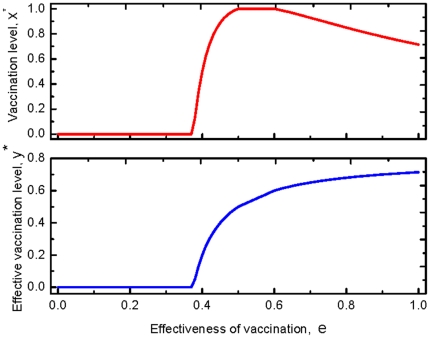
Achieving widespread population immunity by voluntary vaccination poses a major challenge for public health administration and practice. The situation is complicated even more by imperfect vaccines. How the vaccine efficacy affects individuals' vaccination behavior has yet to be fully answered. To address this issue, we combine a simple yet effective game theoretic model of vaccination behavior with an epidemiological process. Our analysis shows that, in a population of self-interested individuals, there exists an overshooting of vaccine uptake levels as the effectiveness of vaccination increases. Moreover, when the basic reproductive number, R0, exceeds a certain threshold, all individuals opt for vaccination for an intermediate region of vaccine efficacy. We further show that increasing effectiveness of vaccination always increases the number of effectively vaccinated individuals and therefore attenuates the epidemic strain. The results suggest that 'number is traded for efficiency': although increases in vaccination effectiveness lead to uptake drops due to free-riding effects, the impact of the epidemic can be better mitigated.
通过自愿接种来实现广泛的人群免疫对公共卫生管理和实践提出了重大挑战。情况因不完善的疫苗而更加复杂。疫苗的功效如何影响个人的接种行为,这一点尚未得到充分解答。为了解决这个问题,我们将接种行为的简单而有效的博弈论模型与流行病学过程相结合。我们的分析表明,在一个自私自利的人群中,随着疫苗接种效果的提高,疫苗接种水平会出现过度增长。此外,当基本繁殖数 R0 超过某个阈值时,所有个体都会在疫苗功效的中间区域选择接种。我们进一步表明,疫苗接种效果的提高总是会增加有效接种者的数量,从而减轻传染病的压力。研究结果表明,“数量可以换取效率”:尽管疫苗接种效果的提高会因搭便车效应而导致接种率下降,但可以更好地减轻传染病的影响。