Department of Mathematics and Statistics, University of Guelph, Guelph, Ontario, Canada.
PLoS One. 2010 Sep 15;5(9):e12594. doi: 10.1371/journal.pone.0012594.
Mathematical models have formalized how free-rider effects can threaten the stability of high vaccine coverage levels under established voluntary vaccination programs. However, little research has addressed the question of when free-riding begins to develop when a new vaccine is first introduced in a population.
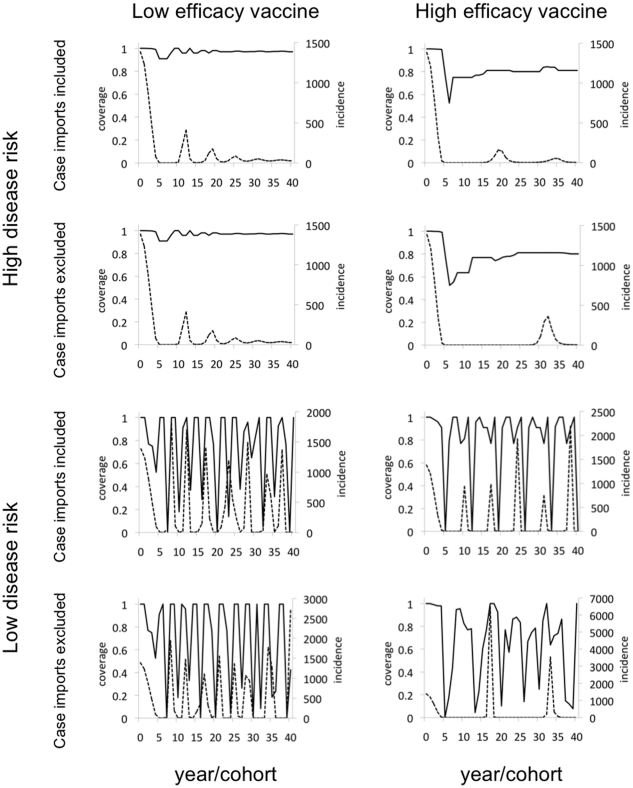
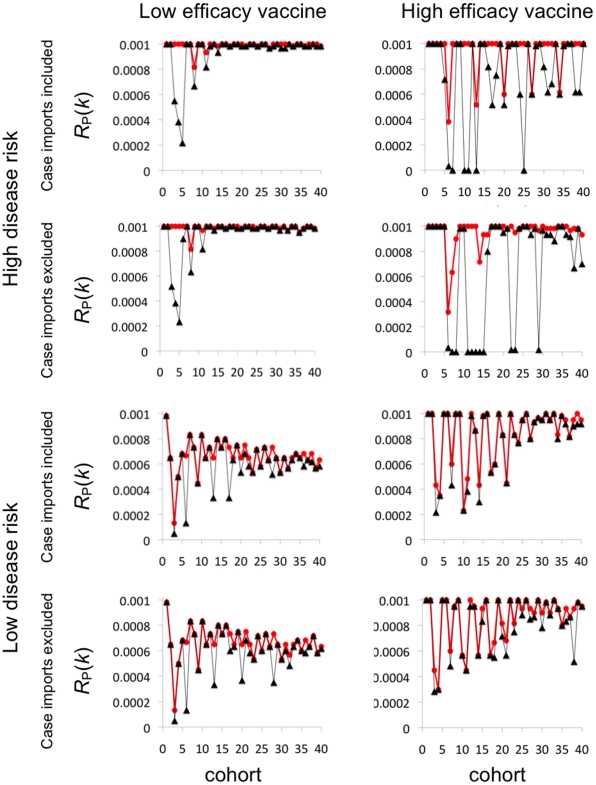
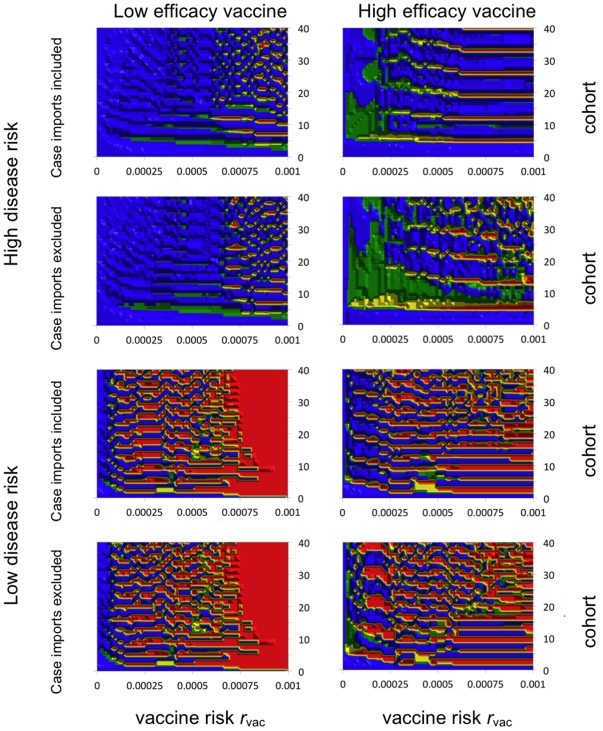
METHODOLOGY/PRINCIPAL FINDINGS: Here, we combine a game theoretical model of vaccinating behavior with an age-structured compartmental model to analyze rational vaccinating behavior in the first years of a universal immunization program, where a new vaccine is free to all children of a specified age. The model captures how successive birth cohorts face different epidemiological landscapes that have been shaped by the vaccinating decisions of previous birth cohorts, resulting in a strategic interaction between individuals in different birth cohorts. The model predicts a Nash equilibrium coverage level of for the first few birth cohorts under the new program. However, free-riding behavior emerges very quickly, with the Nash equilibrium vaccine coverage dropping significantly within 2-5 years after program initiation. Subsequently, a rich set of coupled dynamics between infection prevalence and vaccinating behaviors is possible, ranging from relatively stable (but reduced) coverage in later birth cohorts to wide fluctuations in vaccine coverage from one birth cohort to the next. Individual tolerance for vaccine risk also starts out at relatively high levels before dropping significantly within a few years.
CONCLUSIONS/SIGNIFICANCE: These results suggest that even relatively new immunization programs can be vulnerable to drops in vaccine coverage caused by vaccine scares and exacerbated by herd immunity effects, necessitating vigilance from the start.
数学模型已经形式化了自由搭便车效应如何在既定的自愿疫苗接种计划下威胁高疫苗接种率的稳定性。然而,当一种新疫苗首次在人群中引入时,很少有研究探讨自由搭便车开始出现的时间问题。
方法/主要发现:在这里,我们将接种行为的博弈论模型与年龄结构的隔室模型相结合,分析了普遍免疫计划最初几年的理性接种行为,在该计划中,新疫苗对特定年龄的所有儿童都是免费的。该模型捕捉了连续出生的人群如何面临由前出生人群的接种决策塑造的不同流行病学景观,从而导致不同出生人群之间的个体之间存在战略互动。该模型预测了新计划下最初几个出生队列的纳什均衡覆盖率。然而,自由搭便车行为很快就出现了,在计划启动后 2-5 年内,纳什均衡疫苗接种率显著下降。随后,感染流行率和接种行为之间可能会出现一系列丰富的耦合动态,从后期出生队列中相对稳定(但降低)的覆盖范围到疫苗覆盖范围从一个出生队列到下一个出生队列的广泛波动。个体对疫苗风险的容忍度也在几年内显著下降之前,从相对较高的水平开始。
结论/意义:这些结果表明,即使是相对较新的免疫计划也可能容易受到疫苗恐慌引起的疫苗接种率下降的影响,并因群体免疫效应而加剧,因此从一开始就需要保持警惕。