Department of Psychiatry, Autism Research Centre, University of Cambridge, Cambridge, United Kingdom.
PLoS One. 2011;6(6):e20835. doi: 10.1371/journal.pone.0020835. Epub 2011 Jun 13.
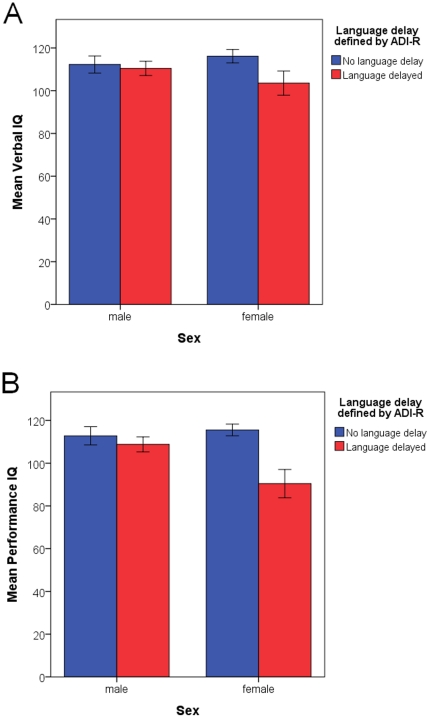
Autism spectrum conditions (ASC) affect more males than females in the general population. However, within ASC it is unclear if there are phenotypic sex differences. Testing for similarities and differences between the sexes is important not only for clinical assessment but also has implications for theories of typical sex differences and of autism. Using cognitive and behavioral measures, we investigated similarities and differences between the sexes in age- and IQ-matched adults with ASC (high-functioning autism or Asperger syndrome). Of the 83 (45 males and 38 females) participants, 62 (33 males and 29 females) met Autism Diagnostic Interview-Revised (ADI-R) cut-off criteria for autism in childhood and were included in all subsequent analyses. The severity of childhood core autism symptoms did not differ between the sexes. Males and females also did not differ in self-reported empathy, systemizing, anxiety, depression, and obsessive-compulsive traits/symptoms or mentalizing performance. However, adult females with ASC showed more lifetime sensory symptoms (p = 0.036), fewer current socio-communication difficulties (p = 0.001), and more self-reported autistic traits (p = 0.012) than males. In addition, females with ASC who also had developmental language delay had lower current performance IQ than those without developmental language delay (p<0.001), a pattern not seen in males. The absence of typical sex differences in empathizing-systemizing profiles within the autism spectrum confirms a prediction from the extreme male brain theory. Behavioral sex differences within ASC may also reflect different developmental mechanisms between males and females with ASC. We discuss the importance of the superficially better socio-communication ability in adult females with ASC in terms of why females with ASC may more often go under-recognized, and receive their diagnosis later, than males.
自闭症谱系条件(ASC)在普通人群中影响男性多于女性。然而,在 ASC 内,尚不清楚是否存在表型性别差异。测试性别之间的相似性和差异不仅对临床评估很重要,而且对典型性别差异理论和自闭症理论也有影响。我们使用认知和行为测量方法,研究了年龄和智商匹配的 ASC 成年男女(高功能自闭症或阿斯伯格综合征)之间的相似性和差异。在 83 名参与者中(45 名男性和 38 名女性),有 62 名(33 名男性和 29 名女性)符合自闭症诊断访谈修订版(ADI-R)的自闭症儿童诊断标准,并纳入了所有后续分析。儿童期核心自闭症症状的严重程度在性别之间没有差异。男性和女性在自我报告的同理心、系统思维、焦虑、抑郁、强迫性特质/症状或心理化表现方面也没有差异。然而,患有 ASC 的成年女性表现出更多的终生感官症状(p = 0.036),当前社交沟通困难较少(p = 0.001),以及更多的自我报告的自闭症特质(p = 0.012)比男性。此外,患有 ASC 且也有发育性语言延迟的女性,其当前表现智商比没有发育性语言延迟的女性低(p<0.001),而男性则没有这种情况。在自闭症谱系内同理心-系统思维特征中没有典型的性别差异,这证实了极端男性大脑理论的一个预测。ASC 内的行为性别差异也可能反映了 ASC 男性和女性之间不同的发育机制。我们根据为什么患有 ASC 的女性比男性更不容易被识别,并且比男性更晚获得诊断的原因,讨论了成年女性 ASC 患者社交沟通能力表面上更好的重要性。