Laboratory of Signal Transduction, Memorial Sloan-Kettering Cancer Center, New York, New York, United States of America.
PLoS One. 2011;6(6):e19783. doi: 10.1371/journal.pone.0019783. Epub 2011 Jun 13.
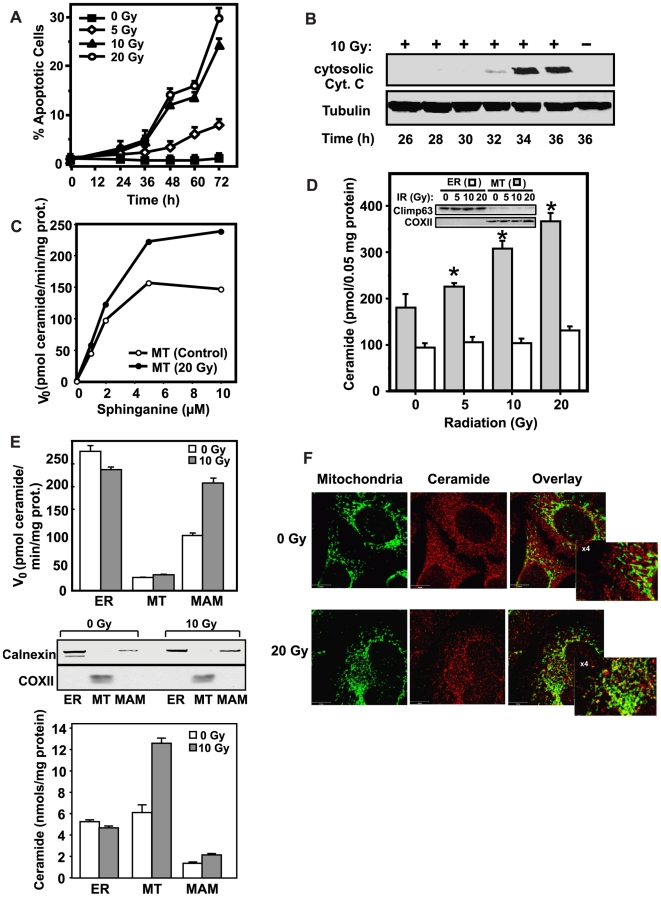
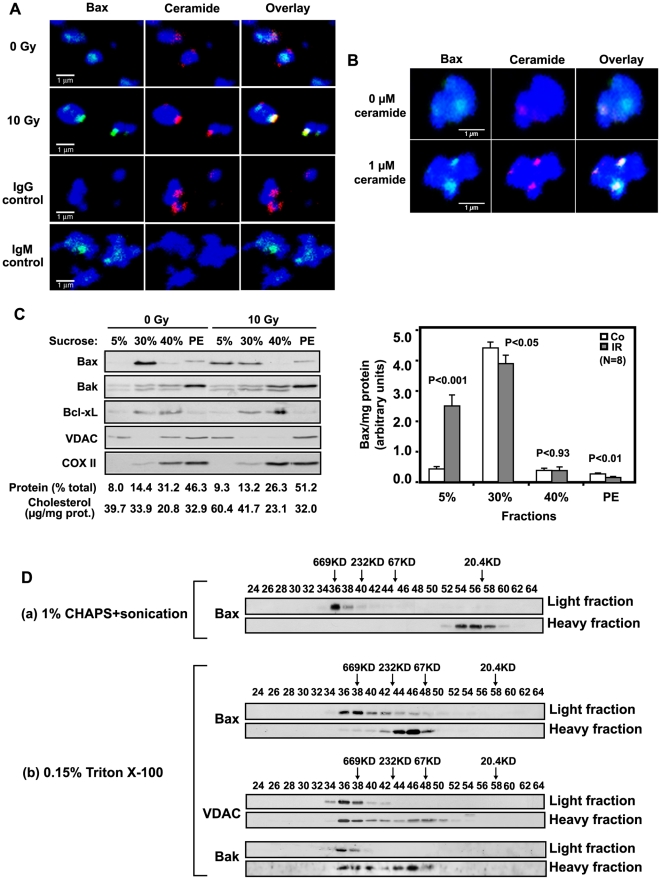
Evidence indicates that Bax functions as a "lipidic" pore to regulate mitochondrial outer membrane permeabilization (MOMP), the apoptosis commitment step, through unknown membrane elements. Here we show mitochondrial ceramide elevation facilitates MOMP-mediated cytochrome c release in HeLa cells by generating a previously-unrecognized mitochondrial ceramide-rich macrodomain (MCRM), which we visualize and isolate, into which Bax integrates.
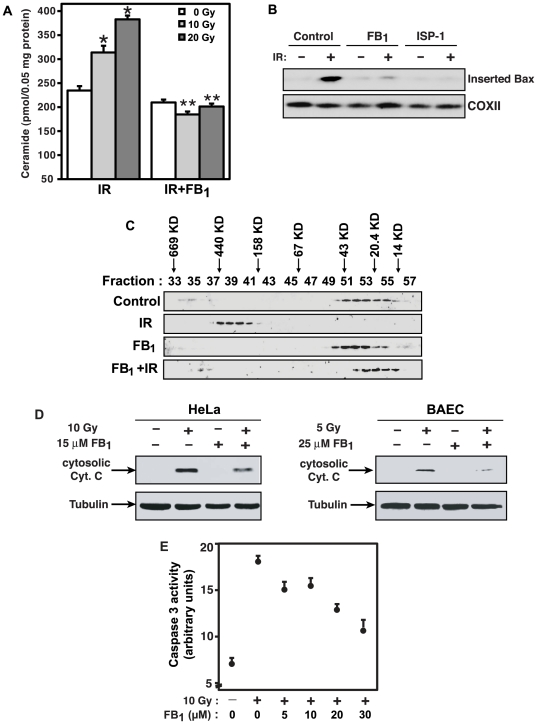
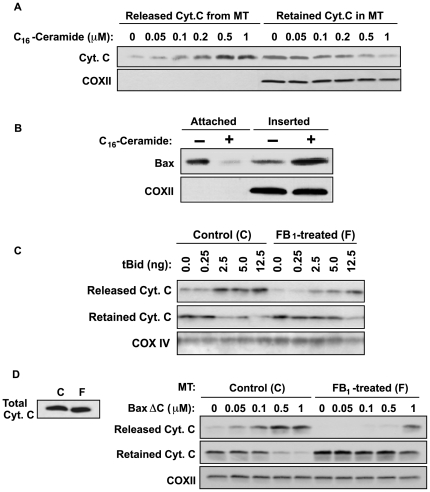
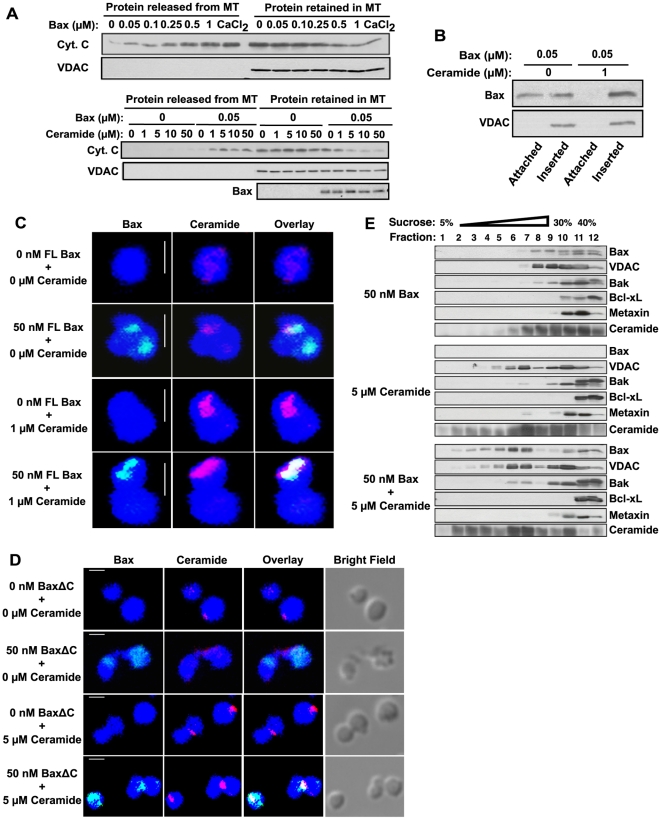
METHODOLOGY/PRINCIPAL FINDINGS: MCRMs, virtually non-existent in resting cells, form upon irradiation coupled to ceramide synthase-mediated ceramide elevation, optimizing Bax insertion/oligomerization and MOMP. MCRMs are detected by confocal microscopy in intact HeLa cells and isolated biophysically as a light membrane fraction from HeLa cell lysates. Inhibiting ceramide generation using a well-defined natural ceramide synthase inhibitor, Fumonisin B1, prevented radiation-induced Bax insertion, oligomerization and MOMP. MCRM deconstruction using purified mouse hepatic mitochondria revealed ceramide alone is non-apoptogenic. Rather Bax integrates into MCRMs, oligomerizing therein, conferring 1-2 log enhanced cytochrome c release. Consistent with this mechanism, MCRM Bax isolates as high molecular weight "pore-forming" oligomers, while non-MCRM membrane contains exclusively MOMP-incompatible monomeric Bax.
CONCLUSIONS/SIGNIFICANCE: Our recent studies in the C. elegans germline indicate that mitochondrial ceramide generation is obligate for radiation-induced apoptosis, although a mechanism for ceramide action was not delineated. Here we demonstrate that ceramide, generated in the mitochondrial outer membrane of mammalian cells upon irradiation, forms a platform into which Bax inserts, oligomerizes and functionalizes as a pore. We posit conceptualization of ceramide as a membrane-based stress calibrator, driving membrane macrodomain organization, which in mitochondria regulates intensity of Bax-induced MOMP, and is pharmacologically tractable in vitro and in vivo.
有证据表明,Bax 通过未知的膜元件作为“脂质”孔调节线粒体外膜通透性(MOMP),即细胞凋亡的决定步骤。在这里,我们表明线粒体神经酰胺的升高通过产生一个以前未被识别的富含线粒体神经酰胺的大域(MCRM)来促进 HeLa 细胞中 MOMP 介导的细胞色素 c 释放,我们将其可视化并分离出来,Bax 整合到其中。
方法/主要发现:MCRMs 在静止细胞中几乎不存在,但在与神经酰胺合酶介导的神经酰胺升高偶联的照射后形成,从而优化了 Bax 的插入/寡聚化和 MOMP。MCRMs 可以通过共聚焦显微镜在完整的 HeLa 细胞中检测到,并从 HeLa 细胞裂解物中分离出来作为一个轻膜部分进行生物物理分析。使用一种经过充分定义的天然神经酰胺合酶抑制剂 Fumonisin B1 抑制神经酰胺的产生,可防止照射诱导的 Bax 插入、寡聚化和 MOMP。使用纯化的鼠肝线粒体进行 MCRM 解构表明,单独的神经酰胺没有促凋亡作用。相反,Bax 整合到 MCRMs 中,在其中寡聚化,赋予 1-2 个对数增强的细胞色素 c 释放。与这种机制一致,MCRM Bax 分离为高分子量的“形成孔”寡聚物,而非 MCRM 膜仅包含不兼容 MOMP 的单体 Bax。
结论/意义:我们最近在秀丽隐杆线虫生殖系中的研究表明,线粒体神经酰胺的产生是辐射诱导细胞凋亡所必需的,尽管没有阐明神经酰胺作用的机制。在这里,我们证明了在哺乳动物细胞的线粒体外膜中,照射后产生的神经酰胺形成一个平台,Bax 插入其中,寡聚化并作为孔功能化。我们假设神经酰胺作为一种基于膜的应激校准器的概念,驱动膜大域的组织,在线粒体中调节 Bax 诱导的 MOMP 的强度,并且在体外和体内都是可药物处理的。