Norwich School of Medicine, University of East Anglia, Norwich, United Kingdom.
PLoS One. 2011;6(6):e20724. doi: 10.1371/journal.pone.0020724. Epub 2011 Jun 10.
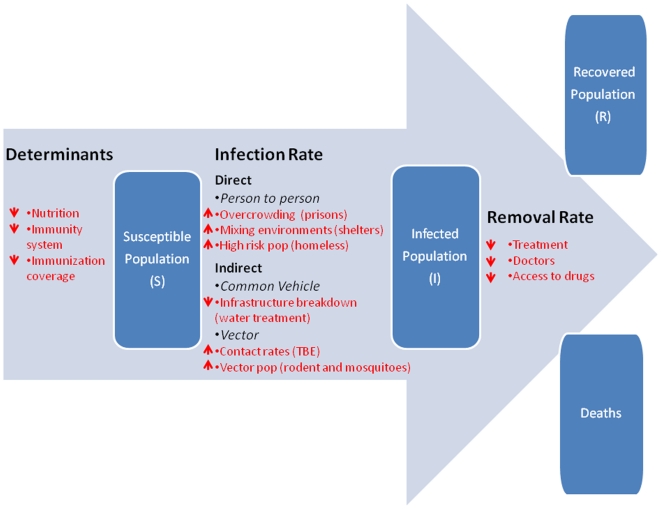
There is concern among public health professionals that the current economic downturn, initiated by the financial crisis that started in 2007, could precipitate the transmission of infectious diseases while also limiting capacity for control. Although studies have reviewed the potential effects of economic downturns on overall health, to our knowledge such an analysis has yet to be done focusing on infectious diseases. We performed a systematic literature review of studies examining changes in infectious disease burden subsequent to periods of crisis. The review identified 230 studies of which 37 met our inclusion criteria. Of these, 30 found evidence of worse infectious disease outcomes during recession, often resulting from higher rates of infectious contact under poorer living circumstances, worsened access to therapy, or poorer retention in treatment. The remaining studies found either reductions in infectious disease or no significant effect. Using the paradigm of the "SIR" (susceptible-infected-recovered) model of infectious disease transmission, we examined the implications of these findings for infectious disease transmission and control. Key susceptible groups include infants and the elderly. We identified certain high-risk groups, including migrants, homeless persons, and prison populations, as particularly vulnerable conduits of epidemics during situations of economic duress. We also observed that the long-term impacts of crises on infectious disease are not inevitable: considerable evidence suggests that the magnitude of effect depends critically on budgetary responses by governments. Like other emergencies and natural disasters, preparedness for financial crises should include consideration of consequences for communicable disease control.
公共卫生专业人员担心,始于 2007 年的金融危机引发的当前经济衰退,可能会加速传染病的传播,同时也会限制控制能力。尽管已有研究综述了经济衰退对整体健康的潜在影响,但据我们所知,尚未有针对传染病的此类分析。我们对考察危机后传染病负担变化的研究进行了系统文献综述。该综述确定了 230 项研究,其中 37 项符合我们的纳入标准。其中,有 30 项研究发现,在经济衰退期间,传染病的结果更差,这通常是由于在较差的生活环境下传染性接触的增加、治疗机会恶化或治疗保留率较差所致。其余研究发现传染病减少或没有显著影响。我们使用传染病传播的“SIR”(易感-感染-恢复)模型范式,研究了这些发现对传染病传播和控制的影响。关键易感人群包括婴儿和老年人。我们确定了某些高风险群体,包括移民、无家可归者和监狱人口,在经济困境期间,这些群体特别容易成为传染病的传播媒介。我们还观察到,危机对传染病的长期影响并非不可避免:大量证据表明,影响的程度取决于政府的预算应对。像其他紧急情况和自然灾害一样,对金融危机的准备工作应考虑到对传染病控制的影响。