Cardiac and Vascular Medicine, St George's, University of London, UK.
Int J Chron Obstruct Pulmon Dis. 2011;6:289-96. doi: 10.2147/COPD.S18181. Epub 2011 May 26.
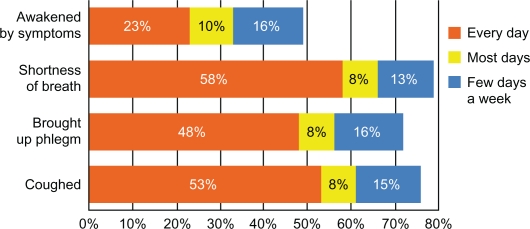
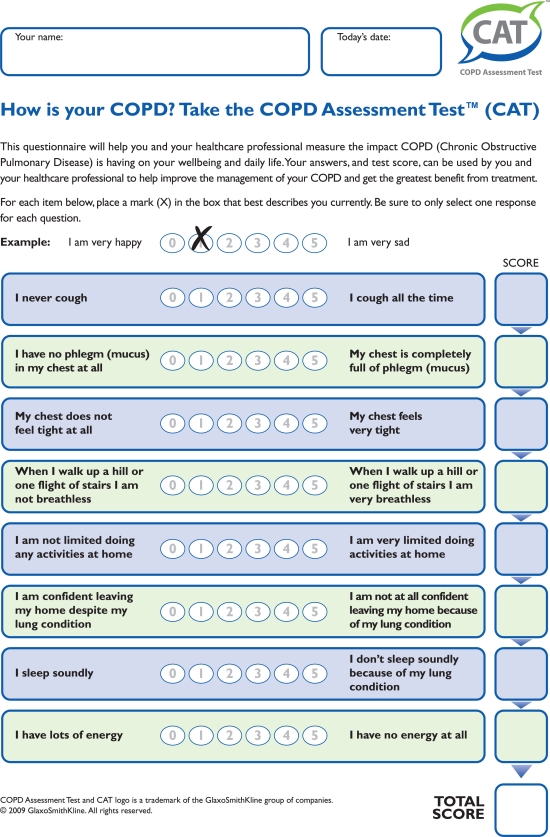
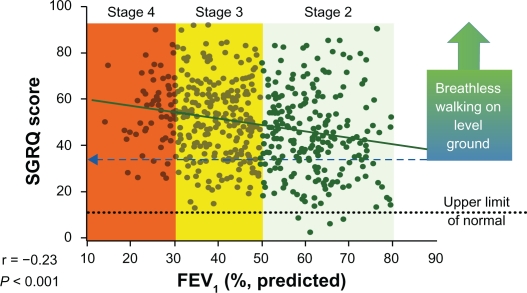
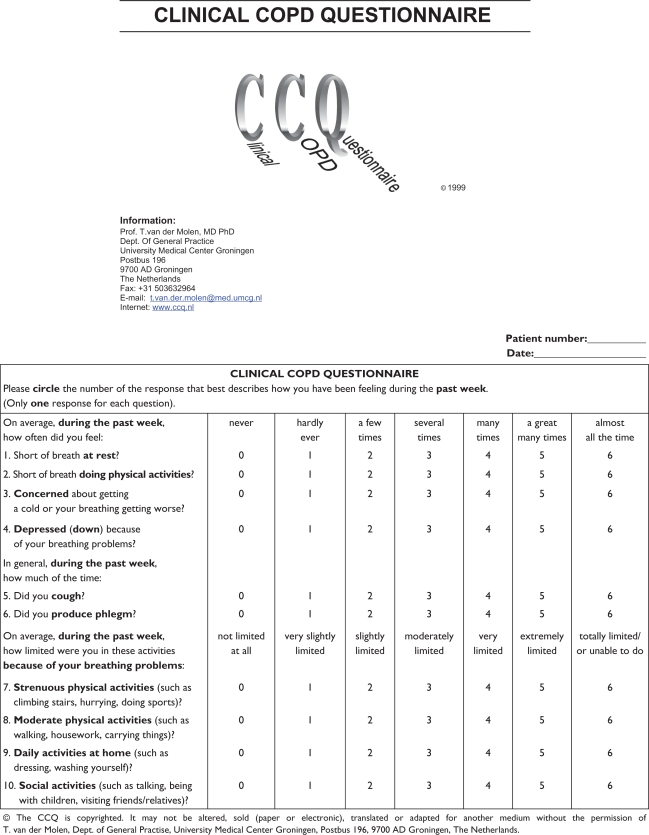
Chronic obstructive pulmonary disease (COPD) is a leading cause of disability in all its stages, and death in patients with moderate or severe obstruction. At present, COPD is suboptimally managed; current health is often not measured properly and hardly taken into account in management plans, and the future risk for patients with regard to health status and quality of life is not being evaluated. This review addresses the effect of COPD on the lives of patients and examines ways in which existing assessment tools meet physicians' needs for a standardized, simple method to measure consistently the full impact of COPD on patients in routine clinical practice. Current assessment of COPD severity tends to focus on airflow limitation, but this does not capture the full impact of the disease and is not well correlated with patient perception of symptoms and health-related quality of life. Qualitative studies have demonstrated that patients usually consider COPD impact in terms of frequency and severity of symptoms, and physical and emotional wellbeing. However, patients often have difficulty expressing their disease burden and physicians generally have insufficient time to collect this information. Therefore, it is important that methods are implemented to help generate a more complete understanding of the impact of COPD. This can be achieved most efficiently using a quick, reliable, and standardized measure of disease impact, such as a short questionnaire that can be applied in daily clinical practice. Questionnaires are precision instruments that contribute sensitive and specific information, and can potentially help physicians provide optimal care for patients with COPD. Two short, easy-to-use, specific measures, ie, the COPD Assessment Test and the Clinical COPD Questionnaire, enable physicians to assess patients' health status accurately and improve disease management. Such questionnaires provide important measurements that can assist primary care physicians to capture the impact of COPD on patients' daily lives and wellbeing, and improve long-term COPD management.
慢性阻塞性肺疾病(COPD)是所有阶段导致残疾的主要原因,也是中重度阻塞患者死亡的主要原因。目前,COPD 的管理效果并不理想;当前的健康状况通常没有得到适当的衡量,在管理计划中几乎没有得到考虑,而且患者未来的健康状况和生活质量风险也没有得到评估。这篇综述探讨了 COPD 对患者生活的影响,并探讨了现有的评估工具如何满足医生的需求,即采用一种标准化、简单的方法,在常规临床实践中持续衡量 COPD 对患者的全面影响。目前对 COPD 严重程度的评估往往侧重于气流受限,但这并不能完全捕捉到疾病的影响,也与患者对症状和健康相关生活质量的感知相关性不佳。定性研究表明,患者通常根据症状的频率和严重程度以及身体和情绪健康来考虑 COPD 的影响。然而,患者通常难以表达他们的疾病负担,而医生通常没有足够的时间来收集这些信息。因此,实施有助于更全面了解 COPD 影响的方法非常重要。使用快速、可靠和标准化的疾病影响衡量方法,如可在日常临床实践中应用的简短问卷,最有效地实现这一目标。问卷是精密仪器,可提供敏感和具体的信息,并且可能有助于医生为 COPD 患者提供最佳护理。两种简短、易用、具体的措施,即 COPD 评估测试和临床 COPD 问卷,使医生能够准确评估患者的健康状况并改善疾病管理。这些问卷提供了重要的测量结果,可以帮助初级保健医生捕捉 COPD 对患者日常生活和幸福感的影响,并改善 COPD 的长期管理。