School of Sport and Exercise Sciences, University of Birmingham, Birmingham, United Kingdom.
PLoS One. 2011;6(6):e20613. doi: 10.1371/journal.pone.0020613. Epub 2011 Jun 20.
To investigate the mechanisms underpinning modifications in glucose homeostasis and insulin sensitivity 24 h after a bout of resistance exercise (RE) with or without protein ingestion.
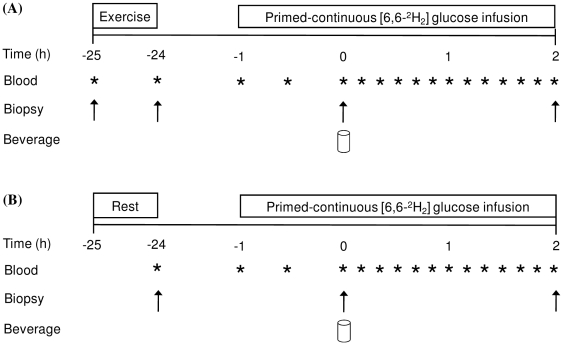
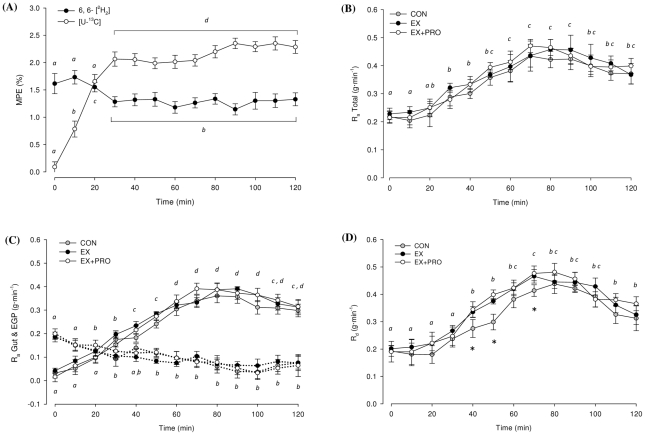
Twenty-four healthy males were assigned to a control (CON; n = 8), exercise (EX; n = 8) or exercise plus protein condition (EX+PRO; n = 8). Muscle biopsy and blood samples were obtained at rest for all groups and immediately post-RE (75% 1RM, 8×10 repetitions of leg-press and extension exercise) for EX and EX+PRO only. At 24 h post-RE (or post-resting biopsy for CON), a further muscle biopsy was obtained. Participants then consumed an oral glucose load (OGTT) containing 2 g of [U-¹³C] glucose during an infusion of 6, 6-[²H₂] glucose. Blood samples were obtained every 10 min for 2 h to determine glucose kinetics. EX+PRO ingested an additional 25 g of intact whey protein with the OGTT. A final biopsy sample was obtained at the end of the OGTT.
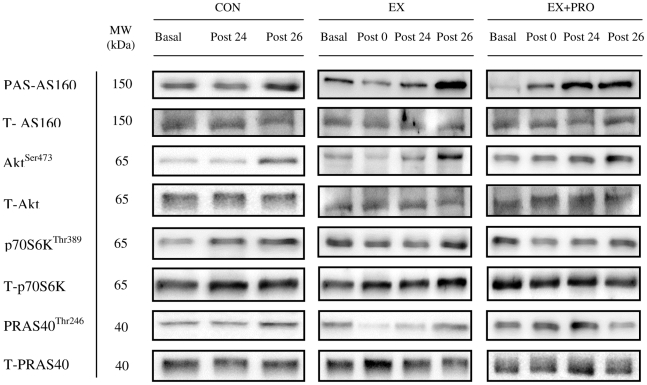
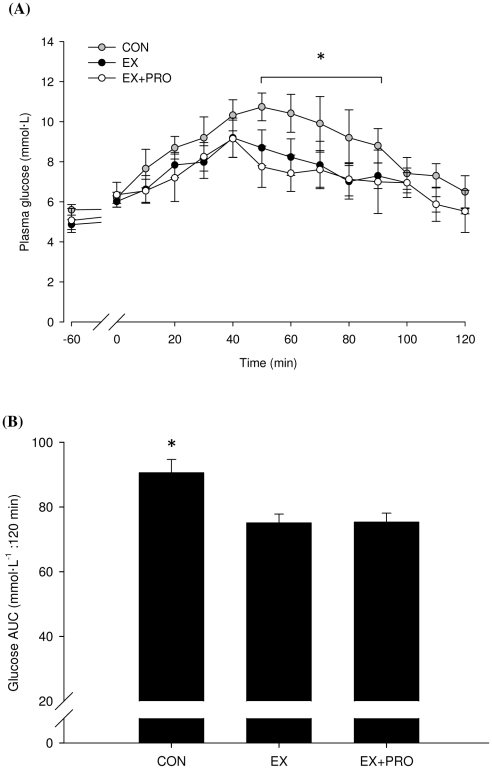
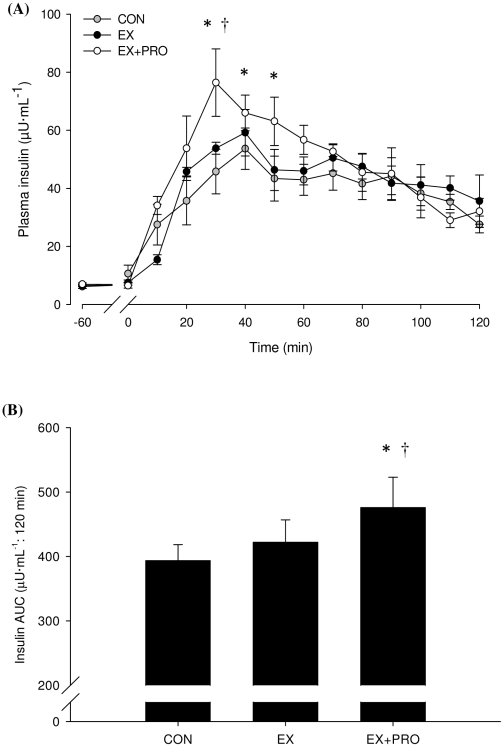
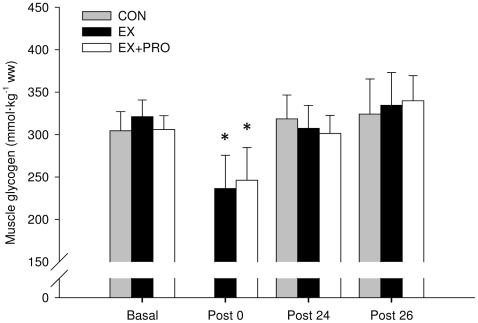
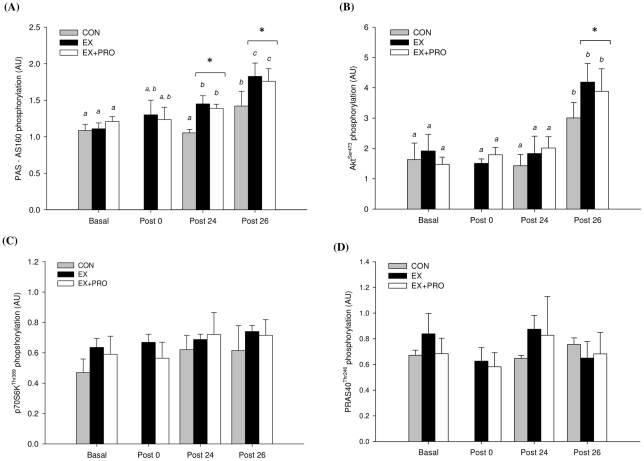
Fasted plasma glucose and insulin were similar for all groups and were not different immediately post- and 24 h post-RE. Following RE, muscle glycogen was 26±8 and 19±6% lower in EX and EX+PRO, respectively. During OGTT, plasma glucose AUC was lower for EX and EX+PRO (75.1±2.7 and 75.3±2.8 mmol·L⁻¹∶120 min, respectively) compared with CON (90.6±4.1 mmol·L⁻¹∶120 min). Plasma insulin response was 13±2 and 21±4% lower for EX and CON, respectively, compared with EX+PRO. Glucose disappearance from the circulation was ∼12% greater in EX and EX+PRO compared with CON. Basal 24 h post-RE and insulin-stimulated PAS-AS160/TBC1D4 phosphorylation was greater for EX and EX+PRO.
Prior RE improves glycemic control and insulin sensitivity through an increase in the rate at which glucose is disposed from the circulation. However, co-ingesting protein during a high-glucose load does not augment this response at 24 h post-exercise in healthy, insulin-sensitive individuals.
探究阻力训练(RE)后 24 小时内葡萄糖稳态和胰岛素敏感性变化的机制,其中 RE 包括有无蛋白质摄入。
24 名健康男性被分为对照组(CON;n=8)、运动组(EX;n=8)或运动加蛋白组(EX+PRO;n=8)。所有组均在休息时采集肌肉活检和血样,仅对 EX 和 EX+PRO 组在 RE 后即刻(75%1RM,腿举和伸展运动 8×10 次)采集。RE 后 24 小时(或 CON 组采集休息时的肌肉活检)时,再次采集肌肉活检。之后,参与者口服含 2 g [U-¹³C]葡萄糖的口服葡萄糖耐量试验(OGTT),同时输注 6,6-[²H₂]葡萄糖。每 10 分钟采集 1 次血样,持续 2 小时以测定葡萄糖动力学。EX+PRO 组在 OGTT 中额外摄入 25 克完整乳清蛋白。OGTT 结束时采集最后一个活检样本。
禁食血糖和胰岛素在所有组中均相似,且在 RE 后即刻和 24 小时后无差异。RE 后,EX 和 EX+PRO 组的肌肉糖原分别降低 26±8%和 19±6%。OGTT 期间,EX 和 EX+PRO 组的血浆葡萄糖 AUC 分别降低(75.1±2.7 和 75.3±2.8 mmol·L⁻¹∶120 min,分别),CON 组为 90.6±4.1 mmol·L⁻¹∶120 min。与 EX+PRO 相比,EX 组和 CON 组的血浆胰岛素反应分别降低 13±2%和 21±4%。与 CON 相比,EX 和 EX+PRO 组的葡萄糖从循环中清除率增加约 12%。RE 后 24 小时基础状态和胰岛素刺激 PAS-AS160/TBC1D4 磷酸化在 EX 和 EX+PRO 组更高。
先前的 RE 通过增加葡萄糖从循环中清除的速度来改善血糖控制和胰岛素敏感性。然而,在健康、胰岛素敏感的个体中,在高葡萄糖负荷时同时摄入蛋白质并不能在运动后 24 小时增强这种反应。