Department of Genetics and Development, College of Physicians and Surgeons of Columbia University, 701 West 168th Street, New York, NY 10032, USA.
Stem Cells Int. 2011;2011:765378. doi: 10.4061/2011/765378. Epub 2011 May 22.
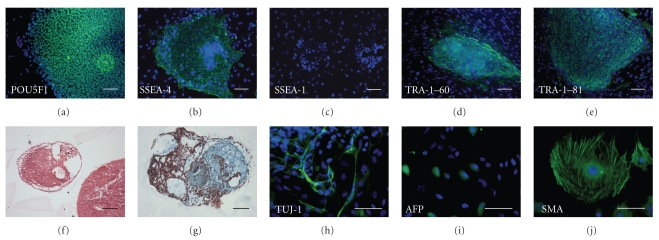
We report the derivation and characterization of two new human embryonic stem cells (hESC) lines (CU1 and CU2) from embryos with an irreversible loss of integrated organismic function. In addition, we analyzed retrospective data of morphological progression from embryonic day (ED) 5 to ED6 for 2480 embryos not suitable for clinical use to assess grading criteria indicative of loss of viability on ED5. Our analysis indicated that a large proportion of in vitro fertilization (IVF) embryos not suitable for clinical use could be used for hESC derivation. Based on these combined findings, we propose that criteria commonly used in IVF clinics to determine optimal embryos for uterine transfer can be employed to predict the potential for hESC derivation from poor quality embryos without the destruction of vital human embryos.
我们报告了两个新的人类胚胎干细胞(hESC)系(CU1 和 CU2)的衍生和特征,这些胚胎来自于整体器官功能不可逆丧失的胚胎。此外,我们分析了 2480 个不适合临床使用的胚胎从胚胎期第 5 天到第 6 天的形态进展的回顾性数据,以评估 ED5 时提示生存能力丧失的分级标准。我们的分析表明,很大一部分不适合临床使用的体外受精(IVF)胚胎可用于 hESC 衍生。基于这些综合发现,我们提出,在 IVF 诊所中用于确定最适合子宫转移的胚胎的标准,可以用于预测从质量较差的胚胎中衍生 hESC 的潜力,而不会破坏重要的人类胚胎。