Health Services Department, University of Washington/Veterans Affairs, Seattle, WA, USA.
Eat Behav. 2011 Aug;12(3):192-9. doi: 10.1016/j.eatbeh.2011.04.005. Epub 2011 Apr 29.
Perceived norms are related to health-related attitudes and behaviors, including body image. The current study examined body dissatisfaction and perceived norms for thinness and muscularity among male and female college students.
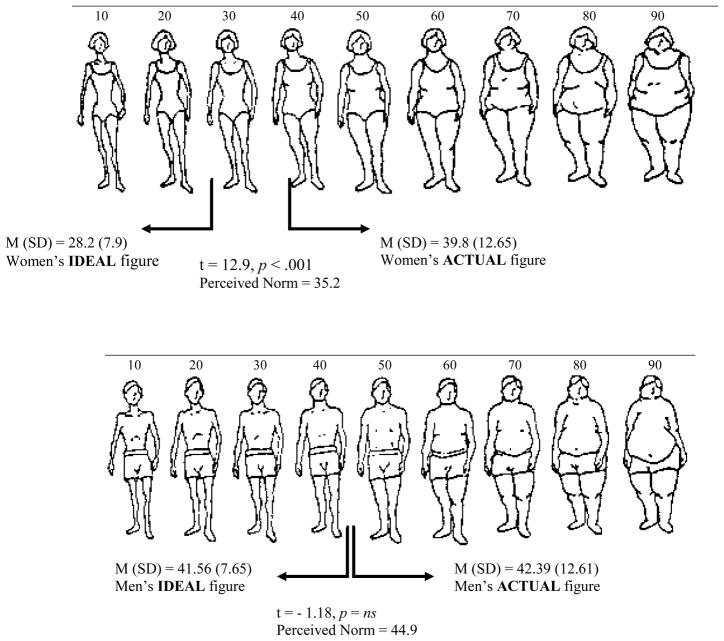
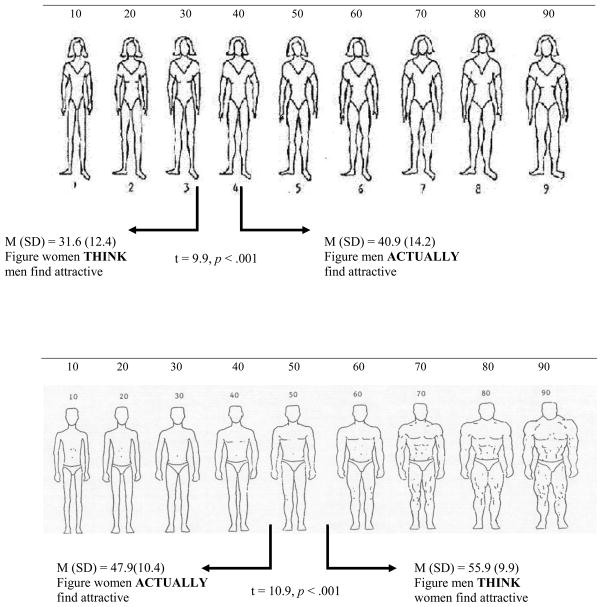
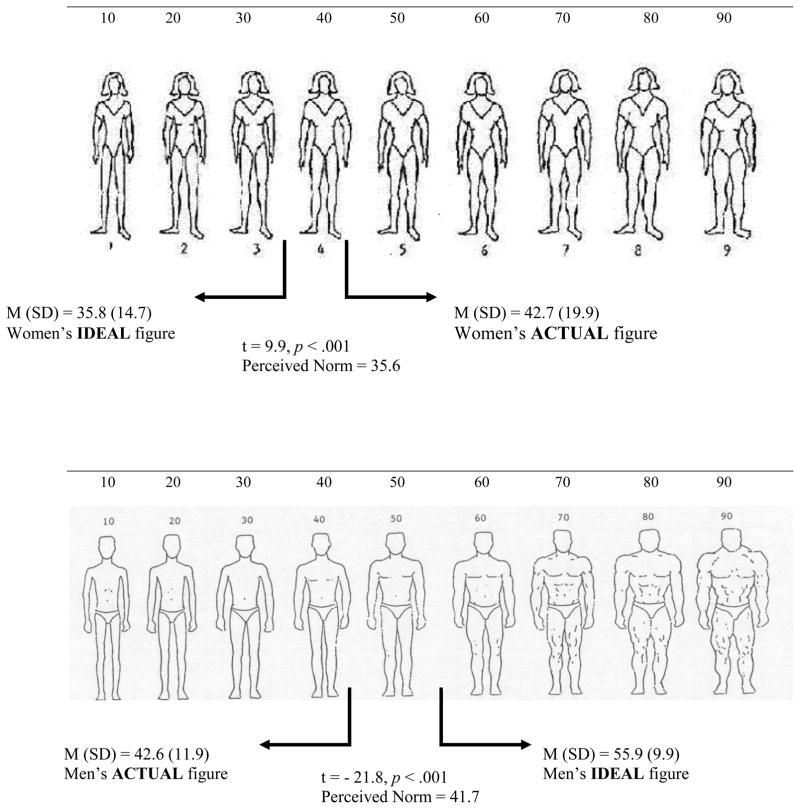
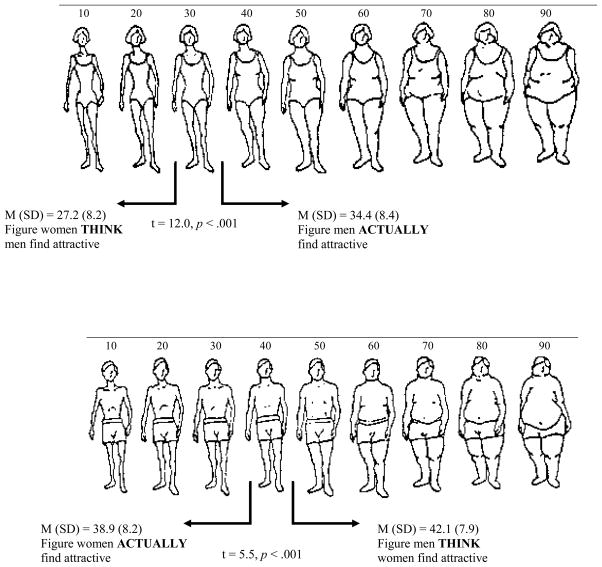
Participants included 842 undergraduate students (64.5% female) who completed an online survey assessing body image and other health-related attitudes and behaviors. A series of independent sample and paired sample t tests were conducted to document sex differences in body dissatisfaction and misperceptions of thinness and muscularity norms.
Based on pictorial ratings, both males and females reported discrepancies between their ideal and actual figures. Females perceived other females as significantly thinner and less muscular than the actual norms. Males perceived other males as significantly heavier than their own figures, but the difference between men's self-reported muscularity and perceived norm was not significant. Both males and females misperceived opposite-sex attractiveness norms for thinness and muscularity.
Results suggest the importance of evaluating same-sex and opposite-sex perceived norms of thinness and muscularity in the etiology of body dissatisfaction, and this research informs social norms interventions targeting misperceptions of body image norms among both males and females.
感知规范与健康相关的态度和行为有关,包括身体形象。本研究考察了男大学生和女大学生的身体不满和对消瘦和肌肉发达的感知规范。
参与者包括 842 名本科学生(64.5%为女性),他们完成了一项在线调查,评估身体形象和其他与健康相关的态度和行为。进行了一系列独立样本和配对样本 t 检验,以记录男女性别在身体不满和对消瘦和肌肉发达规范的误解方面的差异。
根据图片评价,男性和女性都报告了理想和实际身材之间的差异。女性认为其他女性比实际规范更瘦、肌肉更少。男性认为其他男性比自己的体型更重,但男性自我报告的肌肉发达程度与感知规范之间的差异并不显著。男性和女性都对异性吸引力的消瘦和肌肉发达规范存在误解。
研究结果表明,评估消瘦和肌肉发达的同性和异性感知规范在身体不满的病因学中具有重要意义,本研究为针对男性和女性身体形象规范误解的社会规范干预提供了信息。