Information Génomique et Structurale, CNRS - UPR2589, Institut de Microbiologie de la Méditerranée, Aix-Marseille University, Parc Scientifique de Luminy, Marseille, France.
Nucleic Acids Res. 2011 Nov 1;39(20):8665-76. doi: 10.1093/nar/gkr556. Epub 2011 Jul 15.
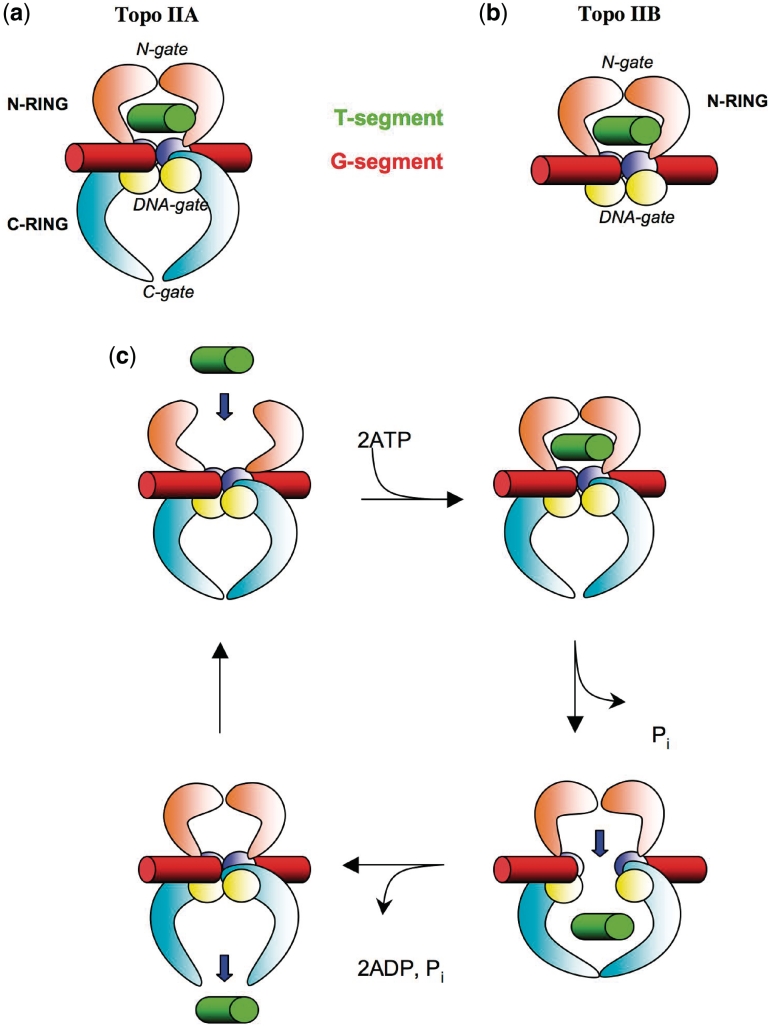
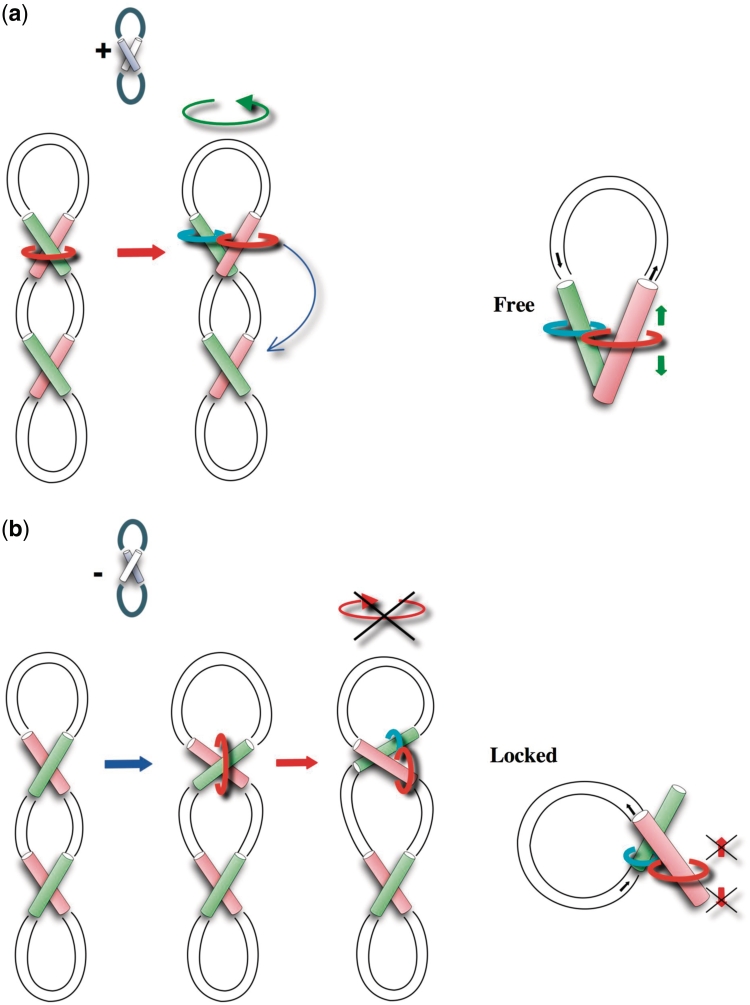
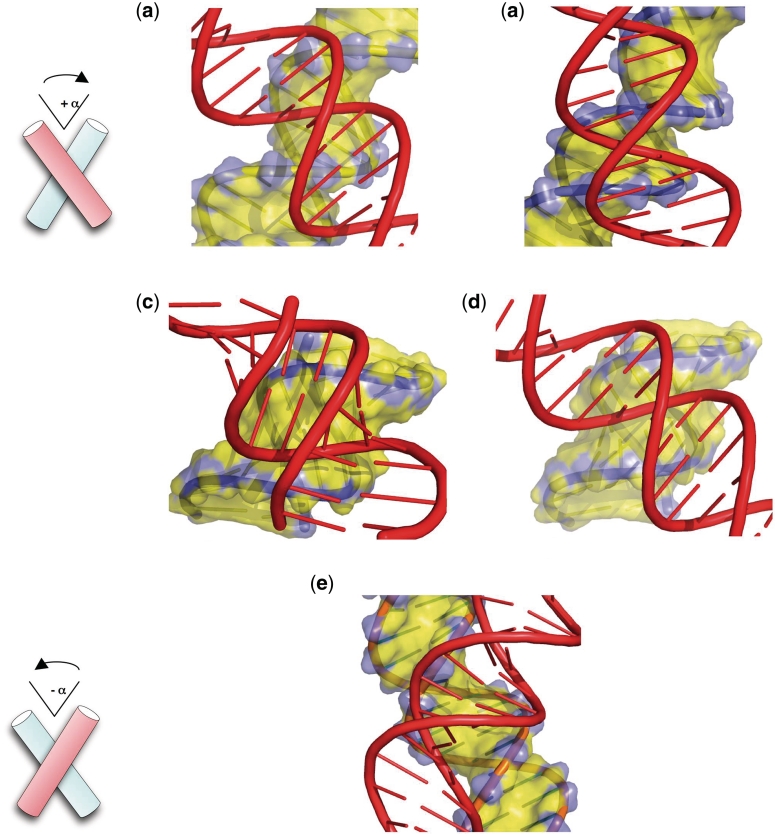
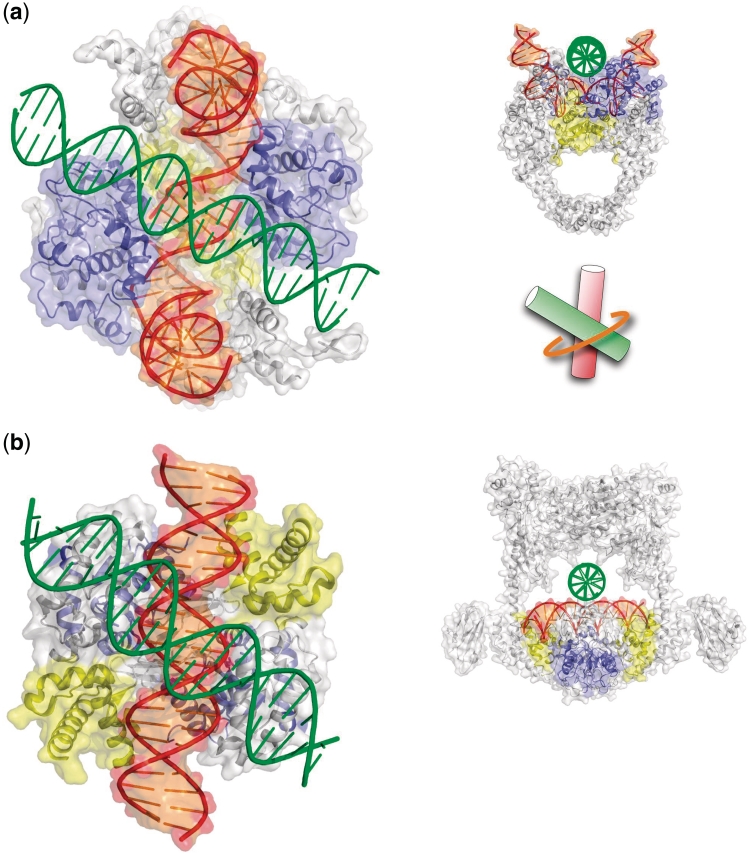
Type II topoisomerases are ubiquitous enzymes that control the topology and higher order structures of DNA. Type IIA enzymes have the remarkable property to sense locally the global DNA topology. Although many theoretical models have been proposed, the molecular mechanism of chiral discrimination is still unclear. While experimental studies have established that topoisomerases IIA discriminate topology on the basis of crossover geometry, a recent single-molecule experiment has shown that the enzyme has a different processivity on supercoiled DNA of opposite sign. Understanding how cross-over geometry influences enzyme processivity is, therefore, the key to elucidate the mechanism of chiral discrimination. Analysing this question from the DNA side reveals first, that the different stability of chiral DNA cross-overs provides a way to locally sense the global DNA topology. Second, it shows that these enzymes have evolved to recognize the G- and T-segments stably assembled into a right-handed cross-over. Third, it demonstrates how binding right-handed cross-overs across their large angle imposes a different topological link between the topoIIA rings and the plectonemes of opposite sign thus directly affecting the enzyme freedom of motion and processivity. In bridging geometry and kinetic data, this study brings a simple solution for type IIA topoisomerase chiral discrimination.
II 型拓扑异构酶是普遍存在的酶,可控制 DNA 的拓扑结构和高级结构。II 型 A 酶具有感知局部全局 DNA 拓扑结构的显著特性。尽管已经提出了许多理论模型,但手性识别的分子机制仍不清楚。虽然实验研究已经证实拓扑异构酶 IIA 基于交叉几何形状来区分拓扑结构,但最近的一项单分子实验表明,该酶在相反符号的超螺旋 DNA 上具有不同的延伸能力。因此,理解交叉几何形状如何影响酶的延伸能力是阐明手性识别机制的关键。从 DNA 方面分析这个问题首先表明,手性 DNA 交叉的不同稳定性提供了一种局部感知全局 DNA 拓扑结构的方法。其次,它表明这些酶已经进化到能够稳定地识别组装成右手交叉的 G 和 T 片段。第三,它展示了如何在其大角度处结合右手交叉会在相反符号的拓扑环和扭曲之间产生不同的拓扑联系,从而直接影响酶的运动自由度和延伸能力。通过桥接几何形状和动力学数据,这项研究为 II 型 A 拓扑异构酶手性识别提供了一个简单的解决方案。