Department of Biochemistry and Molecular Biology, Bloomberg School of Public Health, School of Medicine, Johns Hopkins University, Baltimore, Maryland 21205, USA.
Mol Reprod Dev. 2011 Oct-Nov;78(10-11):769-77. doi: 10.1002/mrd.21358. Epub 2011 Jul 19.
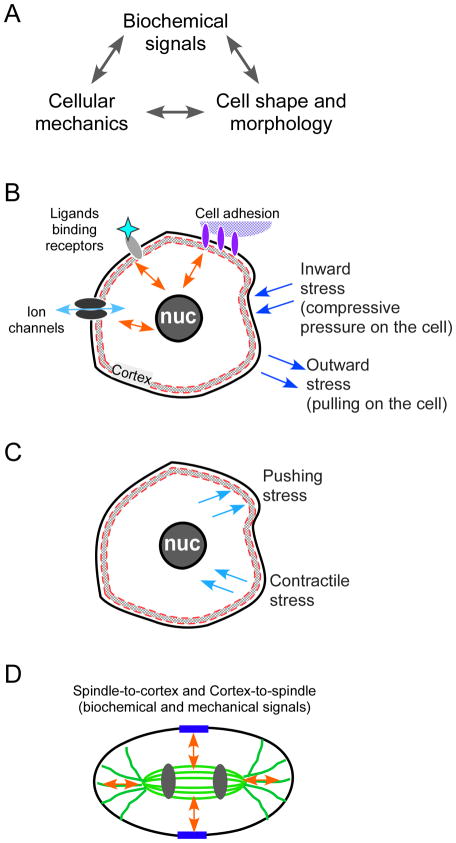
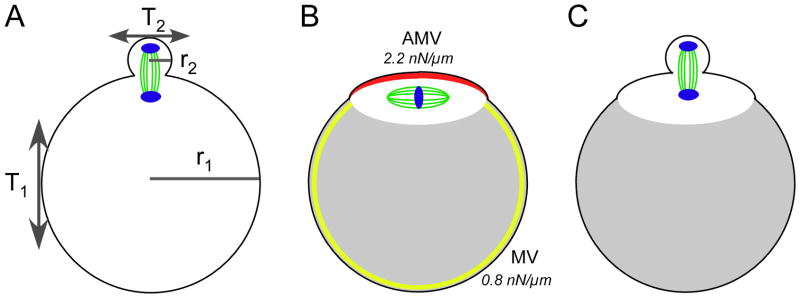
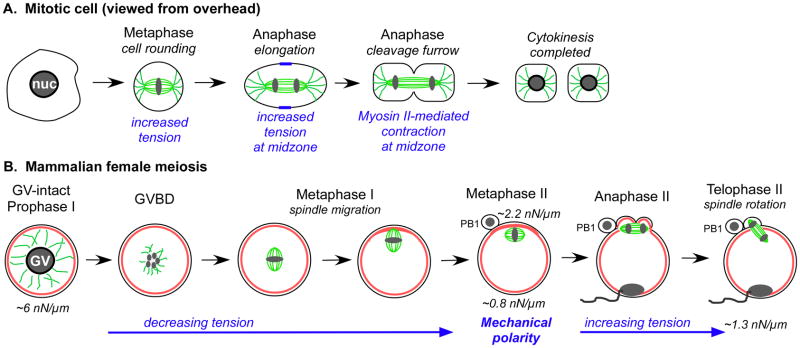
Recent work shows that cytokinesis and other cellular morphogenesis events are tuned by an interplay among biochemical signals, cell shape, and cellular mechanics. In cytokinesis, this includes cross-talk between the cortical cytoskeleton and the mitotic spindle in coordination with cell cycle control, resulting in characteristic changes in cellular morphology and mechanics through metaphase and cytokinesis. The changes in cellular mechanics affect not just overall cell shape, but also mitotic spindle morphology and function. This review will address how these principles apply to oocytes undergoing the asymmetric cell divisions of meiosis I and II. The biochemical signals that regulate cell cycle timing during meiotic maturation and egg activation are crucial for temporal control of meiosis. Spatial control of the meiotic divisions is also important, ensuring that the chromosomes are segregated evenly and that meiotic division is clearly asymmetric, yielding two daughter cells - oocyte and polar body - with enormous volume differences. In contrast to mitotic cells, the oocyte does not undergo overt changes in cell shape with its progression through meiosis, but instead maintains a relatively round morphology with the exception of very localized changes at the time of polar body emission. Placement of the metaphase-I and -II spindles at the oocyte periphery is clearly important for normal polar body emission, although this is likely not the only control element. Here, consideration is given to how cellular mechanics could contribute to successful mammalian female meiosis, ultimately affecting egg quality and competence to form a healthy embryo.
最近的研究表明,细胞分裂和其他细胞形态发生事件是由生化信号、细胞形状和细胞力学之间的相互作用来调节的。在细胞分裂过程中,这包括皮质细胞骨架和有丝分裂纺锤体之间的交叉对话,与细胞周期控制协调,导致细胞形态和力学特征在中期和细胞分裂过程中发生变化。细胞力学的变化不仅影响整体细胞形状,还影响有丝分裂纺锤体的形态和功能。这篇综述将讨论这些原则如何适用于经历减数分裂 I 和 II 不对称细胞分裂的卵母细胞。调节减数成熟和卵子激活期间细胞周期时间的生化信号对于减数分裂的时间控制至关重要。减数分裂分裂的空间控制也很重要,确保染色体均匀分离,减数分裂明显不对称,产生两个具有巨大体积差异的子细胞——卵母细胞和极体。与有丝分裂细胞不同,卵母细胞在减数分裂过程中不会明显改变细胞形状,而是保持相对圆形的形态,除了在极体排放时非常局部的变化。中期-I 和 -II 纺锤体在卵母细胞周围的位置显然对正常极体排放很重要,尽管这可能不是唯一的控制因素。这里考虑了细胞力学如何有助于成功的哺乳动物雌性减数分裂,最终影响卵子质量和形成健康胚胎的能力。