Structural Genomics Laboratory, Bioinformatics and Genomics Department, Centro de Investigación Príncipe Felipe, Valencia, Spain.
PLoS Comput Biol. 2011 Jul;7(7):e1002125. doi: 10.1371/journal.pcbi.1002125. Epub 2011 Jul 14.
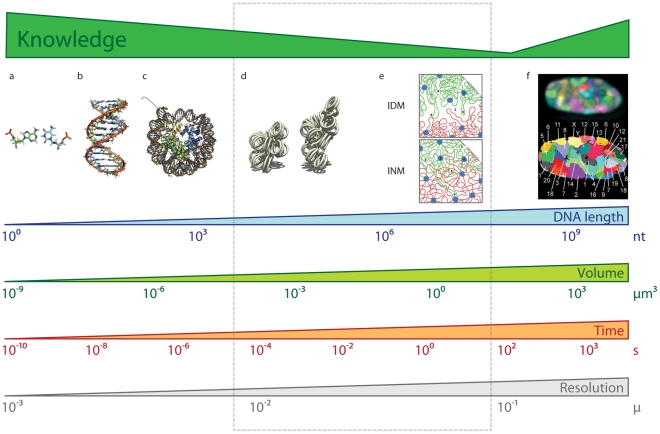
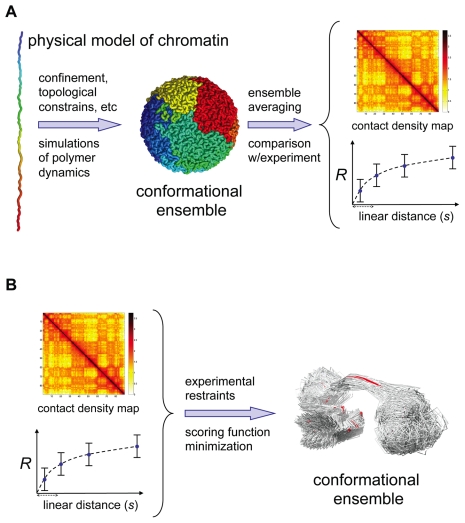
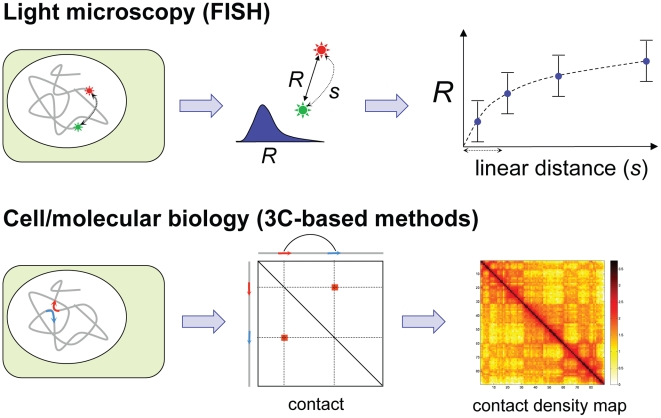
Over the last decade, and especially after the advent of fluorescent in situ hybridization imaging and chromosome conformation capture methods, the availability of experimental data on genome three-dimensional organization has dramatically increased. We now have access to unprecedented details of how genomes organize within the interphase nucleus. Development of new computational approaches to leverage this data has already resulted in the first three-dimensional structures of genomic domains and genomes. Such approaches expand our knowledge of the chromatin folding principles, which has been classically studied using polymer physics and molecular simulations. Our outlook describes computational approaches for integrating experimental data with polymer physics, thereby bridging the resolution gap for structural determination of genomes and genomic domains.
在过去的十年中,特别是在荧光原位杂交成像和染色体构象捕获方法出现之后,关于基因组三维结构的实验数据显著增加。我们现在可以前所未有地详细了解基因组在间期核内的组织方式。利用这些数据开发新的计算方法已经导致了基因组和基因组域的第一个三维结构。这些方法扩展了我们对染色质折叠原则的认识,这些原则在经典上是使用聚合物物理和分子模拟来研究的。我们的展望描述了将实验数据与聚合物物理相结合的计算方法,从而弥合了基因组和基因组域结构测定的分辨率差距。