University of South Carolina, MSW, Columbia, SC 29208, USA.
Soc Sci Med. 2011 Sep;73(5):663-7. doi: 10.1016/j.socscimed.2011.06.031. Epub 2011 Jul 19.
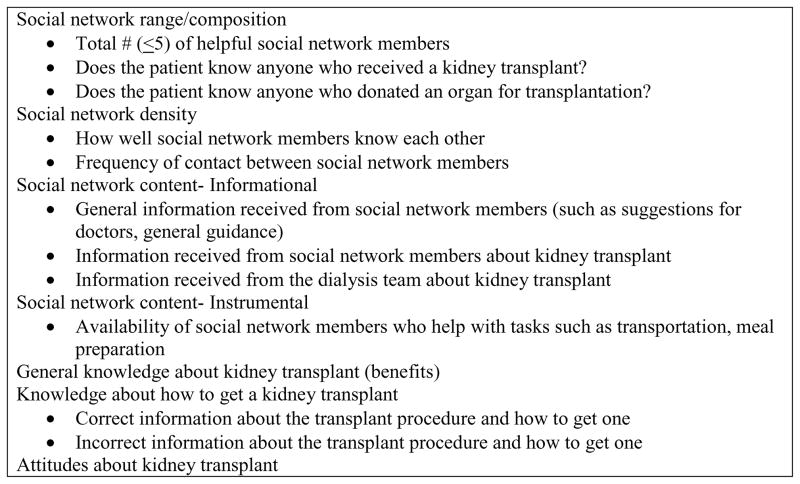
Research has shown that black dialysis patients in the United States are significantly less likely than their white peers to be evaluated and listed for a kidney transplant. Extrapolating from social-network theory, I hypothesize that a lack of access to social contacts with information about kidney transplantation may hinder information transaction regarding the benefits of, and pathway to, transplantation. In 2007-2008, the following research questions were addressed in an investigation in Chicago, USA: (1) What is the role of social networks in providing information about kidney transplantation to black hemodialysis patients? (2) What is the relationship between social networks and a patient's likelihood of being seen at a kidney transplant center? From a stratified sample of dialysis units in the area, a purposive sample of 228 black patients was surveyed while they received treatment about their social networks and kidney transplant status. It was found that the odds of black hemodialysis patients being seen at a kidney transplant center increase with income, and patients who have people in their social network with information about kidney transplant were significantly more likely to be seen at a kidney transplant center. Specifically, black dialysis patients who get informational social support from their dialysis team and social networks were significantly more likely to be seen at kidney transplant centers. I conclude that considering black dialysis patients' social milieu can be complementary to the existing research regarding this public health crisis.
研究表明,美国的黑人透析患者接受肾脏移植评估和列入名单的可能性明显低于他们的白人同龄人。从社交网络理论推断,我假设缺乏与肾脏移植相关信息的社交接触可能会阻碍有关移植的益处和途径的信息交易。2007-2008 年,在美国芝加哥进行的一项调查中,解决了以下研究问题:(1)社交网络在为黑人血液透析患者提供有关肾脏移植的信息方面发挥什么作用?(2)社交网络与患者在肾脏移植中心接受治疗的可能性之间存在什么关系?从该地区的透析单位分层样本中,对 228 名接受治疗的黑人患者进行了一项有针对性的调查,了解他们的社交网络和肾脏移植状况。结果发现,黑人血液透析患者在肾脏移植中心接受治疗的几率随着收入的增加而增加,而社交网络中有肾脏移植相关信息的患者在肾脏移植中心接受治疗的可能性显著更高。具体来说,从透析团队和社交网络中获得信息支持的黑人透析患者在肾脏移植中心接受治疗的几率显著更高。我得出结论,考虑到黑人透析患者的社会环境,可以作为解决这一公共卫生危机的现有研究的补充。