Institute of Basic Medical Sciences of Chinese Academy of Medical Sciences/School of Basic Medicine of Peking Union Medical College, Beijing, China.
Popul Health Metr. 2011 Aug 4;9:37. doi: 10.1186/1478-7954-9-37.
In 2004, the media repeatedly reported water pollution and "cancer villages" along the Huai River in China. Due to the lack of death records for more than 30 years, a retrospective survey of causes of death using verbal autopsy was carried out to investigate cancer rates in this area.
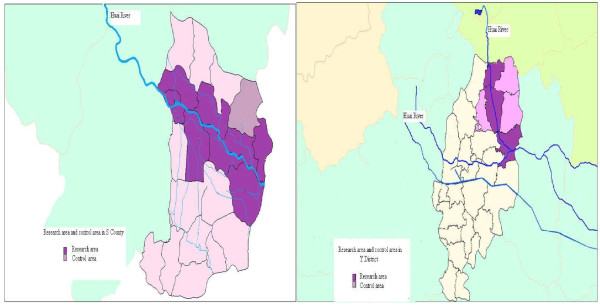
An epidemiologic study was designed to compare numbers of deaths and causes of death between the study areas with water pollution and the control areas without water pollution in S County and Y District in 2005. The study areas were selected based on the distribution of the Huai River and its tributaries. Verbal autopsy was used to assist cause of death (COD) diagnoses and to verify mortality rates. The standard mortality rates (SMRs) of cancer in the study area were compared with those in the control areas. In order to verify the difference between mortality rates due to cancers in the study and the control areas, patients who reported having cancer in the survey received a second diagnosis by national and provincial oncologists with pathological and laboratory examinations. Comparisons were made to determine if differential cancer prevalence rates in the study and control areas were similar to the difference in mortality due to cancer in these study and control areas. Mortality rates of cancers in study and control areas were also compared with national statistics for the rural population of China.
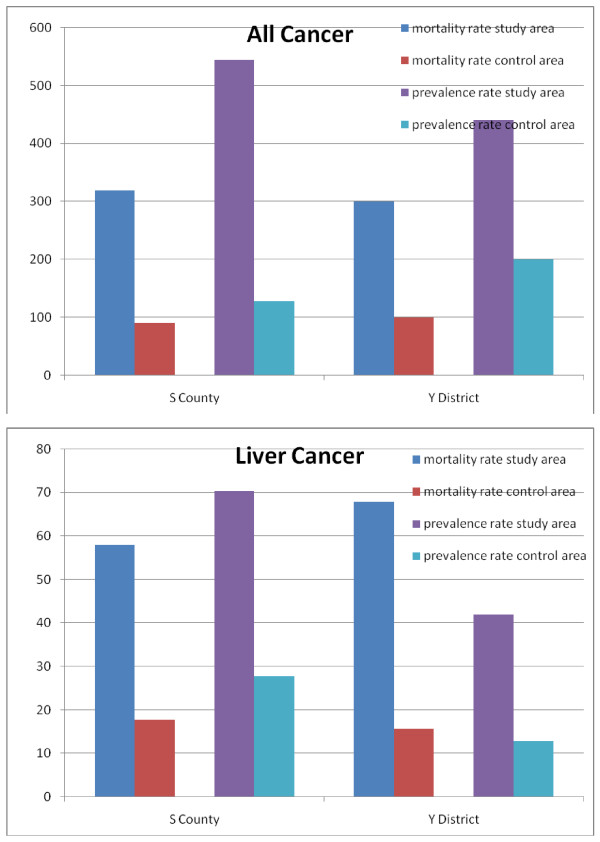
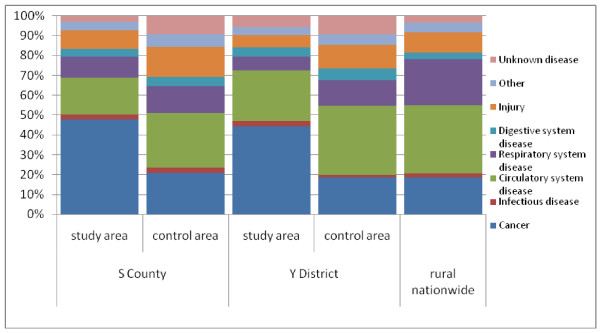
Over five years, 3,301 deaths were identified, including 1,158 cancer deaths. The annual average SMRs of cancer in the study areas of S County and Y District were 277.8/100,000 and 223.6/100,000, respectively, which is three to four times higher than those in the control areas. In addition, a total of 626 cases of cancer in the study and control areas were confirmed. The prevalence rates of cancer were 545/100,000 and 128.1/100,000 per year in the study and control areas in S County, respectively, and 440.9/100,000 and 200/100,000 per year in the study and control areas in Y District, respectively. The mortality and prevalence rates of digestive cancers were higher in the study areas than the control areas. In 2000, the SMR for cancer in rural areas nationwide was 120.9/100,000, and in study areas in S County and Y District, the excess rates of deaths were 184/100,000 and 138.8/100,000, respectively.
The death rates of digestive cancers were much higher in the study areas of S County and Y District. The patterns for between-area differences in prevalence and mortality rates of cancer were similar. Verbal autopsy is shown to be a useful tool in retrospective mortality surveys in low-resource areas with limited access to health care.
2004 年,媒体多次报道中国淮河流域水污染和“癌症村”问题。由于缺乏 30 多年来的死亡记录,因此采用死因回顾性调查(使用口述尸检)对该地区的癌症发病率进行了调查。
设计了一项流行病学研究,以比较 2005 年 S 县和 Y 区水污染研究区与无水污染对照区的死亡人数和死因。根据淮河及其支流的分布选择研究区。使用口述尸检协助死因(COD)诊断并验证死亡率。将研究区的癌症标准死亡率(SMR)与对照区进行比较。为了验证研究区和对照区癌症死亡率的差异,对调查中报告患有癌症的患者进行了国家和省级肿瘤学家的二次诊断,包括病理和实验室检查。比较确定研究和对照区癌症患病率的差异是否与这些研究和对照区癌症死亡率的差异相似。还将研究和对照区的癌症死亡率与中国农村人口的全国统计数据进行了比较。
五年间共发现 3301 例死亡,其中 1158 例死于癌症。S 县和 Y 区研究区的癌症年平均 SMR 分别为 277.8/100,000 和 223.6/100,000,是对照区的三到四倍。此外,共确诊研究区和对照区的癌症病例 626 例。S 县研究区和对照区的癌症年患病率分别为 545/100,000 和 128.1/100,000,Y 区研究区和对照区的癌症年患病率分别为 440.9/100,000 和 200/100,000。研究区消化系统癌症的死亡率和患病率均高于对照区。2000 年,全国农村地区癌症的 SMR 为 120.9/100,000,S 县和 Y 区的超额死亡率分别为 184/100,000 和 138.8/100,000。
S 县和 Y 区研究区消化系统癌症的死亡率要高得多。癌症发病率和死亡率的地区间差异模式相似。口述尸检被证明是一种在医疗资源有限的低资源地区进行回顾性死亡率调查的有用工具。