Klemm William R
College of Veterinary Medicine & Biomedical Sciences, Texas A&M University, Texas.
Adv Cogn Psychol. 2011;7:16-30. doi: 10.2478/v10053-008-0084-2. Epub 2011 Jul 20.
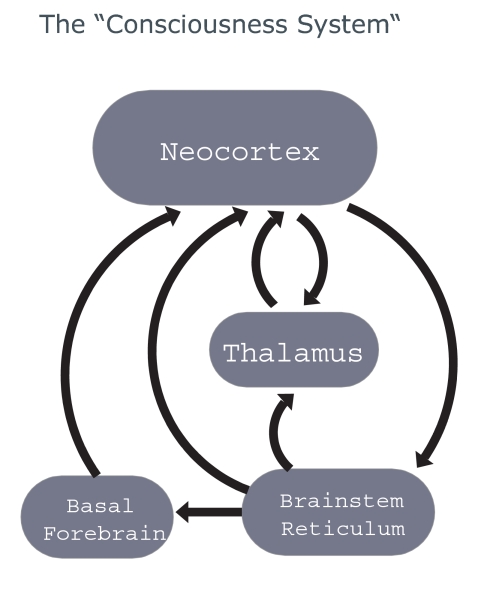
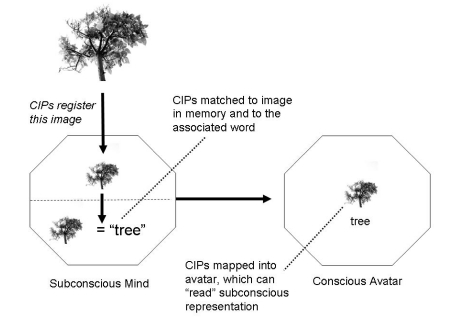
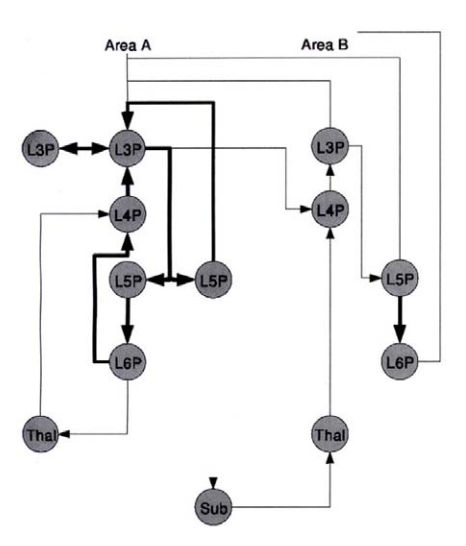
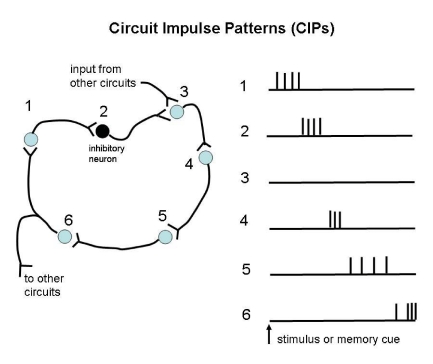
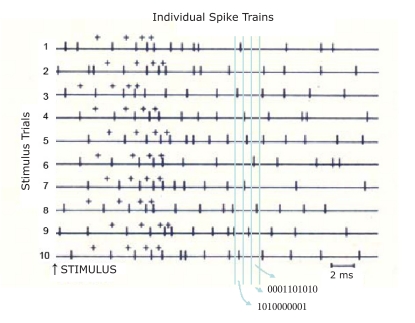
The brain constructs representations of what is sensed and thought about in the form of nerve impulses that propagate in circuits and network assemblies (Circuit Impulse Patterns, CIPs). CIP representations of which humans are consciously aware occur in the context of a sense of self. Thus, research on mechanisms of consciousness might benefit from a focus on how a conscious sense of self is represented in brain. Like all senses, the sense of self must be contained in patterns of nerve impulses. Unlike the traditional senses that are registered by impulse flow in relatively simple, pauci-synaptic projection pathways, the sense of self is a system- level phenomenon that may be generated by impulse patterns in widely distributed complex and interacting circuits. The problem for researchers then is to identify the CIPs that are unique to conscious experience. Also likely to be of great relevance to constructing the representation of self are the coherence shifts in activity timing relations among the circuits. Consider that an embodied sense of self is generated and contained as unique combinatorial temporal patterns across multiple neurons in each circuit that contributes to constructing the sense of self. As with other kinds of CIPs, those representing the sense of self can be learned from experience, stored in memory, modified by subsequent experiences, and expressed in the form of decisions, choices, and commands. These CIPs are proposed here to be the actual physical basis for conscious thought and the sense of self. When active in wakefulness or dream states, the CIP representations of self act as an agent of the brain, metaphorically as an avatar. Because the selfhood CIP patterns may only have to represent the self and not directly represent the inner and outer worlds of embodied brain, the self representation should have more degrees of freedom than subconscious mind and may therefore have some capacity for a free-will mind of its own. S everal lines of evidence for this theory are reviewed. Suggested new research includes identifying distinct combinatorially coded impulse patterns and their temporal coherence shifts in defined circuitry, such as neocortical microcolumns. This task might be facilitated by identifying the micro-topography of field-potential oscillatory coherences among various regions and between different frequencies associated with specific conscious mentation. Other approaches can include identifying the changes in discrete conscious operations produced by focal trans-cranial magnetic stimulation.
大脑以在回路和网络组件中传播的神经冲动(回路冲动模式,CIPs)的形式构建所感知和思考内容的表征。人类有意识觉知的CIP表征出现在自我感的背景下。因此,关于意识机制的研究可能会受益于关注大脑中自我意识是如何被表征的。与所有感觉一样,自我感必须包含在神经冲动模式中。与通过相对简单的少突触投射通路中的冲动流记录的传统感觉不同,自我感是一种系统层面的现象,可能由广泛分布的复杂且相互作用的回路中的冲动模式产生。那么研究人员面临的问题是识别有意识体验所特有的CIPs。回路之间活动时间关系的相干性变化也可能与构建自我表征密切相关。考虑到具身化的自我感是作为跨每个有助于构建自我感的回路中多个神经元的独特组合时间模式而产生和包含的。与其他类型的CIPs一样,那些代表自我感的可以从经验中学习,存储在记忆中,被后续经验修改,并以决策、选择和命令的形式表达。这里提出这些CIPs是有意识思维和自我感的实际物理基础。当在清醒或梦境状态下活跃时,自我的CIP表征就像大脑的一个代理,比喻为一个化身。由于自我CIP模式可能只需要表征自我,而不必直接表征具身化大脑的内在和外在世界,自我表征应该比潜意识思维有更多的自由度,因此可能有一定能力拥有自己的自由意志思维。本文回顾了支持该理论的几条证据线索。建议的新研究包括识别定义回路(如新皮质微柱)中不同的组合编码冲动模式及其时间相干性变化。通过识别与特定有意识思维相关的不同区域之间以及不同频率之间的场电位振荡相干性的微地形,这项任务可能会更容易。其他方法可以包括识别局灶性经颅磁刺激产生的离散有意识操作的变化。