Thailand-Japan Zoonotic Diseases Collaborating Center (ZDCC), Kasetklang, Chatuchak, Bangkok, Thailand.
PLoS One. 2011;6(8):e23103. doi: 10.1371/journal.pone.0023103. Epub 2011 Aug 3.
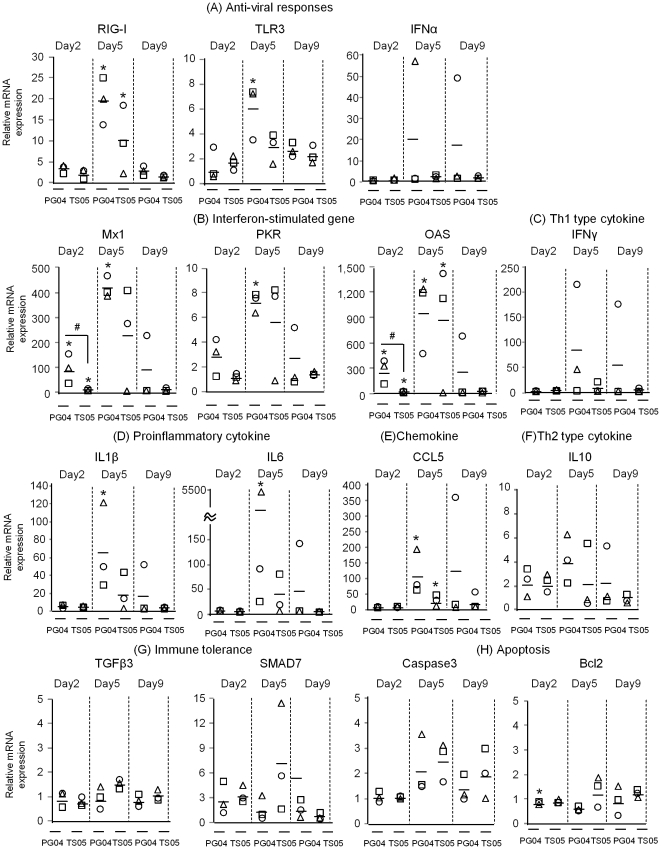
Highly pathogenic avian influenza virus (HPAIV) of the H5N1 subtype has been reported to infect pigeons asymptomatically or induce mild symptoms. However, host immune responses of pigeons inoculated with HPAIVs have not been well documented. To assess host responses of pigeons against HPAIV infection, we compared lethality, viral distribution and mRNA expression of immune related genes of pigeons infected with two HPAIVs (A/Pigeon/Thailand/VSMU-7-NPT/2004; Pigeon04 and A/Tree sparrow/Ratchaburi/VSMU-16-RBR/2005; T.sparrow05) isolated from wild birds in Thailand. The survival experiment showed that 25% of pigeons died within 2 weeks after the inoculation of two HPAIVs or medium only, suggesting that these viruses did not cause lethal infection in pigeons. Pigeon04 replicated in the lungs more efficiently than T.sparrow05 and spread to multiple extrapulmonary organs such as the brain, spleen, liver, kidney and rectum on days 2, 5 and 9 post infection. No severe lesion was observed in the lungs infected with Pigeon04 as well as T.sparrow05 throughout the collection periods. Encephalitis was occasionally observed in Pigeon04- or T.sparrow05-infected brain, the severity, however was mostly mild. To analyze the expression of immune-related genes in the infected pigeons, we established a quantitative real-time PCR analysis for 14 genes of pigeons. On day 2 post infection, Pigeon04 induced mRNA expression of Mx1, PKR and OAS to a greater extent than T.sparrow05 in the lungs, however their expressions were not up-regulated concomitantly on day 5 post infection when the peak viral replication was observed. Expressions of TLR3, IFNα, IL6, IL8 and CCL5 in the lungs following infection with the two HPAIVs were low. In sum, Pigeon04 exhibited efficient replication in the lungs compared to T.sparrow05, but did not induce excessive host cytokine expressions. Our study has provided the first insight into host immune responses of pigeons against HPAIV infection.
高致病性禽流感病毒(HPAIV)H5N1 亚型已被报道可无症状感染鸽子或引起轻微症状。然而,接种 HPAIV 的鸽子的宿主免疫反应尚未得到很好的记录。为了评估鸽子对 HPAIV 感染的宿主反应,我们比较了来自泰国野生鸟类的两种 HPAIV(A/鸽子/泰国/VSMU-7-NPT/2004;鸽子 04 和 A/树麻雀/拉差布里/VSMU-16-RBR/2005;T.麻雀 05)感染鸽子的致死率、病毒分布和免疫相关基因的 mRNA 表达。生存实验表明,接种两种 HPAIV 或仅接种培养基后,25%的鸽子在 2 周内死亡,这表明这些病毒不会导致鸽子致命感染。鸽子 04 在肺部的复制效率高于 T.麻雀 05,在感染后第 2、5 和 9 天传播到多个肺外器官,如大脑、脾脏、肝脏、肾脏和直肠。在整个采集期内,感染鸽子 04 和 T.麻雀 05 的肺部均未观察到严重病变。偶尔在感染鸽子 04 或 T.麻雀 05 的大脑中观察到脑炎,但严重程度大多较轻。为了分析感染鸽子的免疫相关基因的表达,我们建立了鸽子 14 个基因的定量实时 PCR 分析。感染后第 2 天,鸽子 04 在肺部诱导 Mx1、PKR 和 OAS 的 mRNA 表达比 T.麻雀 05 更明显,但在观察到病毒复制峰值的第 5 天,它们的表达并没有同时上调。感染后肺部 TLR3、IFNα、IL6、IL8 和 CCL5 的表达较低。总之,与 T.麻雀 05 相比,鸽子 04 在肺部表现出高效复制,但未诱导过度的宿主细胞因子表达。我们的研究首次提供了鸽子对 HPAIV 感染的宿主免疫反应的见解。