School of Humanities and Informatics, University of Skövde Skövde, Sweden.
Front Psychol. 2011 Jan 27;1:243. doi: 10.3389/fpsyg.2010.00243. eCollection 2010.
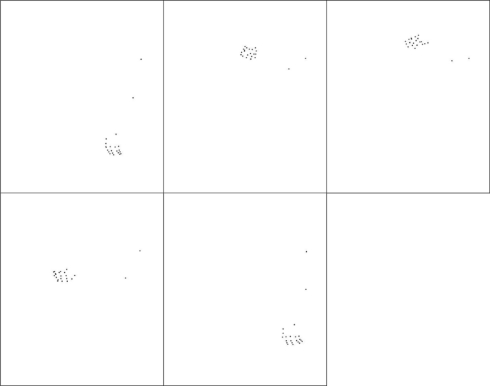
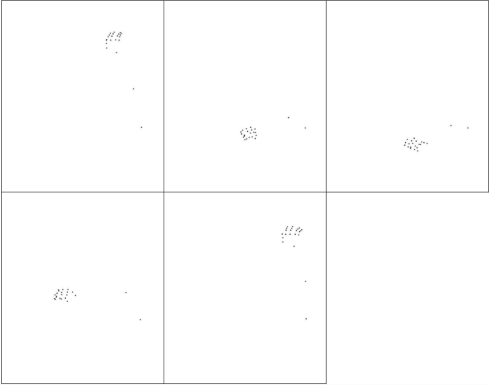
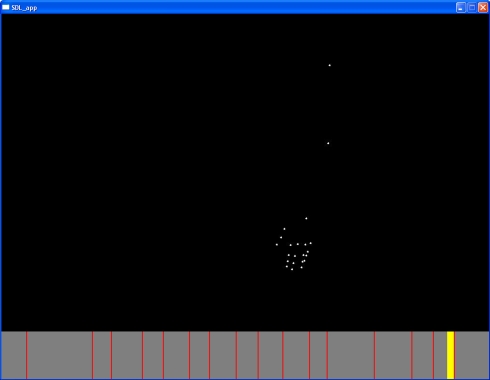
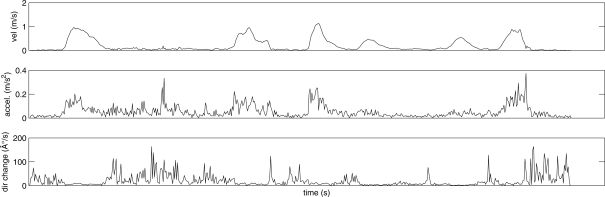
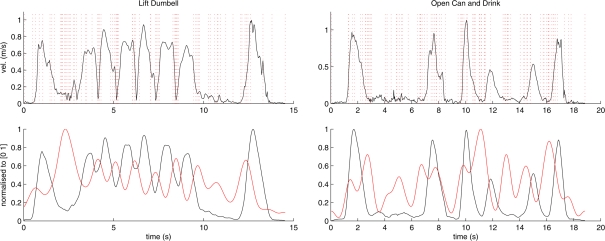
The purpose of the present experiment is to further understand the effect of levels of processing (top-down vs. bottom-up) on the perception of movement kinematics and primitives for grasping actions in order to gain insight into possible primitives used by the mirror system. In the present study, we investigated the potential of identifying such primitives using an action segmentation task. Specifically, we investigated whether or not segmentation was driven primarily by the kinematics of the action, as opposed to high-level top-down information about the action and the object used in the action. Participants in the experiment were shown 12 point-light movies of object-centered hand/arm actions that were either presented in their canonical orientation together with the object in question (top-down condition) or upside down (inverted) without information about the object (bottom-up condition). The results show that (1) despite impaired high-level action recognition for the inverted actions participants were able to reliably segment the actions according to lower-level kinematic variables, (2) segmentation behavior in both groups was significantly related to the kinematic variables of change in direction, velocity, and acceleration of the wrist (thumb and finger tips) for most of the included actions. This indicates that top-down activation of an action representation leads to similar segmentation behavior for hand/arm actions compared to bottom-up, or local, visual processing when performing a fairly unconstrained segmentation task. Motor primitives as parts of more complex actions may therefore be reliably derived through visual segmentation based on movement kinematics.
本实验旨在进一步了解加工水平(自上而下与自下而上)对运动运动学和抓握动作感知的影响,以便深入了解镜像系统可能使用的基元。在本研究中,我们调查了使用动作分割任务识别这些基元的可能性。具体来说,我们研究了分割是否主要是由动作的运动学驱动的,而不是关于动作和动作中使用的对象的高层自上而下的信息。实验中的参与者观看了 12 个以物体为中心的手/臂动作的光点电影,这些动作要么以其标准方向与所讨论的物体一起呈现(自上而下条件),要么颠倒(倒置)而没有关于物体的信息(自下而上条件)。结果表明:(1)尽管对倒置动作的高层动作识别受损,参与者仍能够根据较低层次的运动学变量可靠地分割动作;(2)两组的分割行为与手腕(拇指和指尖)方向变化、速度和加速度的运动学变量显著相关,对于大多数包含的动作。这表明,与执行相当不受限制的分割任务时的自上而下的动作表示或局部视觉处理相比,动作表示的自上而下激活会导致手/臂动作的类似分割行为。因此,运动基元作为更复杂动作的一部分,可以通过基于运动运动学的视觉分割可靠地推导出来。