Department of Social and Environmental Health Research, London School of Hygiene and Tropical Medicine, London, United Kingdom.
Environ Health Perspect. 2011 Dec;119(12):1817-23. doi: 10.1289/ehp.1003311. Epub 2011 Aug 15.
Global climate change is anticipated to reduce future cereal yields and threaten food security, thus potentially increasing the risk of undernutrition. The causation of undernutrition is complex, and there is a need to develop models that better quantify the potential impacts of climate change on population health.
We developed a model for estimating future undernutrition that accounts for food and nonfood (socioeconomic) causes and can be linked to available regional scenario data. We estimated child stunting attributable to climate change in five regions in South Asia and sub-Saharan Africa (SSA) in 2050.
We used current national food availability and undernutrition data to parameterize and validate a global model, using a process-driven approach based on estimations of the physiological relationship between a lack of food and stunting. We estimated stunting in 2050 using published modeled national calorie availability under two climate scenarios and a reference scenario (no climate change).
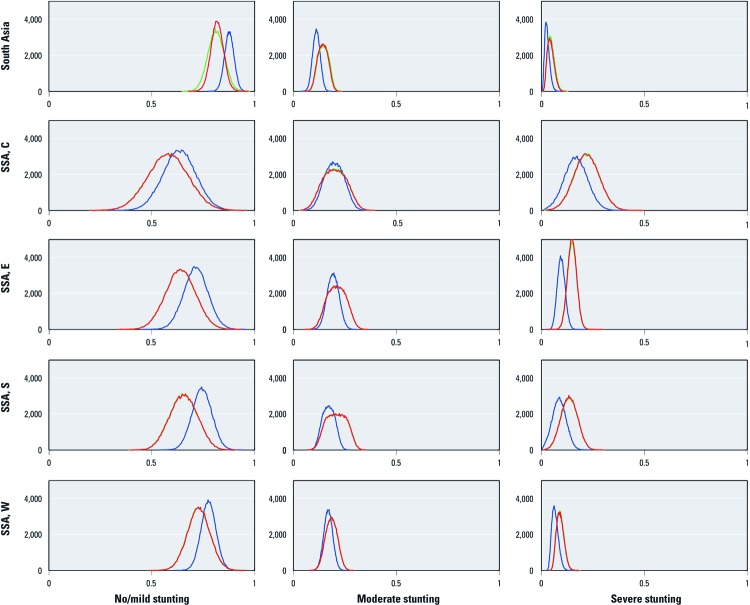
We estimated that climate change will lead to a relative increase in moderate stunting of 1-29% in 2050 compared with a future without climate change. Climate change will have a greater impact on rates of severe stunting, which we estimated will increase by 23% (central SSA) to 62% (South Asia).
Climate change is likely to impair future efforts to reduce child malnutrition in South Asia and SSA, even when economic growth is taken into account. Our model suggests that to reduce and prevent future undernutrition, it is necessary to both increase food access and improve socioeconomic conditions, as well as reduce greenhouse gas emissions.
预计全球气候变化将减少未来的谷物产量,威胁粮食安全,从而可能增加营养不足的风险。营养不足的原因很复杂,因此需要开发更好地量化气候变化对人口健康潜在影响的模型。
我们开发了一种估计未来营养不足的模型,该模型考虑了食物和非食物(社会经济)原因,并可以与可用的区域情景数据相联系。我们估计了 2050 年南亚和撒哈拉以南非洲(SSA)五个地区因气候变化导致的儿童发育迟缓。
我们使用当前的国家粮食供应和营养不足数据来参数化和验证一个全球模型,采用基于缺乏食物与发育迟缓之间生理关系估计的过程驱动方法。我们使用已发表的模型来估计在两种气候情景和一个参考情景(没有气候变化)下 2050 年的卡路里供应情况,并以此来估计 2050 年的发育迟缓情况。
我们估计,与没有气候变化的未来相比,气候变化将导致 2050 年中度发育迟缓的相对增长率增加 1-29%。气候变化对严重发育迟缓的影响更大,我们估计严重发育迟缓的增长率将增加 23%(中南部 SSA)至 62%(南亚)。
即使考虑到经济增长,气候变化也可能会影响南亚和 SSA 未来减少儿童营养不良的努力。我们的模型表明,要减少和预防未来的营养不足,不仅需要增加食物获取,还要改善社会经济条件,同时减少温室气体排放。