Unidad de Investigación en Epidemiología Clínica, Unidad Médica de Alta Especialidad UMAE Hospital de Pediatría, Centro Médico Nacional Siglo XXI, Instituto Mexicano de Seguridad Social, México DF, México.
BMC Cancer. 2011 Aug 17;11:355. doi: 10.1186/1471-2407-11-355.
Worldwide, acute leukemia is the most common type of childhood cancer. It is particularly common in the Hispanic populations residing in the United States, Costa Rica, and Mexico City. The objective of this study was to determine the incidence of acute leukemia in children who were diagnosed and treated in public hospitals in Mexico City.
Included in this study were those children, under 15 years of age and residents of Mexico City, who were diagnosed in 2006 and 2007 with leukemia, as determined by using the International Classification of Childhood Cancer. The average annual incidence rates (AAIR), and the standardized average annual incidence rates (SAAIR) per million children were calculated. We calculated crude, age- and sex-specific incidence rates and adjusted for age by the direct method with the world population as standard. We determined if there were a correlation between the incidence of acute leukemias in the various boroughs of Mexico City and either the number of agricultural hectares, the average number of persons per household, or the municipal human development index for Mexico (used as a reference of socio-economic level).
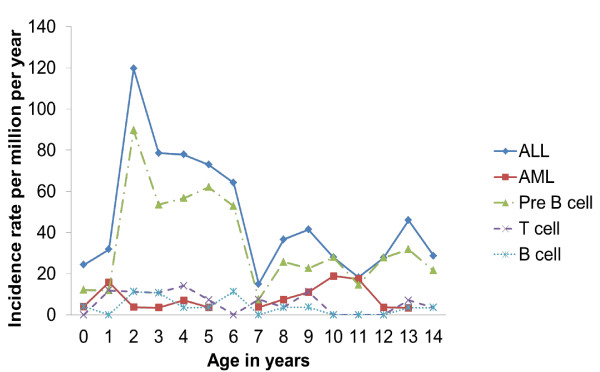
Although a total of 610 new cases of leukemia were registered during 2006-2007, only 228 fit the criteria for inclusion in this study. The overall SAAIR was 57.6 per million children (95% CI, 46.9-68.3); acute lymphoblastic leukemia (ALL) was the most frequent type of leukemia, constituting 85.1% of the cases (SAAIR: 49.5 per million), followed by acute myeloblastic leukemia at 12.3% (SAAIR: 6.9 per million), and chronic myeloid leukemia at 1.7% (SAAIR: 0.9 per million). The 1-4 years age group had the highest SAAIR for ALL (77.7 per million). For cases of ALL, 73.2% had precursor B-cell immunophenotype (SAAIR: 35.8 per million) and 12.4% had T-cell immunophenotype (SAAIR 6.3 per million). The peak ages for ALL were 2-6 years and 8-10 years. More than half the children (58.8%) were classified as high risk. There was a positive correlation between the average number of persons per household and the incidence of the pre-B immunophenotype (Pearson's r, 0.789; P = 0.02).
The frequency of ALL in Mexico City is among the highest in the world, similar to those found for Hispanics in the United States and in Costa Rica.
在全球范围内,急性白血病是儿童中最常见的癌症类型。它在美国、哥斯达黎加和墨西哥城的西班牙裔人群中尤为常见。本研究的目的是确定在墨西哥城公立医院诊断和治疗的儿童中急性白血病的发病率。
本研究纳入了 2006 年至 2007 年间在墨西哥城被诊断患有白血病的年龄在 15 岁以下的儿童,这些儿童通过国际儿童癌症分类法确定。计算了平均年发病率(AAIR)和每百万儿童标准化平均年发病率(SAAIR)。我们计算了粗发病率、年龄和性别特异性发病率,并通过世界人口作为标准进行了直接法年龄调整。我们确定了墨西哥城各行政区急性白血病的发病率与农业公顷数、每户平均人数或墨西哥市人类发展指数(用作社会经济水平的参考)之间是否存在相关性。
尽管 2006-2007 年共登记了 610 例新的白血病病例,但只有 228 例符合纳入本研究的标准。总体 SAAIR 为 57.6/百万儿童(95%CI:46.9-68.3);急性淋巴细胞白血病(ALL)是最常见的白血病类型,占病例的 85.1%(SAAIR:49.5/百万),其次是急性髓细胞白血病占 12.3%(SAAIR:6.9/百万),慢性髓细胞白血病占 1.7%(SAAIR:0.9/百万)。1-4 岁年龄组 ALL 的 SAAIR 最高(77.7/百万)。对于 ALL 病例,73.2%具有前 B 细胞免疫表型(SAAIR:35.8/百万),12.4%具有 T 细胞免疫表型(SAAIR:6.3/百万)。ALL 的发病高峰年龄为 2-6 岁和 8-10 岁。超过一半的儿童(58.8%)被归类为高危。每户平均人数与前 B 免疫表型的发病率呈正相关(皮尔逊相关系数,0.789;P=0.02)。
墨西哥城 ALL 的频率位居世界前列,与美国和哥斯达黎加的西班牙裔人群相似。