Department of Molecular Tropical Medicine and Genetics, Faculty of Tropical Medicine, Mahidol University, Bangkok, Thailand.
Malar J. 2011 Aug 31;10:253. doi: 10.1186/1475-2875-10-253.
In patients with malaria mixed species infections are common and under reported. In PCR studies conducted in Asia mixed infection rates often exceed 20%. In South-East Asia, approximately one third of patients treated for falciparum malaria experience a subsequent Plasmodium vivax infection with a time interval suggesting relapse. It is uncertain whether the two infections are acquired simultaneously or separately. To determine whether mixed species infections in humans are derived from mainly from simultaneous or separate mosquito inoculations the literature on malaria species infection in wild captured anopheline mosquitoes was reviewed.
The biomedical literature was searched for studies of malaria infection and species identification in trapped wild mosquitoes and artificially infected mosquitoes. The study location and year, collection methods, mosquito species, number of specimens, parasite stage examined (oocysts or sporozoites), and the methods of parasite detection and speciation were tabulated. The entomological results in South East Asia were compared with mixed infection rates documented in patients in clinical studies.
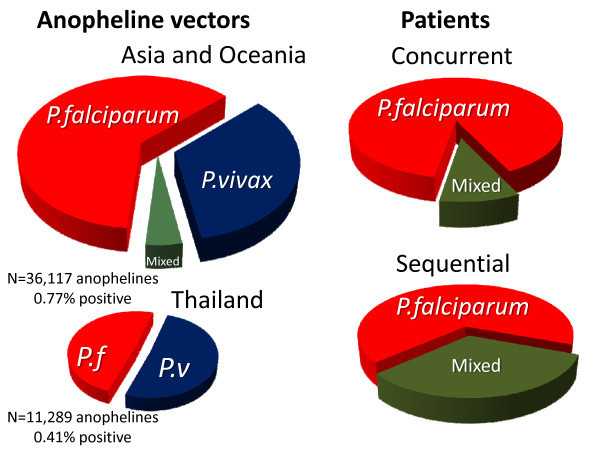
In total 63 studies were identified. Individual anopheline mosquitoes were examined for different malaria species in 28 of these. There were 14 studies from Africa; four with species evaluations in individual captured mosquitoes (SEICM). One study, from Ghana, identified a single mixed infection. No mixed infections were identified in Central and South America (seven studies, two SEICM). 42 studies were conducted in Asia and Oceania (11 from Thailand; 27 SEICM). The proportion of anophelines infected with Plasmodium falciparum parasites only was 0.51% (95% CI: 0.44 to 0.57%), for P. vivax only was 0.26% (95% CI: 0.21 to 0.30%), and for mixed P. falciparum and P. vivax infections was 0.036% (95% CI: 0.016 to 0.056%). The proportion of mixed infections in mosquitoes was significantly higher than expected by chance (P < 0.001), but was one fifth of that sufficient to explain the high rates of clinical mixed infections by simultaneous inoculation.
There are relatively few data on mixed infection rates in mosquitoes from Africa. Mixed species malaria infections may be acquired by simultaneous inoculation of sporozoites from multiply infected anopheline mosquitoes but this is relatively unusual. In South East Asia, where P. vivax infection follows P. falciparum malaria in one third of cases, the available entomological information suggests that the majority of these mixed species malaria infections are acquired from separate inoculations.
在疟疾混合物种感染的患者中,这种情况很常见,但报告的却很少。在亚洲进行的 PCR 研究中,混合感染率经常超过 20%。在东南亚,大约三分之一接受恶性疟原虫治疗的患者随后会感染间日疟原虫,这一时间间隔表明是复发。目前尚不确定这两种感染是同时发生还是分别发生的。为了确定人类的混合物种感染是否主要来自同时或单独的蚊子接种,我们回顾了有关野生捕获的按蚊中疟疾物种感染的文献。
在医学文献中搜索了有关捕获的野生蚊子和人工感染蚊子中的疟疾感染和物种鉴定的研究。列出了研究地点和年份、采集方法、蚊子种类、标本数量、检查的寄生虫阶段(卵囊或子孢子)以及寄生虫检测和分类的方法。将东南亚的昆虫学结果与临床研究中记录的患者混合感染率进行了比较。
共确定了 63 项研究。其中 28 项研究对单个按蚊进行了不同疟疾物种的检查。非洲有 14 项研究;其中 4 项对个体捕获的蚊子(SEICM)进行了物种评估。一项来自加纳的研究发现了一例单一的混合感染。中美洲和南美洲(7 项研究,2 项 SEICM)没有发现混合感染。亚洲和大洋洲共进行了 42 项研究(来自泰国的 11 项;27 项 SEICM)。感染恶性疟原虫寄生虫的按蚊比例为 0.51%(95%CI:0.44-0.57%),感染间日疟原虫的按蚊比例为 0.26%(95%CI:0.21-0.30%),感染混合性恶性疟原虫和间日疟原虫的按蚊比例为 0.036%(95%CI:0.016-0.056%)。蚊子中混合感染的比例明显高于随机预期(P<0.001),但仅为同时接种足以解释临床混合感染高率的五分之一。
关于非洲按蚊混合感染率的数据相对较少。混合物种疟疾感染可能是由感染了多种疟原虫的按蚊传播的子孢子同时接种引起的,但这种情况相对较少。在东南亚,三分之一的恶性疟原虫感染患者随后会感染间日疟原虫,现有的昆虫学信息表明,这些混合物种疟疾感染中的大多数是由单独接种引起的。