Departamento de Microbiologia y Parasitologia, Facultad de Medicina, Universidad Nacional Autónoma de México, México City, México.
PLoS One. 2011;6(8):e23467. doi: 10.1371/journal.pone.0023467. Epub 2011 Aug 19.
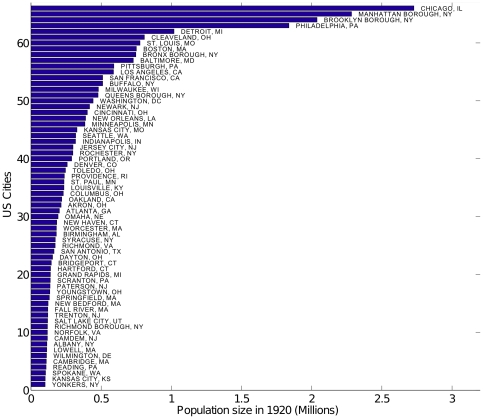
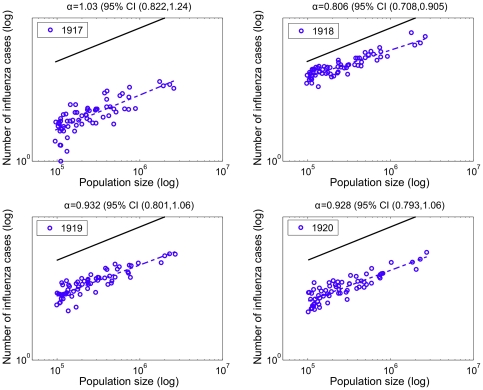
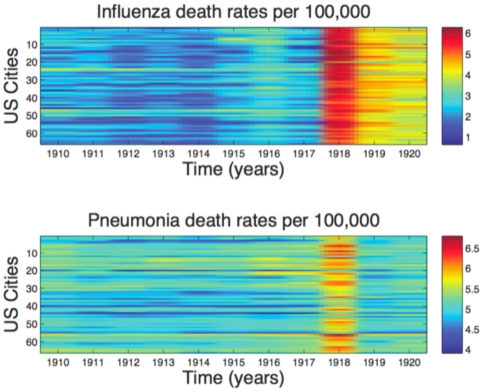
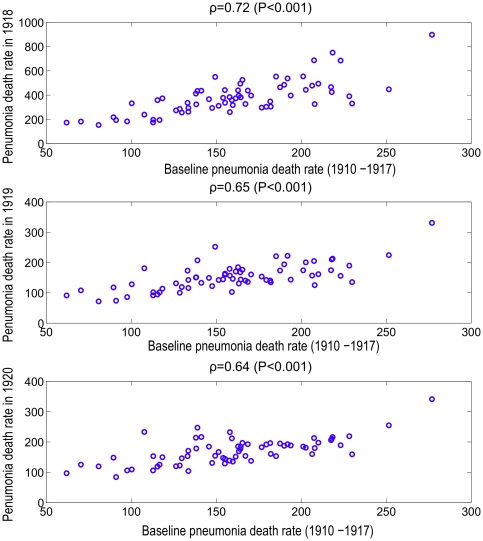
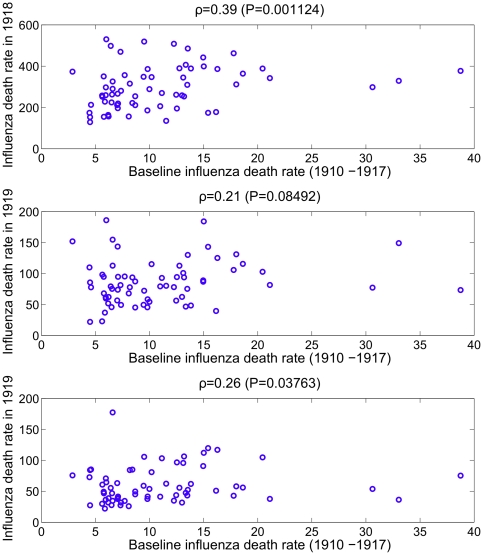
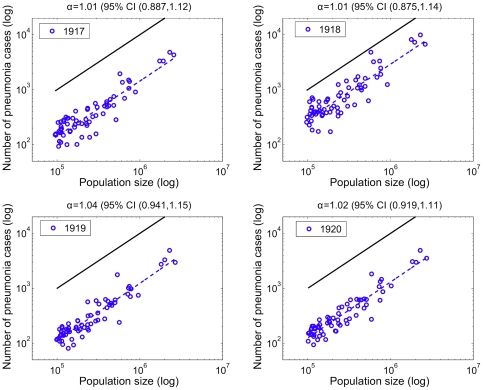
The 1918 influenza pandemic was a major epidemiological event of the twentieth century resulting in at least twenty million deaths worldwide; however, despite its historical, epidemiological, and biological relevance, it remains poorly understood. Here we examine the relationship between annual pneumonia and influenza death rates in the pre-pandemic (1910-17) and pandemic (1918-20) periods and the scaling of mortality with latitude, longitude and population size, using data from 66 large cities of the United States. The mean pre-pandemic pneumonia death rates were highly associated with pneumonia death rates during the pandemic period (Spearman ρ = 0.64-0.72; P<0.001). By contrast, there was a weak correlation between pre-pandemic and pandemic influenza mortality rates. Pneumonia mortality rates partially explained influenza mortality rates in 1918 (ρ = 0.34, P = 0.005) but not during any other year. Pneumonia death counts followed a linear relationship with population size in all study years, suggesting that pneumonia death rates were homogeneous across the range of population sizes studied. By contrast, influenza death counts followed a power law relationship with a scaling exponent of ∼0.81 (95%CI: 0.71, 0.91) in 1918, suggesting that smaller cities experienced worst outcomes during the pandemic. A linear relationship was observed for all other years. Our study suggests that mortality associated with the 1918-20 influenza pandemic was in part predetermined by pre-pandemic pneumonia death rates in 66 large US cities, perhaps through the impact of the physical and social structure of each city. Smaller cities suffered a disproportionately high per capita influenza mortality burden than larger ones in 1918, while city size did not affect pneumonia mortality rates in the pre-pandemic and pandemic periods.
1918 年流感大流行是 20 世纪的一次重大流行病学事件,导致全球至少 2000 万人死亡;然而,尽管它具有历史、流行病学和生物学意义,但人们对它的了解仍然很差。在这里,我们使用来自美国 66 个大城市的数据,研究了大流行前(1910-17 年)和大流行期间(1918-20 年)每年肺炎和流感死亡率与纬度、经度和人口规模的关系,以及死亡率随纬度、经度和人口规模的变化情况。大流行前的平均肺炎死亡率与大流行期间的肺炎死亡率高度相关(Spearman ρ=0.64-0.72;P<0.001)。相比之下,大流行前和大流行期间的流感死亡率相关性较弱。1918 年肺炎死亡率部分解释了流感死亡率(ρ=0.34,P=0.005),但其他年份则不然。在所有研究年份中,肺炎死亡人数与人口规模呈线性关系,这表明肺炎死亡率在研究的人口规模范围内是均匀的。相比之下,流感死亡人数与人口规模呈幂律关系,1918 年的标度指数约为 0.81(95%CI:0.71,0.91),这表明较小的城市在大流行期间遭受了更严重的后果。其他所有年份都观察到线性关系。我们的研究表明,1918-20 年流感大流行相关的死亡率部分由 66 个美国大城市大流行前的肺炎死亡率预先决定,这可能是通过每个城市的物理和社会结构的影响。1918 年,较小的城市比较大的城市遭受了不成比例的高人均流感死亡率负担,而城市规模在大流行前和大流行期间都没有影响肺炎死亡率。