Division of Health Behavior Research, School of Medicine, Washington University, St Louis, MO 63108, USA.
Health Psychol. 2011 Nov;30(6):674-82. doi: 10.1037/a0025395. Epub 2011 Sep 5.
Examine the longitudinal effects of personal narratives about mammography and breast cancer compared with a traditional informational approach.
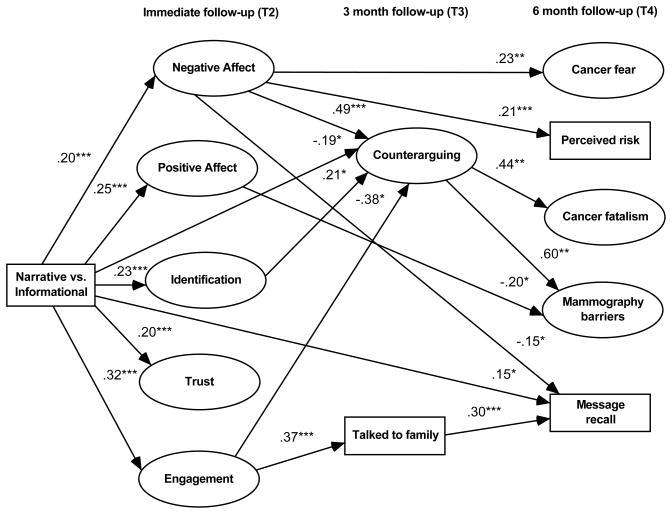
African American women (n = 489) ages 40 and older were recruited from low-income neighborhoods in St. Louis, Missouri, and randomized to watch a narrative video comprised of stories from African American breast cancer survivors or a content-equivalent informational video. Effects were measured immediately postexposure (T2) and at 3- (T3) and 6-month (T4) follow-up. T2 measures of initial reaction included positive and negative affect, trust, identification, and engagement. T3 message-processing variables included arguing against the messages (counterarguing) and talking to family members about the information (cognitive rehearsal). T4 behavioral correlates included perceived breast cancer risk, cancer fear, cancer fatalism, perceived barriers to mammography, and recall of core messages. Structural equation modeling examined interrelations among constructs.
Women who watched the narrative video (n = 244) compared to the informational video (n = 245) experienced more positive and negative affect, identified more with the message source, and were more engaged with the video. Narratives, negative affect, identification, and engagement influenced counterarguing, which, in turn, influenced perceived barriers and cancer fatalism. More engaged women talked with family members more, which increased message recall. Narratives also increased risk perceptions and fear via increased negative affect.
Narratives produced stronger cognitive and affective responses immediately, which, in turn, influenced message processing and behavioral correlates. Narratives reduced counterarguing and increased cognitive rehearsal, which may increase acceptance and motivation to act on health information in populations most adversely affected by cancer disparities.
研究与传统信息方法相比,关于乳房 X 光检查和乳腺癌的个人叙述的纵向效果。
从密苏里州圣路易斯的低收入社区招募了 489 名年龄在 40 岁及以上的非裔美国女性,并将她们随机分配观看由非裔美国乳腺癌幸存者的故事组成的叙述视频或内容等效的信息视频。在暴露后即刻(T2)以及 3 个月(T3)和 6 个月(T4)随访时测量效果。T2 的初始反应测量包括积极和消极情绪、信任、认同和参与。T3 的信息处理变量包括反驳信息(反驳)和与家人谈论信息(认知演练)。T4 的行为相关性包括感知的乳腺癌风险、癌症恐惧、癌症宿命论、感知的乳房 X 光检查障碍以及核心信息的回忆。结构方程模型检查了结构之间的相互关系。
与观看信息视频(n=245)的女性相比,观看叙述视频(n=244)的女性体验到更多的积极和消极情绪,与信息来源的认同感更强,对视频的参与度更高。叙述、消极情绪、认同和参与影响反驳,而反驳又影响感知的障碍和癌症宿命论。更投入的女性与家人交谈更多,从而增加了信息的回忆。叙述也通过增加负面情绪增加了风险感知和恐惧。
叙述立即产生更强的认知和情感反应,从而影响信息处理和行为相关性。叙述减少了反驳并增加了认知演练,这可能会增加最易受癌症差异影响的人群对健康信息的接受度和采取行动的动机。