INRA, Laboratoire des Interactions Plantes-Microorganismes (LIPM), UMR441, F-31326 Castanet-Tolosan, France.
CNRS, Laboratoire des Interactions Plantes-Microorganismes (LIPM), UMR2594, F-31326 Castanet-Tolosan, France.
New Phytol. 2011 Dec;192(4):976-987. doi: 10.1111/j.1469-8137.2011.03854.x. Epub 2011 Sep 8.
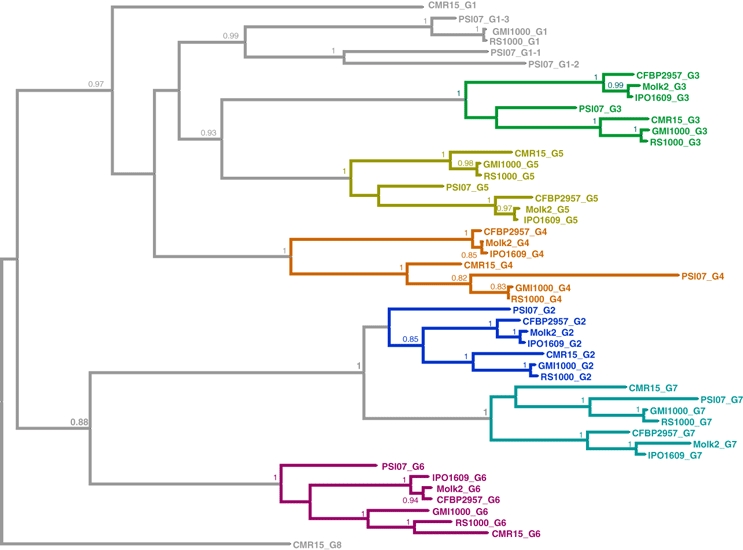
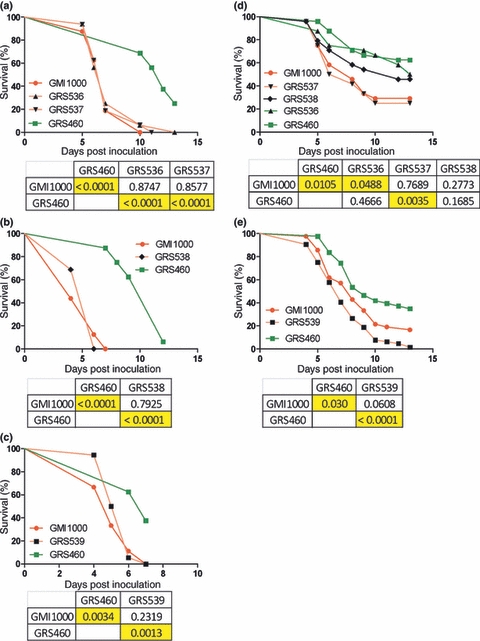
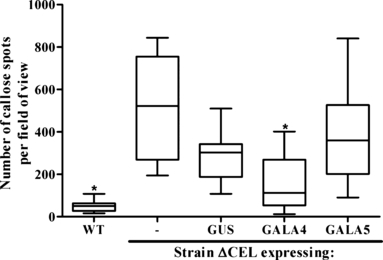
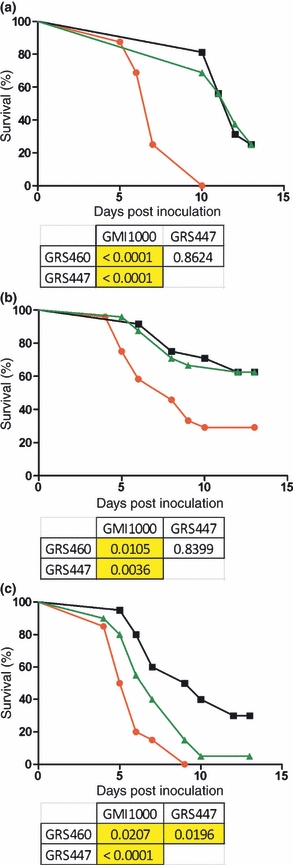
Type III effectors from phytopathogenic bacteria exhibit a high degree of functional redundancy, hampering the evaluation of their precise contribution to pathogenicity. This is illustrated by the GALA type III effectors from Ralstonia solanacearum, which have been shown to be collectively, but not individually, required for disease on Arabidopsis thaliana and tomato. We investigated evolution, redundancy and diversification of this family in order to understand the individual contribution of the GALA effectors to pathogenicity. From sequences available, we reconstructed GALA phylogeny and performed selection studies. We then focused on the GALAs from the reference strain GMI1000 to examine their ability to suppress plant defense responses and contribution to pathogenicity on three different host plants: A. thaliana, tomato (Lycopersicum esculentum) and eggplant (Solanum melongena). The GALA family is well conserved within R. solanacearum species. Patterns of selection detected on some GALA family members, together with experimental results, show that GALAs underwent functional diversification. We conclude that functional divergence of the GALA family likely accounts for its remarkable conservation during R. solanacearum evolution and could contribute to R. solanacearum's adaptation on several host plants.
III 型效应物来自植物病原菌表现出高度的功能冗余,这阻碍了对其致病性的确切贡献的评估。这可以通过 Ralstonia solanacearum 的 GALA III 型效应物来说明,它们被证明在拟南芥和番茄上共同但不是单独地对疾病有作用。我们研究了这个家族的进化、冗余和多样化,以了解 GALA 效应物对致病性的个体贡献。从现有的序列中,我们重建了 GALA 的系统发育,并进行了选择研究。然后,我们专注于参考菌株 GMI1000 中的 GALAs,以研究它们抑制植物防御反应的能力及其在三种不同宿主植物(拟南芥、番茄和茄子)上的致病性。GALA 家族在 R. solanacearum 种内高度保守。在一些 GALA 家族成员上检测到的选择模式,以及实验结果表明,GALAs 经历了功能多样化。我们得出结论,GALA 家族的功能分化可能解释了它在 R. solanacearum 进化过程中的显著保守性,并可能有助于 R. solanacearum 在几种宿主植物上的适应。