Department of Psychology, Barnwell College, University of South Carolina, Columbia, USA.
Am J Prev Med. 2011 Oct;41(4):399-406. doi: 10.1016/j.amepre.2011.06.037.
Few studies have examined environmental, home, and parental supports for physical activity in underserved adolescents (low income, ethnic minority). Given the increasing incidence of obesity in minority adolescents, it is important to better understand ecologic determinants of physical activity in these youth. This study used an ecologic model to evaluate the significance of neighborhood, home, and parental supports for physical activity on moderate-to-vigorous (MV) physical activity in underserved adolescents.
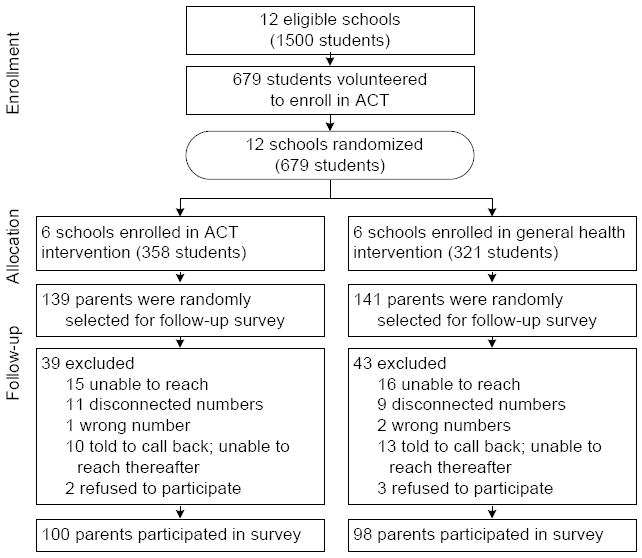
The study was a secondary data analysis of a randomized controlled school-based trial "Active by Choice Today" (ACT) for increasing physical activity in underserved sixth-graders. Schools were matched on school size, percentage minorities, percentage entitled to free or reduced-price lunch, and urban or rural setting prior to randomization. This study used a randomly selected sample of parents (n=280) from the intervention and control schools whose adolescent was enrolled in the larger trial.
SETTING/PARTICIPANTS: A total of 679 6th-grade students (mean age=11.4 years, 70% African-American, 76% free or reduced-price lunch, 52% female) participated in the larger trial. Parents of 280 youth were contacted to participate in a telephone survey and 198 (71%) took part in the study.
The ACT trial was designed to test the efficacy of a 17-week (1 academic year) motivational plus behavioral skills intervention versus comparison after-school programs on increasing physical activity. A telephone survey was developed and was administered within 6 months after the trial began on parents of 198 adolescents from the ACT randomized school-based trial during 2005-2007.
The primary outcome measure was adolescent MVPA based on 7-day accelerometry estimates from baseline to mid-intervention. The data were analyzed in 2010-2011 and included both parent and adolescent self-reports of environmental, home, and family supports for physical activity.
Regression analyses indicated a significant effect of parental and neighborhood supports for physical activity on adolescent MVPA. Adolescents who perceived higher (vs lower) levels of parental support for physical activity engaged in more minutes of MVPA (B=3.01, SE=1.38, p<0.05) at mid-intervention. Adolescents who lived in neighborhoods with more (vs fewer) supports for physical activity (parks, lighting), also engaged in more minutes MVPA (B=4.27, SE=2.15, p<0.05).
Support from parents and neighborhood quality are both associated with increased physical activity in underserved adolescents.
很少有研究调查过服务不足的青少年(低收入、少数民族)的身体活动的环境、家庭和父母支持。鉴于少数族裔青少年肥胖发病率的不断上升,了解这些青少年身体活动的生态决定因素非常重要。本研究采用生态模型评估邻里、家庭和父母支持对身体活动的重要性,以了解服务不足的青少年的适度至剧烈(MV)身体活动。
这项研究是一项名为“今天主动选择”(ACT)的针对服务不足的六年级学生增加身体活动的随机对照学校试验的二次数据分析。在随机分组之前,根据学校规模、少数民族比例、有资格获得免费或降价午餐的比例以及城市或农村环境对学校进行匹配。本研究随机抽取了干预和对照学校的父母(n=280)的样本,他们的青少年参加了更大规模的试验。
地点/参与者:共有 679 名六年级学生(平均年龄=11.4 岁,70%为非裔美国人,76%享受免费或降价午餐,52%为女性)参加了更大规模的试验。联系了 280 名青少年的家长参与电话调查,其中 198 名(71%)参加了研究。
ACT 试验旨在测试 17 周(1 个学年)动机加行为技能干预与比较课后计划对增加身体活动的功效。2005-2007 年期间,在 ACT 基于学校的随机试验中,为试验开始后 6 个月内的 198 名青少年的父母开发并进行了一项电话调查。
主要结果测量是青少年的 MVPA,根据基线至中期干预期间 7 天加速度计估计得出。数据分析于 2010-2011 年进行,包括父母和青少年对身体活动的环境、家庭和家庭支持的自我报告。
回归分析表明,父母和邻里对身体活动的支持对青少年的 MVPA 有显著影响。感知到父母对身体活动的支持水平较高(而非较低)的青少年在中期干预时的 MVPA 时间更长(B=3.01,SE=1.38,p<0.05)。居住在邻里环境中支持身体活动(公园、照明)较多的青少年的 MVPA 时间也更长(B=4.27,SE=2.15,p<0.05)。
父母和邻里质量的支持都与服务不足的青少年的身体活动增加有关。