Kenya Agricultural Research Institute, Veterinary Research Centre, P.O. Box 32, 00902 Kikuyu, Kenya.
Res Vet Sci. 2012 Oct;93(2):568-73. doi: 10.1016/j.rvsc.2011.08.020. Epub 2011 Oct 2.
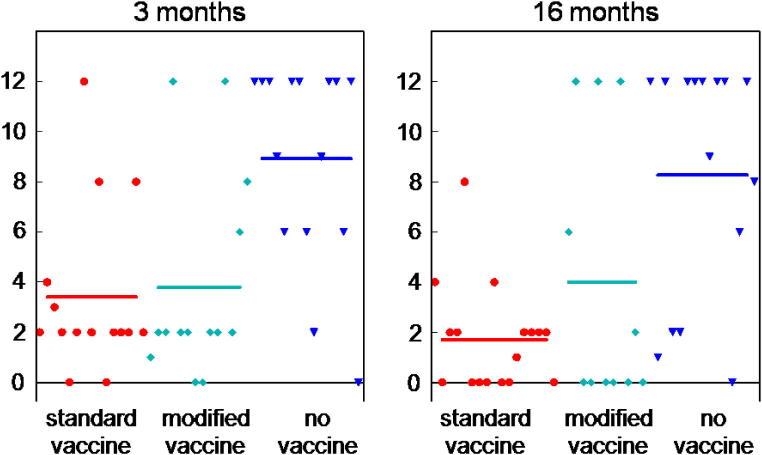
A live, attenuated vaccine is currently the only viable option to control of CBPP in Africa. It has been suggested that simple modifications to current vaccines and protocols might improve efficacy in the field. In this report we compared the current vaccine formulation with a buffered preparation that maintains Mycoplasma viability at ambient temperature for a longer time. Groups of animals were vaccinated with the two formulations and compared with non vaccinated groups. Half of the animals in each group were challenged 3 months post vaccination, the other half after 16 months. Protection levels were measured using the pathology index, calculated from post mortem scores of lesions from animals killed during the course of clinical disease. In the challenge at 3 months post vaccination, the protection levels were 52% and 77% for the modified and current vaccine preparations, respectively. At 16 months post vaccination, the protection levels were 56% and 62% for the modified and current vaccine preparations, respectively. These findings indicate that there are no differences in protection levels between the two vaccines. Because of its longer half life after reconstitution, the modified vaccine might be preferred in field situations where the reconstituted vaccine is likely not to be administered immediately.
目前,活毒减毒疫苗是控制非洲牛地方性肺炎的唯一可行选择。有人提出,对现有疫苗和方案进行简单修改,可能会提高其在现场的效果。在本报告中,我们将当前的疫苗配方与一种缓冲制剂进行了比较,该制剂在环境温度下可维持支原体更长时间的活力。将两组动物分别用两种制剂进行接种,并与未接种组进行比较。每组的一半动物在接种后 3 个月进行攻毒,另一半则在 16 个月后进行攻毒。通过对临床疾病过程中死亡动物的病变进行死后评分,计算病理指数来衡量保护水平。在接种后 3 个月的攻毒中,改良疫苗和现行疫苗制剂的保护水平分别为 52%和 77%。在接种后 16 个月时,改良疫苗和现行疫苗制剂的保护水平分别为 56%和 62%。这些发现表明,两种疫苗的保护水平没有差异。由于其在复水后半衰期更长,因此在现场情况下,改良疫苗可能更受欢迎,因为在现场情况下,复水后的疫苗可能不会立即使用。