University of Zurich, Pestalozzistrasse 24, Zurich, Switzerland.
Trials. 2011 Oct 11;12:221. doi: 10.1186/1745-6215-12-221.
Neovascular age-related macular degeneration is the leading cause of irreversible blindness in people 50 years of age or older in the developed world. As in other chronic diseases, several effective treatments are available, but in clinical daily practice there is an evidence performance gap. The Chronic Care Model represents an evidence-based framework for the care of chronically ill patients and aims at closing that gap. However, no data are available regarding patients with neovascular age-related macular degeneration.
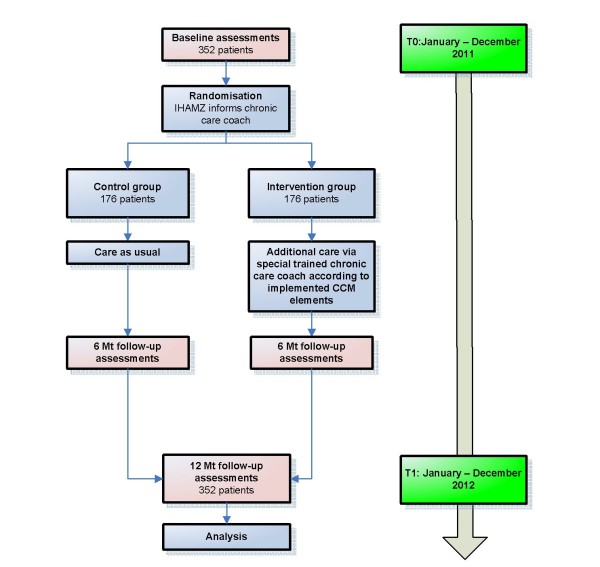
METHODS/DESIGN: CHARMED is a multicenter randomized controlled trial. The study challenges the hypothesis that the implementation of core elements of the Chronic Care Model (patient empowerment, delivering evidence based information, clinical information system, reminder system with structured follow up and frequent monitoring) via a specially trained Chronic Care Coach in Swiss centres for neovascular age-related macular degeneration results in better visual acuity (primary outcome) and an increased disease specific quality of life (secondary outcome) in patients with neovascular age-related macular degeneration. According to the power calculation, a total sample size of 352 patients is needed (drop out rate of 25%). 14 specialised medical doctors from leading ophtalmologic centres in Switzerland will include 25 patients. In each centre, a Chronic Care Coach will provide disease specific care according to the Chronic Care Model for intervention group. Patients from the control group will be treated as usual. Baseline measurements will be taken in month III - XII, starting in March 2011. Follow-up data will be collected after 6 months and 1 year.
Multiple studies have shown that implementing Chronic Care Model elements improve clinical outcomes as well as process parameters in different chronic diseases as osteoarthritis, depression or e.g. the cardiovascular risk profile of diabetes patients. This study will be the first to assess this approach in neovascular age-related macular degeneration. If our hypothesis will be confirmed, the implementation of this approach in routine care for patients with with neovascular age-related macular degeneration should be considered.
Current controlled trials ISRCTN32507927.
新生血管性年龄相关性黄斑变性是发达国家 50 岁及以上人群中导致不可逆性失明的主要原因。与其他慢性病一样,有多种有效的治疗方法,但在临床实践中存在证据执行差距。慢性病护理模式代表了一种针对慢性病患者护理的循证框架,旨在缩小这一差距。然而,尚无关于新生血管性年龄相关性黄斑变性患者的相关数据。
方法/设计:CHARMED 是一项多中心随机对照试验。该研究对以下假设提出了挑战,即通过在瑞士新生血管性年龄相关性黄斑变性中心专门培训的慢性病护理教练实施慢性病护理模式的核心要素(患者赋权、提供基于证据的信息、临床信息系统、带有结构化随访和频繁监测的提醒系统)是否会改善新生血管性年龄相关性黄斑变性患者的视力(主要结局)和疾病特异性生活质量(次要结局)。根据计算的效力,需要 352 名患者的总样本量(25%的脱落率)。瑞士领先的眼科中心的 14 名专科医生将纳入 25 名患者。在每个中心,慢性病护理教练将根据慢性病护理模式为干预组提供特定疾病的护理。对照组的患者将按照常规进行治疗。基线测量将在第 III 至第 XII 个月进行,从 2011 年 3 月开始。6 个月和 1 年后将收集随访数据。
多项研究表明,在不同的慢性病中,如骨关节炎、抑郁症或例如糖尿病患者的心血管风险特征,实施慢性病护理模式元素可以改善临床结局和过程参数。这项研究将是第一个评估这种方法在新生血管性年龄相关性黄斑变性中的应用。如果我们的假设得到证实,应考虑将这种方法应用于新生血管性年龄相关性黄斑变性患者的常规护理中。
当前对照试验 ISRCTN32507927。