Division of Clinical Neurosciences, University of Edinburgh, Edinburgh, United Kingdom.
PLoS One. 2011;6(10):e25829. doi: 10.1371/journal.pone.0025829. Epub 2011 Oct 4.
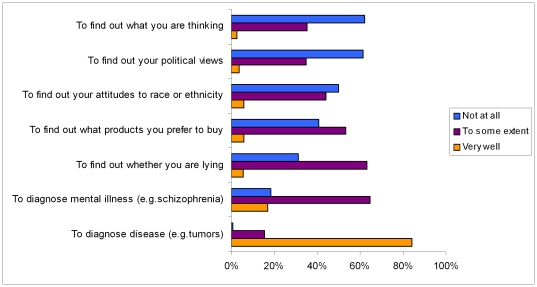
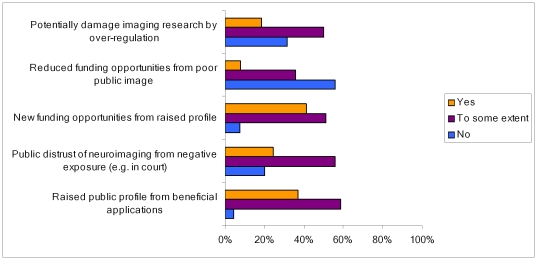
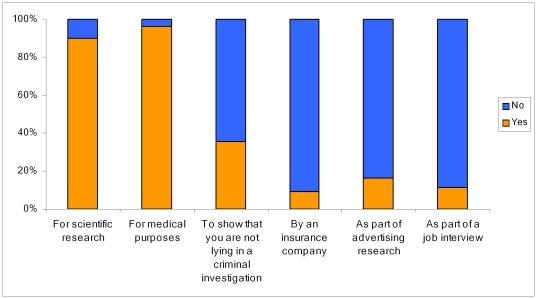
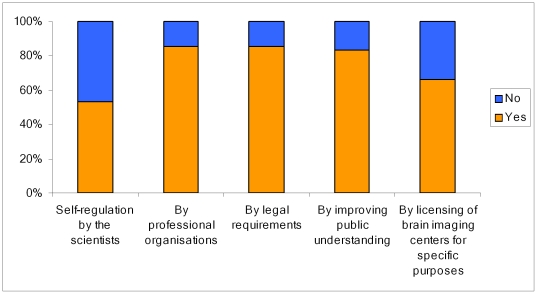
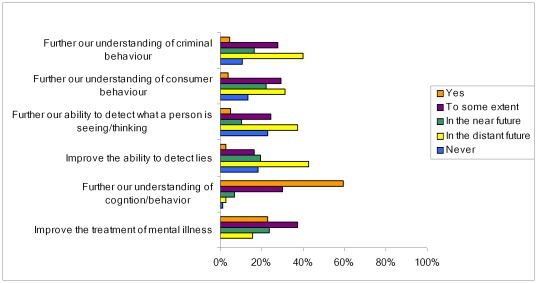
Emerging applications of neuroimaging outside medicine and science have received intense public exposure through the media. Media misrepresentations can create a gulf between public and scientific understanding of the capabilities of neuroimaging and raise false expectations. To determine the extent of this effect and determine public opinions on acceptable uses and the need for regulation, we designed an electronic survey to obtain anonymous opinions from as wide a range of members of the public and neuroimaging experts as possible. The surveys ran from 1(st) June to 30 September 2010, asked 10 and 21 questions, respectively, about uses of neuroimaging outside traditional medical diagnosis, data storage, science communication and potential methods of regulation. We analysed the responses using descriptive statistics; 660 individuals responded to the public and 303 individuals responded to the expert survey. We found evidence of public skepticism about the use of neuroimaging for applications such as lie detection or to determine consumer preferences and considerable disquiet about use by employers or government and about how their data would be stored and used. While also somewhat skeptical about new applications of neuroimaging, experts grossly underestimated how often neuroimaging had been used as evidence in court. Although both the public and the experts rated highly the importance of a better informed public in limiting the inappropriate uses to which neuroimaging might be put, opinions differed on the need for, and mechanism of, actual regulation. Neuroscientists recognized the risks of inaccurate reporting of neuroimaging capabilities in the media but showed little motivation to engage with the public. The present study also emphasizes the need for better frameworks for scientific engagement with media and public education.
神经影像学在医学和科学领域之外的新兴应用已经通过媒体得到了广泛的关注。媒体的不当表述可能会导致公众对神经影像学的能力产生误解,并引发不切实际的期望。为了确定这种影响的程度,并了解公众对可接受用途和监管需求的看法,我们设计了一项电子调查,以尽可能广泛地从公众和神经影像学专家中获取匿名意见。该调查于 2010 年 6 月 1 日至 9 月 30 日进行,分别就神经影像学在传统医学诊断、数据存储、科学传播以及潜在监管方法之外的用途提出了 10 个和 21 个问题。我们使用描述性统计方法对这些回答进行了分析;有 660 名公众和 303 名专家对公众和专家调查做出了回应。我们发现,公众对神经影像学在测谎或确定消费者偏好等应用中的使用存在怀疑,并且对雇主或政府的使用以及对他们的数据将如何存储和使用存在相当大的担忧。虽然专家们对神经影像学的新应用也持怀疑态度,但他们严重低估了神经影像学作为法庭证据的使用频率。尽管公众和专家都高度重视让公众更了解情况,以限制神经影像学可能被滥用的情况,但他们对监管的必要性和机制存在不同看法。神经科学家认识到媒体对神经影像学能力的不准确报道存在风险,但他们很少有动力与公众接触。本研究还强调了需要更好的科学与媒体互动和公众教育框架。