Niethammer Marc, Hart Gabriel L, Pace Danielle F, Vespa Paul M, Irimia Andrei, Van Horn John D, Aylward Stephen R
University of North Carolina (UNC), Chapel Hill NC 27599-3175, USA.
Med Image Comput Comput Assist Interv. 2011;14(Pt 2):639-46. doi: 10.1007/978-3-642-23629-7_78.
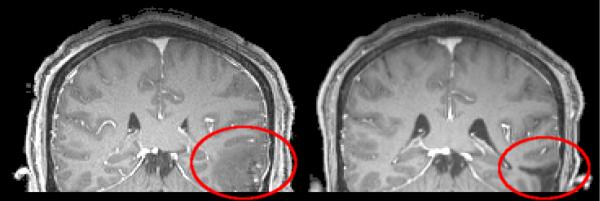
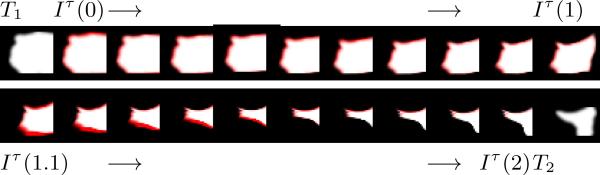
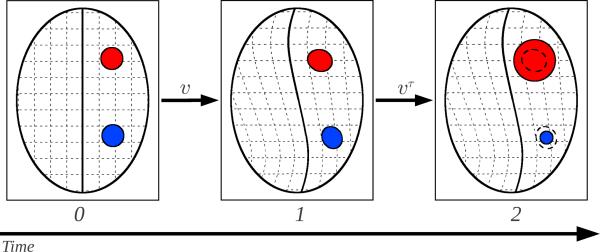
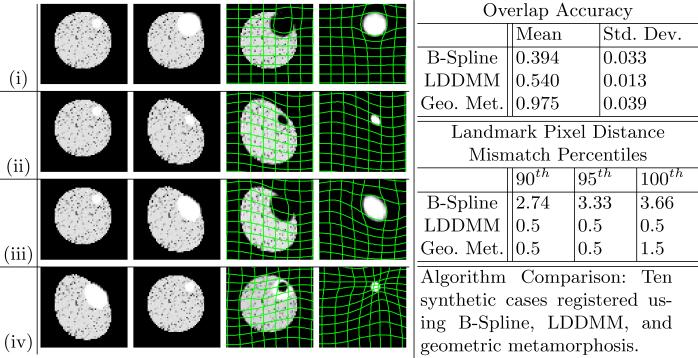
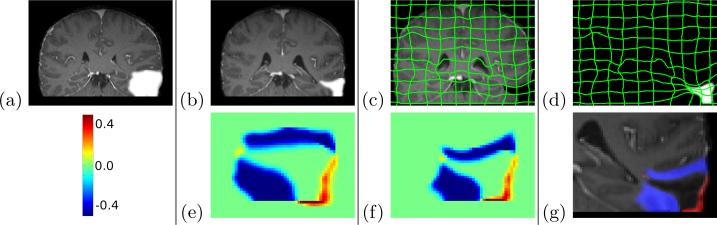
Standard image registration methods do not account for changes in image appearance. Hence, metamorphosis approaches have been developed which jointly estimate a space deformation and a change in image appearance to construct a spatio-temporal trajectory smoothly transforming a source to a target image. For standard metamorphosis, geometric changes are not explicitly modeled. We propose a geometric metamorphosis formulation, which explains changes in image appearance by a global deformation, a deformation of a geometric model, and an image composition model. This work is motivated by the clinical challenge of predicting the long-term effects of traumatic brain injuries based on time-series images. This work is also applicable to the quantification of tumor progression (e.g., estimating its infiltrating and displacing components) and predicting chronic blood perfusion changes after stroke. We demonstrate the utility of the method using simulated data as well as scans from a clinical traumatic brain injury patient.
标准的图像配准方法没有考虑图像外观的变化。因此,已经开发出了变形方法,该方法联合估计空间变形和图像外观变化,以构建将源图像平滑变换为目标图像的时空轨迹。对于标准变形,几何变化没有被明确建模。我们提出了一种几何变形公式,通过全局变形、几何模型的变形和图像合成模型来解释图像外观的变化。这项工作的动机来自于基于时间序列图像预测创伤性脑损伤长期影响的临床挑战。这项工作也适用于肿瘤进展的量化(例如,估计其浸润和移位成分)以及预测中风后的慢性血液灌注变化。我们使用模拟数据以及一名临床创伤性脑损伤患者的扫描结果证明了该方法的实用性。