Teagasc Food Research Centre, Moorepark, Fermoy, Co. Cork, Ireland.
Microb Cell Fact. 2011 Aug 30;10 Suppl 1(Suppl 1):S12. doi: 10.1186/1475-2859-10-S1-S12.
Lactobacillus ruminis is a poorly characterized member of the Lactobacillus salivarius clade that is part of the intestinal microbiota of pigs, humans and other mammals. Its variable abundance in human and animals may be linked to historical changes over time and geographical differences in dietary intake of complex carbohydrates.
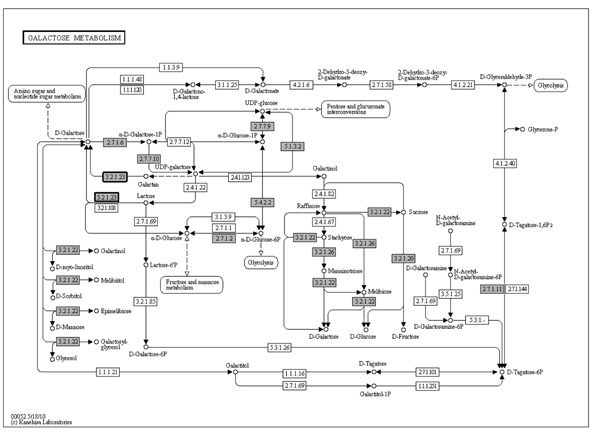
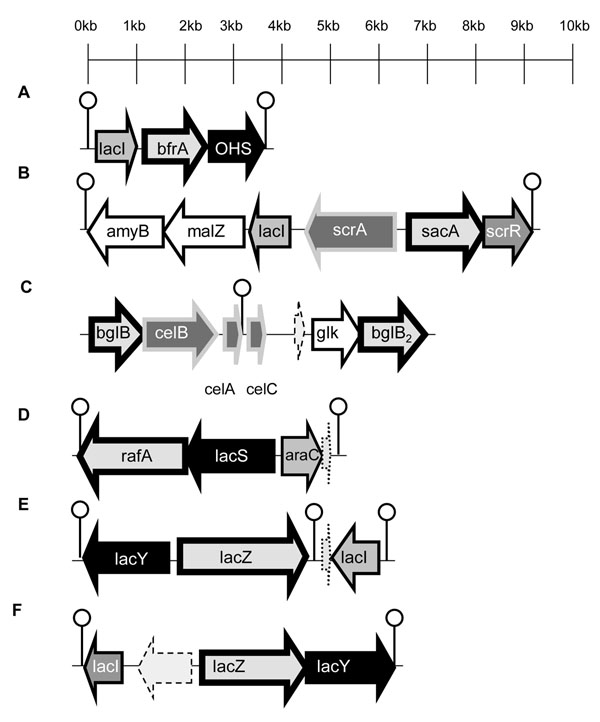
In this study, we investigated the ability of nine L. ruminis strains of human and bovine origin to utilize fifty carbohydrates including simple sugars, oligosaccharides, and prebiotic polysaccharides. The growth patterns were compared with metabolic pathways predicted by annotation of a high quality draft genome sequence of ATCC 25644 (human isolate) and the complete genome of ATCC 27782 (bovine isolate). All of the strains tested utilized prebiotics including fructooligosaccharides (FOS), soybean-oligosaccharides (SOS) and 1,3:1,4-β-D-gluco-oligosaccharides to varying degrees. Six strains isolated from humans utilized FOS-enriched inulin, as well as FOS. In contrast, three strains isolated from cows grew poorly in FOS-supplemented medium. In general, carbohydrate utilisation patterns were strain-dependent and also varied depending on the degree of polymerisation or complexity of structure. Six putative operons were identified in the genome of the human isolate ATCC 25644 for the transport and utilisation of the prebiotics FOS, galacto-oligosaccharides (GOS), SOS, and 1,3:1,4-β-D-Gluco-oligosaccharides. One of these comprised a novel FOS utilisation operon with predicted capacity to degrade chicory-derived FOS. However, only three of these operons were identified in the ATCC 27782 genome that might account for the utilisation of only SOS and 1,3:1,4-β-D-Gluco-oligosaccharides.
This study has provided definitive genome-based evidence to support the fermentation patterns of nine strains of Lactobacillus ruminis, and has linked it to gene distribution patterns in strains from different sources. Furthermore, the study has identified prebiotic carbohydrates with the potential to promote L. ruminis growth in vivo.
鼠李糖乳杆菌是唾液乳杆菌群中特征不明显的成员,是猪、人类和其他哺乳动物肠道微生物群的一部分。其在人类和动物中的丰度变化可能与其随时间的历史变化以及复杂碳水化合物饮食摄入的地理差异有关。
在这项研究中,我们研究了九个人源和牛源的鼠李糖乳杆菌菌株利用包括单糖、低聚糖和益生元多糖在内的五十种碳水化合物的能力。将生长模式与 ATCC 25644(人源分离株)的高质量草图基因组序列注释和 ATCC 27782(牛源分离株)的完整基因组预测的代谢途径进行了比较。所有测试的菌株都不同程度地利用了包括低聚果糖(FOS)、大豆低聚糖(SOS)和 1,3:1,4-β-D-葡糖低聚糖在内的益生元。六株从人类中分离的菌株利用了富含低聚果糖的菊粉和 FOS。相比之下,三株从奶牛中分离的菌株在添加 FOS 的培养基中生长不良。一般来说,碳水化合物的利用模式取决于菌株,也取决于聚合度或结构的复杂程度。在人源分离株 ATCC 25644 的基因组中,确定了六个用于 FOS、半乳糖低聚糖(GOS)、SOS 和 1,3:1,4-β-D-葡糖低聚糖的运输和利用的假定操纵子。其中一个包括用于降解菊苣衍生的 FOS 的新型 FOS 利用操纵子。然而,在 ATCC 27782 基因组中仅鉴定出三个这样的操纵子,这可能解释了其仅利用 SOS 和 1,3:1,4-β-D-葡糖低聚糖的原因。
本研究提供了明确的基于基因组的证据,支持了九株鼠李糖乳杆菌的发酵模式,并将其与不同来源菌株的基因分布模式联系起来。此外,该研究还鉴定了具有促进体内鼠李糖乳杆菌生长潜力的益生元碳水化合物。