Department of Surgery, Division of Surgical Oncology and Endocrine Surgery, University University Medical Center Utrecht, The Netherlands.
Cancer. 2012 Jul 1;118(13):3426-32. doi: 10.1002/cncr.26587. Epub 2011 Oct 17.
Approximately 30% of fine-needle aspiration (FNA) biopsies of thyroid nodules are indeterminate or nondiagnostic. Recent studies suggest microRNA (miRNA, miR) is differentially expressed in malignant tumors and may have a role in carcinogenesis, including thyroid cancer. The authors therefore tested the hypothesis that miRNA expression analysis would identify putative markers that could distinguish benign from malignant thyroid neoplasms that are often indeterminate on FNA biopsy.
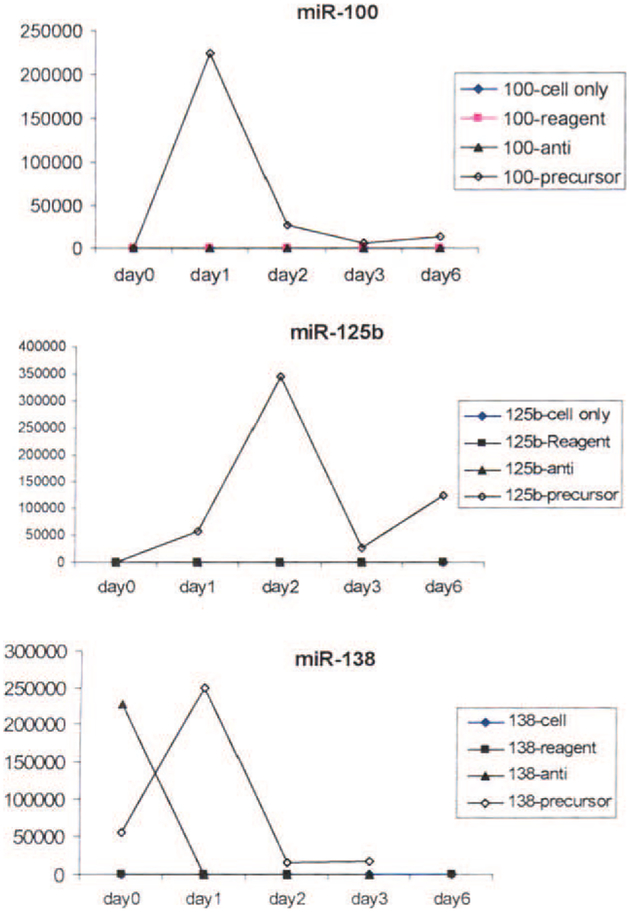
A miRNA array was used to identify differentially expressed genes (5-fold higher or lower) in pooled normal, malignant, and benign thyroid tissue samples. Real-time quantitative polymerase chain reaction was used to confirm miRNA array expression data in 104 tissue samples (7 normal thyroid, 14 hyperplastic nodule, 12 follicular variant of papillary thyroid cancer, 8 papillary thyroid cancer, 15 follicular adenoma, 12 follicular carcinoma, 12 Hurthle cell adenoma, 20 Hurthle cell carcinoma, and 4 anaplastic carcinoma cases), and 125 indeterminate clinical FNA samples. The diagnostic accuracy of differentially expressed genes was determined by analyzing receiver operating characteristics.
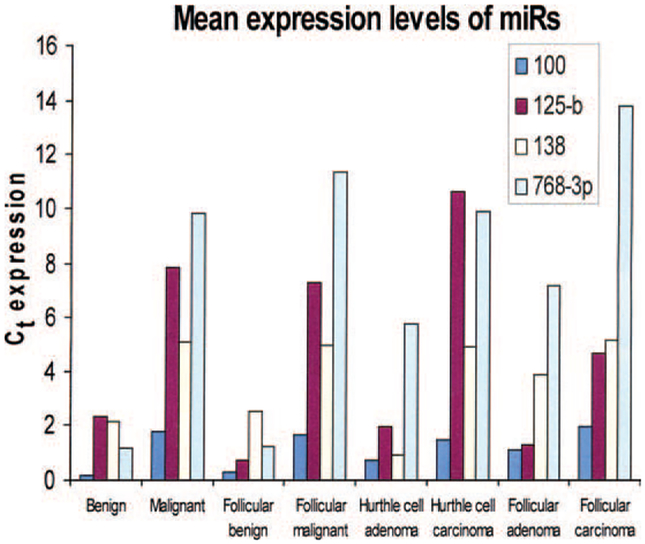
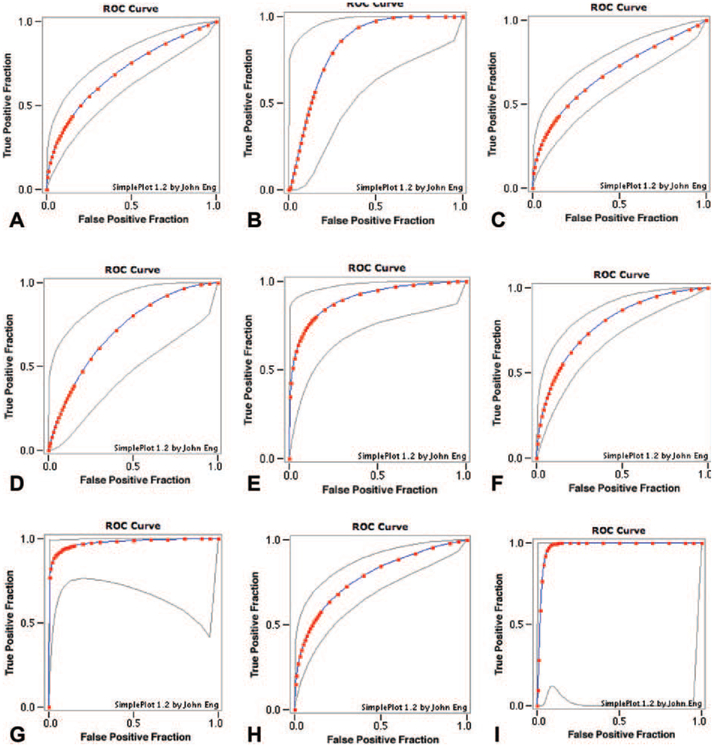
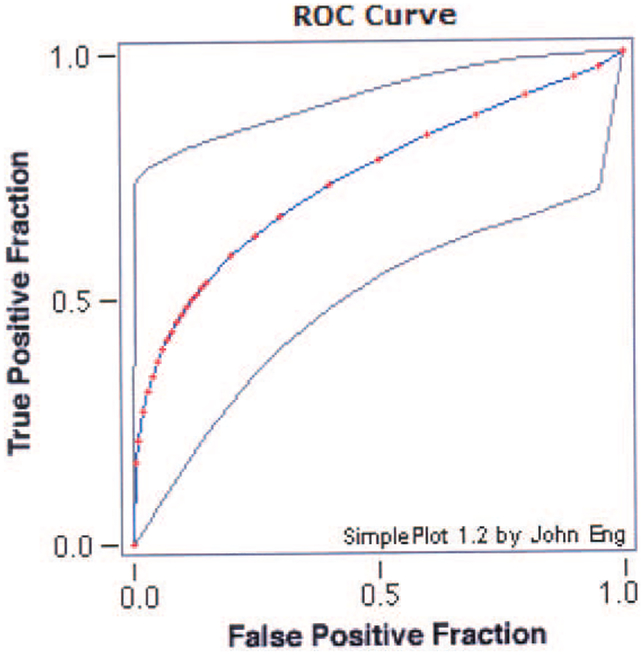
Ten miRNAs showed >5-fold expression difference between benign and malignant thyroid neoplasms on miRNA array analysis. Four of the 10 miRNAs were validated to be significantly differentially expressed between benign and malignant thyroid neoplasms by quantitative polymerase chain reaction (P < .002): miR-100, miR-125b, miR-138, and miR-768-3p were overexpressed in malignant samples of follicular origin (P < .001), and in Hurthle cell carcinoma samples alone (P < .01). Only miR-125b was significantly overexpressed in follicular carcinoma samples (P < .05). The accuracy for distinguishing benign from malignant thyroid neoplasms was 79% overall, 98% for Hurthle cell neoplasms, and 71% for follicular neoplasms. The miR-138 was overexpressed in the FNA samples (P = .04) that were malignant on final pathology with an accuracy of 75%.
MicroRNA expression differs for normal, benign, and malignant thyroid tissue. Expression analysis of differentially expressed miRNA could help distinguish benign from malignant thyroid neoplasms that are indeterminate on thyroid FNA biopsy.
大约 30%的甲状腺结节细针抽吸活检(FNA)结果为不确定或非诊断性。最近的研究表明,微小 RNA(miRNA,miR)在恶性肿瘤中存在差异表达,可能在包括甲状腺癌在内的癌症发生中发挥作用。因此,作者验证了这样一个假设,即 miRNA 表达分析可以确定潜在的标记物,这些标记物可以区分通常在 FNA 活检中不确定的良性和恶性甲状腺肿瘤。
使用 miRNA 芯片鉴定汇集的正常、恶性和良性甲状腺组织样本中差异表达的基因(高 5 倍或低 5 倍)。实时定量聚合酶链反应(PCR)用于在 104 个组织样本(7 个正常甲状腺、14 个增生性结节、12 个滤泡状甲状腺癌变异型、8 个甲状腺乳头状癌、15 个滤泡性腺瘤、12 个滤泡状癌、12 个 Hurthle 细胞腺瘤、20 个 Hurthle 细胞癌和 4 个间变性癌)和 125 个不确定的临床 FNA 样本中验证 miRNA 芯片表达数据。通过分析接收者操作特性来确定差异表达基因的诊断准确性。
miRNA 芯片分析显示,良性和恶性甲状腺肿瘤之间有 10 个 miRNA 表达差异大于 5 倍。其中 4 个 miRNA 通过定量 PCR 验证在良性和恶性甲状腺肿瘤之间表达差异显著(P <.002):miR-100、miR-125b、miR-138 和 miR-768-3p 在滤泡来源的恶性样本中(P <.001),以及 Hurthle 细胞癌样本中(P <.01)过表达。仅 miR-125b 在滤泡状癌样本中显著过表达(P <.05)。总的来说,良性和恶性甲状腺肿瘤的鉴别准确率为 79%,Hurthle 细胞肿瘤为 98%,滤泡状肿瘤为 71%。miR-138 在最终病理恶性的 FNA 样本中过表达(P =.04),准确率为 75%。
正常、良性和恶性甲状腺组织的 miRNA 表达不同。差异表达 miRNA 的表达分析有助于区分甲状腺 FNA 活检不确定的良性和恶性甲状腺肿瘤。