Biosciences Center, National Renewable Energy Laboratory, 1617 Cole Boulevard, Golden, CO 80401, USA.
Biotechnol Biofuels. 2011 Oct 19;4:41. doi: 10.1186/1754-6834-4-41.
In converting biomass to bioethanol, pretreatment is a key step intended to render cellulose more amenable and accessible to cellulase enzymes and thus increase glucose yields. In this study, four cellulose samples with different degrees of polymerization and crystallinity indexes were subjected to aqueous sodium hydroxide and anhydrous liquid ammonia treatments. The effects of the treatments on cellulose crystalline structure were studied, in addition to the effects on the digestibility of the celluloses by a cellulase complex.
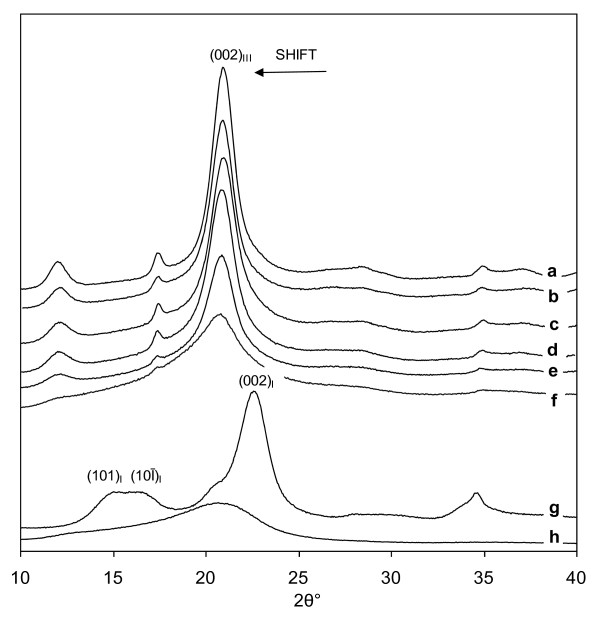
From X-ray diffractograms and nuclear magnetic resonance spectra, it was revealed that treatment with liquid ammonia produced the cellulose IIII allomorph; however, crystallinity depended on treatment conditions. Treatment at a low temperature (25°C) resulted in a less crystalline product, whereas treatment at elevated temperatures (130°C or 140°C) gave a more crystalline product. Treatment of cellulose I with aqueous sodium hydroxide (16.5 percent by weight) resulted in formation of cellulose II, but also produced a much less crystalline cellulose. The relative digestibilities of the different cellulose allomorphs were tested by exposing the treated and untreated cellulose samples to a commercial enzyme mixture (Genencor-Danisco; GC 220). The digestibility results showed that the starting cellulose I samples were the least digestible (except for corn stover cellulose, which had a high amorphous content). Treatment with sodium hydroxide produced the most digestible cellulose, followed by treatment with liquid ammonia at a low temperature. Factor analysis indicated that initial rates of digestion (up to 24 hours) were most strongly correlated with amorphous content. Correlation of allomorph type with digestibility was weak, but was strongest with cellulose conversion at later times. The cellulose IIII samples produced at higher temperatures had comparable crystallinities to the initial cellulose I samples, but achieved higher levels of cellulose conversion, at longer digestion times.
Earlier studies have focused on determining which cellulose allomorph is the most digestible. In this study we have found that the chemical treatments to produce different allomorphs also changed the crystallinity of the cellulose, and this had a significant effect on the digestibility of the substrate. When determining the relative digestibilities of different cellulose allomorphs it is essential to also consider the relative crystallinities of the celluloses being tested.
在将生物质转化为生物乙醇的过程中,预处理是一个关键步骤,旨在使纤维素更易于纤维素酶酶解,从而提高葡萄糖的产量。在这项研究中,对四种聚合度和结晶度指数不同的纤维素样品进行了水合氢氧化钠和无水液氨处理。研究了处理对纤维素结晶结构的影响,以及对纤维素酶复合物对纤维素的消化率的影响。
从 X 射线衍射图谱和核磁共振谱来看,液氨处理生成了纤维素 IIII 同晶型物;然而,结晶度取决于处理条件。在低温(25°C)下处理会得到结晶度较低的产物,而在高温(130°C 或 140°C)下处理则会得到结晶度较高的产物。用 16.5%(重量)的水合氢氧化钠处理纤维素 I 会生成纤维素 II,但也会产生结晶度较低的纤维素。通过将处理和未处理的纤维素样品暴露于商业酶混合物(Genencor-Danisco;GC 220)来测试不同纤维素同晶型物的相对消化率。消化率结果表明,起始纤维素 I 样品是最难消化的(玉米秸秆纤维素除外,其无定形含量较高)。氢氧化钠处理生成的纤维素最易消化,其次是低温下的液氨处理。因子分析表明,初始消化速率(长达 24 小时)与无定形含量相关性最强。同晶型物类型与消化率的相关性较弱,但在后期与纤维素转化率的相关性最强。在较高温度下生成的纤维素 IIII 样品的结晶度与初始纤维素 I 样品相当,但在较长的消化时间内,实现了更高的纤维素转化率。
早期的研究集中于确定哪种纤维素同晶型物最易消化。在这项研究中,我们发现生成不同同晶型物的化学处理也改变了纤维素的结晶度,这对底物的消化率有显著影响。在确定不同纤维素同晶型物的相对消化率时,必须同时考虑所测试纤维素的相对结晶度。