Brain Infections Group, Department of Clinical Infection, Microbiology and Immunology, Institute of Infection and Global Health, University of Liverpool, Liverpool L69 3GA, UK.
Arch Virol. 2012 Jan;157(1):75-83. doi: 10.1007/s00705-011-1143-4. Epub 2011 Oct 28.
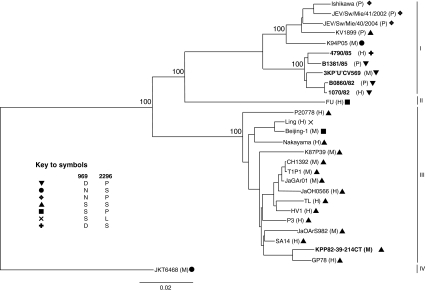
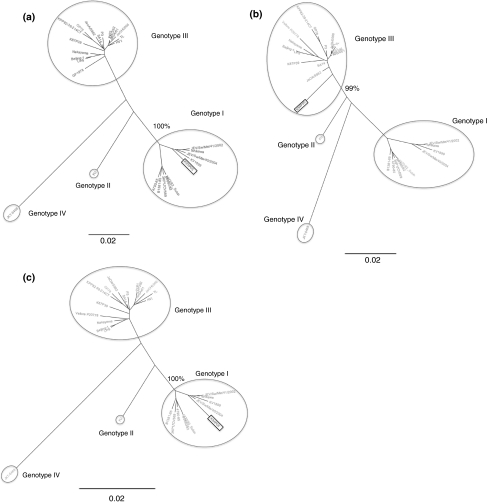
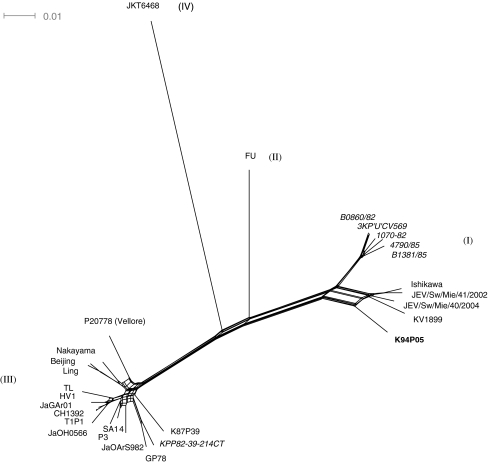
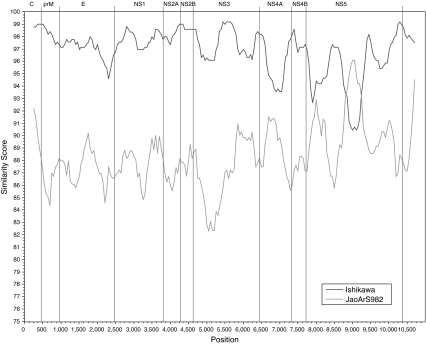
The mosquito-borne Japanese encephalitis virus (JEV) causes encephalitis in man but not in pigs. Complete genomes of a human, mosquito and pig isolate from outbreaks in 1982 and 1985 in Thailand were sequenced with the aim of identifying determinants of virulence that may explain the differences in outcomes of JEV infection between pigs and man. Phylogenetic analysis revealed that five of these isolates belonged to genotype I, but the 1982 mosquito isolate belonged to genotype III. There was no evidence of recombination among the Thai isolates, but there were phylogenetic signals suggestive of recombination in a 1994 Korean isolate (K94P05). Two sites of the genome under positive selection were identified: codons 996 and 2296 (amino acids 175 of the non-structural protein NS1 and 24 of NS4B, respectively). A structurally significant substitution was seen at NS4B position 24 of the human isolate compared with the mosquito and pig isolates from the 1985 outbreak in Thailand. The potential importance of the two sites in the evolution and ecology of JEV merits further investigation.
日本脑炎病毒(JEV)通过蚊子传播,可引起人类脑炎,但不会引起猪的脑炎。我们对 1982 年和 1985 年泰国暴发疫情期间的人类、蚊子和猪分离株的完整基因组进行了测序,目的是确定毒力决定因素,这些因素可能解释了 JEV 感染在人和猪之间产生不同结果的原因。系统进化分析显示,其中 5 个分离株属于基因型 I,但 1982 年的蚊子分离株属于基因型 III。泰国分离株之间没有重组的证据,但在 1994 年韩国分离株(K94P05)中存在重组的系统进化信号。鉴定出基因组中有两个受正选择影响的位点:密码子 996 和 2296(非结构蛋白 NS1 的 175 位氨基酸和 NS4B 的 24 位氨基酸)。与 1985 年泰国暴发疫情的蚊子和猪分离株相比,人类分离株的 NS4B 位置 24 出现了结构上显著的取代。这两个位点在 JEV 的进化和生态学中可能具有重要意义,值得进一步研究。