Behavioural Ecology and Self-Organization, Centre for Ecological and Evolutionary Studies, University of Groningen, Groningen, The Netherlands.
PLoS One. 2011;6(10):e26423. doi: 10.1371/journal.pone.0026423. Epub 2011 Oct 27.
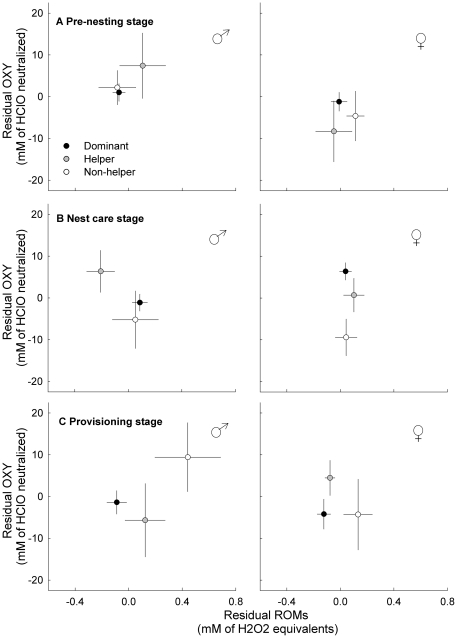
In cooperatively breeding species, helping close relatives may provide important fitness benefits. However, helping can be energetically expensive and may result in increased generation of reactive oxygen species. Consequently, an oxidant/antioxidant imbalance can lead to higher oxidative stress susceptibility. Given the potential costs of helping, it may be that only individuals with a sufficiently good body condition and/or stable oxidative balance can afford to help. Knowledge about relationships between social status and oxidative balance in cooperatively breeding systems is still limited. Studying these relationships is important for understanding the costs of helping and physiological pressures of reproduction. Here we evaluate the relationship between helping behaviour, body condition and oxidative balance in a wild population of the cooperatively breeding Seychelles warbler (Acrocephalus sechellensis). In this species, some subordinate individuals help dominant birds with the rearing of young, while others refrain from any assistance. We assessed body condition and oxidative parameters of birds of different social status caught during different breeding stages. We found that, prior to breeding, female subordinates that did not subsequently help (non-helpers) had significantly lower body condition and higher ROMs (reactive oxygen metabolites) than helpers and dominants. During the later stages of breeding, body condition was low in dominants and helpers, but high in non-helpers. Differences in oxidative balance between individuals of different social status were found only during nest care: Dominant males occupied with guarding behaviours tended to have relatively high oxidative stress susceptibility. Furthermore, dominant and helper females showed elevated antioxidant capacity (measured as OXY) in the weeks just prior to egg-laying, possibly representing a change in their reproductive physiology. The results imply that an individuals' oxidative balance may be influenced by factors related to reproduction, which can differ with sex and--within cooperative breeding systems--social status.
在合作繁殖物种中,帮助近亲可能会带来重要的适应度收益。然而,帮助可能会耗费大量能量,并导致活性氧物质的产生增加。因此,氧化还原失衡可能会导致更高的氧化应激易感性。考虑到帮助的潜在成本,只有身体状况良好且/或氧化平衡稳定的个体才能负担得起帮助。关于合作繁殖系统中社会地位和氧化平衡之间关系的知识仍然有限。研究这些关系对于理解帮助的成本和繁殖的生理压力很重要。在这里,我们评估了在合作繁殖的塞舌尔莺(Acrocephalus sechellensis)的野生种群中帮助行为、身体状况和氧化平衡之间的关系。在这个物种中,一些从属个体帮助优势个体抚养幼鸟,而其他个体则不提供任何帮助。我们评估了在不同繁殖阶段捕捉到的不同社会地位鸟类的身体状况和氧化参数。我们发现,在繁殖之前,没有随后提供帮助的雌性从属个体(非帮助者)的身体状况明显较差,ROM(活性氧代谢物)较高,而帮助者和优势者的身体状况和 ROM 较低。在繁殖的后期,优势者和帮助者的身体状况较差,但非帮助者的身体状况较好。不同社会地位个体之间的氧化平衡差异仅在巢期护理期间存在:忙于守护行为的优势雄性个体往往具有相对较高的氧化应激易感性。此外,优势和帮助雌性在产卵前几周表现出较高的抗氧化能力(以 OXY 衡量),这可能代表其生殖生理发生了变化。结果表明,个体的氧化平衡可能受到与繁殖相关的因素的影响,这些因素可能因性别和——在合作繁殖系统中——社会地位而异。