Dipartimento di Psicologia dello Sviluppo e della Socializzazione, University of Padova, Padova, Italy.
PLoS One. 2011;6(11):e26456. doi: 10.1371/journal.pone.0026456. Epub 2011 Nov 9.
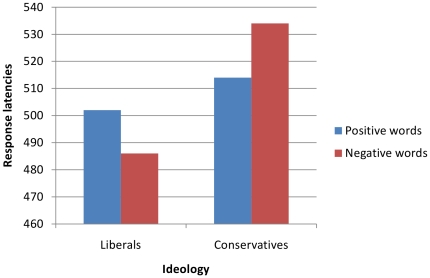
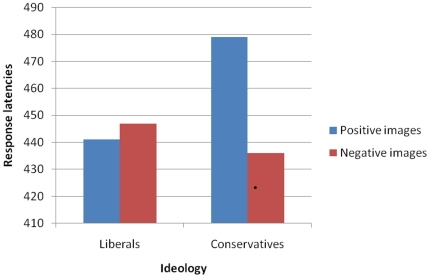
Research has widely explored the differences between conservatives and liberals, and it has been also recently demonstrated that conservatives display different reactions toward valenced stimuli. However, previous studies have not yet fully illuminated the cognitive underpinnings of these differences. In the current work, we argued that political ideology is related to selective attention processes, so that negative stimuli are more likely to automatically grab the attention of conservatives as compared to liberals. In Experiment 1, we demonstrated that negative (vs. positive) information impaired the performance of conservatives, more than liberals, in an Emotional Stroop Task. This finding was confirmed in Experiment 2 and in Experiment 3 employing a Dot-Probe Task, demonstrating that threatening stimuli were more likely to attract the attention of conservatives. Overall, results support the conclusion that people embracing conservative views of the world display an automatic selective attention for negative stimuli.
研究已经广泛探讨了保守派和自由派之间的差异,最近也有研究表明,保守派对有价值的刺激会有不同的反应。然而,之前的研究尚未完全阐明这些差异的认知基础。在当前的工作中,我们认为政治意识形态与选择性注意过程有关,因此与自由派相比,负面刺激更有可能自动吸引保守派的注意。在实验 1 中,我们证明了在情绪斯特鲁普任务中,负面(与正面)信息会损害保守派的表现,而不是自由派。这一发现在实验 2 和实验 3 中得到了证实,在这两项实验中,使用了点探测任务,证明了威胁性刺激更有可能吸引保守派的注意力。总的来说,结果支持这样的结论,即持有保守世界观的人会自动对负面刺激产生选择性注意。