Public Health Agency of Canada, Winnipeg, Manitoba, Canada.
Emerg Infect Dis. 2011 Nov;17(11):2113-21. doi: 10.3201/eid1711.110794.
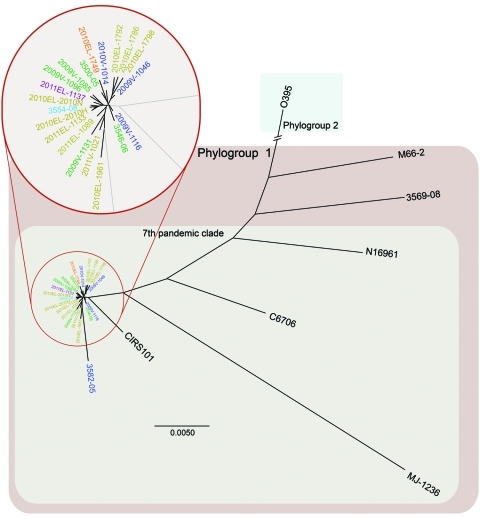
Cholera was absent from the island of Hispaniola at least a century before an outbreak that began in Haiti in the fall of 2010. Pulsed-field gel electrophoresis (PFGE) analysis of clinical isolates from the Haiti outbreak and recent global travelers returning to the United States showed indistinguishable PFGE fingerprints. To better explore the genetic ancestry of the Haiti outbreak strain, we acquired 23 whole-genome Vibrio cholerae sequences: 9 isolates obtained in Haiti or the Dominican Republic, 12 PFGE pattern-matched isolates linked to Asia or Africa, and 2 nonmatched outliers from the Western Hemisphere. Phylogenies for whole-genome sequences and core genome single-nucleotide polymorphisms showed that the Haiti outbreak strain is genetically related to strains originating in India and Cameroon. However, because no identical genetic match was found among sequenced contemporary isolates, a definitive genetic origin for the outbreak in Haiti remains speculative.
霍乱至少在 2010 年秋季海地爆发疫情的一个世纪之前就已经从伊斯帕尼奥拉岛消失了。对海地疫情爆发期间的临床分离株和最近返回美国的全球旅行者进行脉冲场凝胶电泳(PFGE)分析显示,这些分离株的 PFGE 指纹图谱无法区分。为了更好地探索海地疫情爆发菌株的遗传起源,我们获得了 23 株全基因组霍乱弧菌序列:9 株分离自海地或多米尼加共和国,12 株与亚洲或非洲有关的 PFGE 模式匹配分离株,以及 2 株来自西半球的非匹配离群值。全基因组序列和核心基因组单核苷酸多态性的系统发育分析表明,海地疫情爆发菌株与起源于印度和喀麦隆的菌株在基因上有关。然而,由于在测序的当代分离株中没有发现完全相同的基因匹配,因此海地疫情的确切遗传起源仍存在推测。